

Combat Sambo vs Sport Sambo: How the Rules Differ (2026 Update)
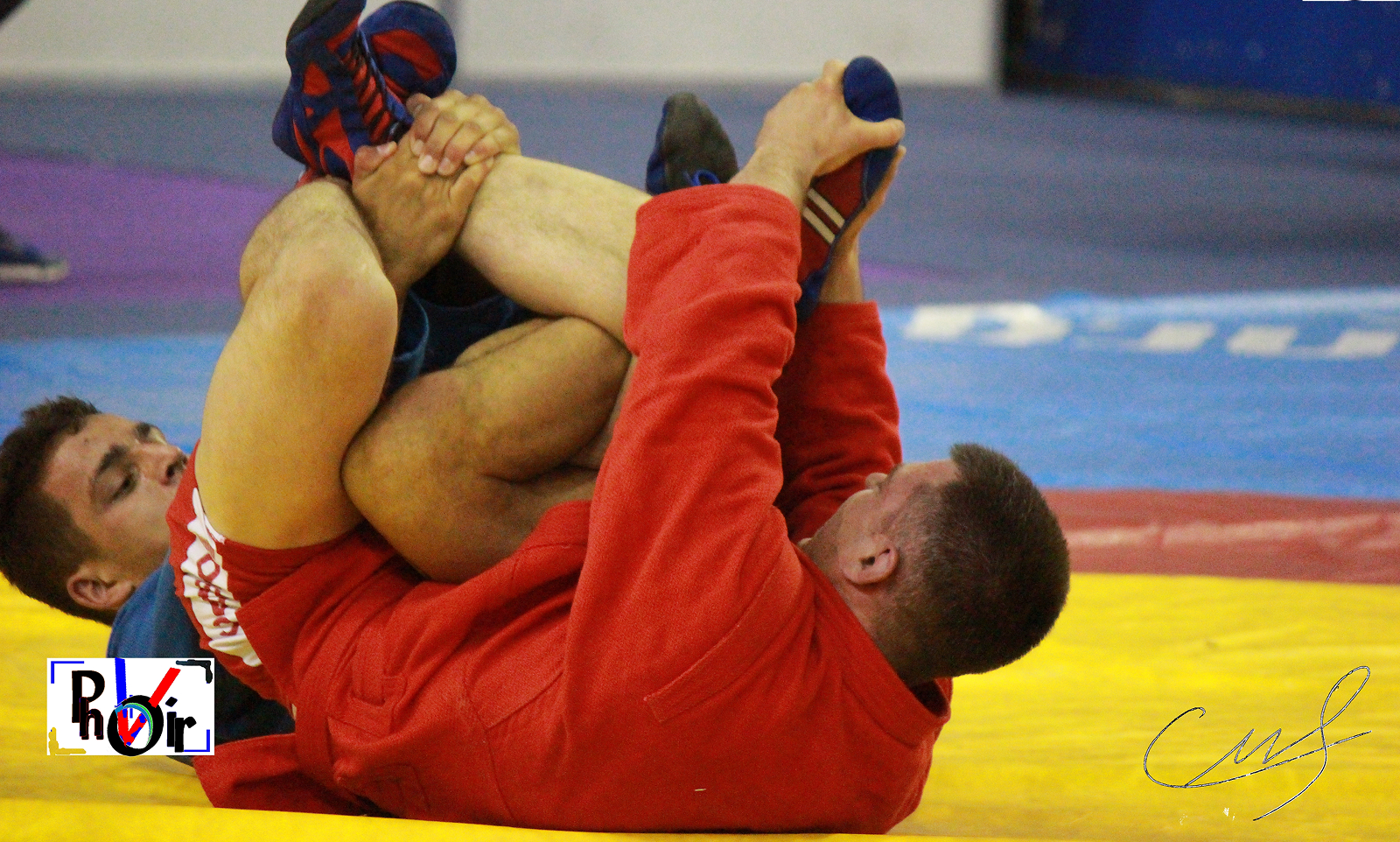
Step onto the mat at a World SAMBO Championship and you may see two very different contests under one banner. Both athletes wear the red or blue jacket, both chase the same clean throw, and both compete inside the same 8-meter circle.
The fundamental difference between sport and combat sambo everybodey highlights first is whether striking is part of the fight.
Sport sambo is a grappling sport, often described as jacket wrestling with leg locks. You win by throwing, pinning or forcing a submission with arm and leg locks. Strikes and chokes are banned.
Combat sambo keeps that whole grappling base and adds striking: punches, kicks, knees, elbows and, with helmets on, headbutts. Chokes are allowed too. It grew out of the branch of sambo built for military and police use, which is why researchers class sport sambo as a form of wrestling and combat sambo as a self-defense or combat system.
That is the heart of combat sambo vs sport sambo. Most explanations stop at "one has strikes, the other doesn't," and that leaves out much of what matters: how points are scored, when a submission can begin, what equipment is required, and what changed when the International SAMBO Federation (FIAS, from its French name, Fédération Internationale de SAMBO) updated its rules in 2026.
This guide compares the two disciplines rule by rule, using FIAS's own rulebooks. Whether you're choosing your first club, preparing for a tournament or watching sambo for the first time, you'll come away knowing what separates them and which path suits your training.
A note on sources: FIAS drafts its rules in Russian and publishes an English translation. Where the translation is unclear, this article follows the Russian original.
What Is the Difference Between Combat Sambo and Sport Sambo?
Sport sambo is a jacket wrestling sport. Athletes score with throws and hold-downs and can win by submission with arm and leg locks, but strikes and chokes are not allowed. Combat sambo keeps that entire grappling base and adds punches, kicks, knees, elbows, headbutts, chokes and standing submissions, with protective equipment to match.
Both are governed by FIAS, but each has its own rulebook. The 2026 Combat SAMBO rules (Russian edition) and the 2026 Sport SAMBO rules share much of their structure, from the uniform to the throw-scoring table. That shared core is why the two disciplines feel so closely related on the mat.
Researchers draw the same line. A 2025 peer-reviewed study on how sambo should be classified describes sport sambo as a form of wrestling built from freestyle wrestling and judo, while its other variants work as self-defense or military combat systems. Combat sambo is the competitive expression of that second branch.
Shared Roots, Separate Rulebooks
One Soviet System, Two Branches
Sambo takes its name from the Russian phrase samozashchita bez oruzhiya, "self-defense without weapons." Its official birthday is November 16, 1938, when the Soviet sports committee issued an order supporting its development, according to FIAS's history of the sport. Vasily Oshchepkov, Viktor Spiridonov and Anatoly Kharlampiev are credited as its founders, each bringing a different blend of judo, wrestling and self-defense experience.
From the beginning, the work developed along two lines. The European SAMBO Federation traces a sport branch and a combat branch back to the 1920s. One was shaped for open competition; the other served the practical needs of the army and police.
Deeper dive: Sambo: The Russian Martial Art and Combat Sport
Where the Two Meet Today
For decades, combat sambo stayed largely within those professional circles. The first Combat SAMBO World Championship was held in Panama in 2002, and in 2007 FIAS brought both disciplines together at a single World Championship for the first time. The World Championships still run both side by side, for men and women.
Recognition has grown alongside. FIAS received full recognition from the International Olympic Committee (IOC) at its 2021 session in Tokyo, as Inside the Games reported at the time. When sambo appeared on the program of the 2025 World Games in Chengdu, China, it was combat sambo that took the stage, with 15 medal events across men's, women's and mixed team competition.
Combat Sambo vs Sport Sambo Rules, Side by Side
The clearest way to see the combat sambo vs sport sambo divide is to set the two rulebooks next to each other.
Sources: FIAS International SAMBO Rules, Combat SAMBO 2026, Russian edition and Sport SAMBO 2026.
What Carries Over
Much of the rulebook is shared. Throws against a standing opponent are scored the same way in both disciplines: a perfect throw, one that lands the opponent on their back while the thrower stays standing, ends the bout at once, and the same landing earns 4 points if the thrower falls with them. Landings on the side, chest or buttocks score less, and either discipline awards an early win for an 8-point lead.
Adult and junior bouts last five minutes, the adult weight classes are identical (58 kg to over 98 kg for men, 50 kg to over 80 kg for women), and the fighting area is the same 8-meter circle. Leg locks belong to both, with the same exceptions.
Where Scoring Changes
The differences begin with control on the ground. In sport sambo, a hold-down lasting 10 to 19 seconds earns 2 points and a full 20 seconds earns 4, up to 4 hold-down points per bout. In combat sambo, a 20-second hold-down earns 2 points, and only one hold-down can score in a bout.
The gap makes sense once you picture the fight. Pinning someone for 20 seconds proves more in pure grappling than in a contest where the person underneath can still strike back. Combat sambo, in turn, rewards striking: a strike that drops an opponent is scored like a throw, a knockdown earns 4 points, and two knockdowns or a knockout end the bout.
Sport sambo is also more generous with throws. It rewards throwing an opponent who is already down on a knee or both knees, at half the usual value, while combat sambo only scores throws against an opponent who is standing.
The tournament format differs as well. Sport sambo runs repechage bouts, which give athletes who lost to a finalist or semi-finalist a route back to a medal, while combat sambo uses straight elimination.
What Combat Sambo Adds: Strikes, Chokes and Protective Gear
Strikes and Where They Are Allowed
Combat sambo permits punches with the fist, elbow or forearm; kicks with the foot, shin or knee; and headbutts, provided both athletes are wearing helmets. Strikes may target the front and sides of the head and torso, the arms and the legs.
The ground rules are precise. Strikes on the ground are only allowed when both athletes are down, and a fighter on the ground may strike an opponent who is still standing. Striking a downed opponent from a standing position is prohibited. Men may not use elbows or headbutts to the head on the ground; women may not use them to the head at all, standing or grounded.
One line in the banned list often confuses readers of the English translation. It prohibits "direct impact with the elbow or knee" on any part of the opponent's body, which seems to contradict the strikes above. The Russian original uses the word for applied force, vozdeystviye, rather than the word for a strike, udar. The rule bans pressing or driving an elbow or knee into an opponent, not striking with it, and the same line appears in the sport rulebook, where there are no strikes at all.
Chokes and Standing Submissions
Sambo has its own name for a submission lock: the painful hold (bolevoy priyom), which bends, twists or squeezes a limb until the opponent gives up. In sport sambo, chokes are prohibited and a painful hold may only begin once the opponent is on the ground. Combat sambo allows both submissions and chokes in any position, standing or on the ground, with one minute for each attempt.
Chokes come with their own discipline. Hand chokes must be applied with the forearm, without twisting the neck; leg chokes must trap the opponent's arm along with the neck; and choking with the uniform is only allowed using the jacket lapels. An athlete who loses consciousness in a choke is withdrawn from the competition.
The Protective Equipment
Sport sambo athletes compete in a jacket, belt, shorts and sambo shoes, with no protective gear. Combat sambo adds an open-face helmet, gloves designed for both striking and gripping, shin guards, a mouthguard, a hard groin cup for men and a chest protector for women. At official FIAS events, all of it must be certified, and the full kit must be a single color, red or blue.
What Changed in the 2026 Combat Sambo Rules?
FIAS approved the current combat edition on March 31, 2026, and explained the changes in a September announcement. Five matter most to competitors:
- Shorts built for gripping. Combat sambo shorts must now be wide and durable enough for an opponent to grab, running from the belt line to two-thirds of the thigh. Gripping the shorts remains legal only in combat sambo.
- A set knockout protocol. After a knockout, or a loss of consciousness from a choke, the referee removes the helmet and mouthguard, calls the doctor onto the mat and signals the win, with a second official confirming.
- Knockdowns counted and assessed. The referee counts to 10, awards 4 points and checks the athlete's stance, muscle tone and pupil reaction before deciding whether the bout continues.
- A cap on medical time. An athlete now receives no more than three minutes of medical attention in total per bout. Sport sambo keeps a two-minute limit.
- No knees to the head in women's bouts. Knee strikes to the head are banned for women, standing or on the ground. Men may still use them from a standing position.
The direction is consistent: more room for grappling, and firmer safety procedures around the head.
Does Combat Sambo Allow Chokes? Three Popular Beliefs, Checked Against the Rulebook
"There are no chokes in combat sambo." This long-held belief most likely comes from sport sambo, where chokes are banned. In combat sambo, chokes are legal both standing and on the ground.
"Sambo bans leg locks." The reverse is closer to the truth, since leg locks are a signature of both disciplines. What the rules prohibit are twisting attacks: the foot "knot" and knee locks that bend the leg outside its natural plane, along with locks on fingers and toes and direct pressure on the spine or neck. Sport sambo also bans "scissors" attacks on the knee and ankle. In practice, these bans rule out the heel hook while keeping straight knee and ankle locks.
"Fighters only get a few seconds on the ground." Neither rulebook sets a fixed time limit for groundwork. The referee stands athletes up when they stop working, each submission attempt has up to one minute, and a hold-down runs for 20 seconds. Active grappling is given room; stalling is not.
Combat Sambo or Sport Sambo: Which Should You Train?
Start with your goals. Sport sambo builds a deep grappling foundation of throws, pins and leg locks without the impact of strikes. It suits judoka and wrestlers looking for a new rule set, and it stays open to you for life, with masters divisions running from age 35 to over 65.
Combat sambo is the more complete preparation for mixed martial arts (MMA). Fedor Emelianenko and Khabib Nurmagomedov both won combat sambo world titles before becoming household names in MMA, and the blend of throws, ground control and strikes maps closely onto the cage. It also asks more of you: a striking base, careful conditioning and respect for rules that remove an athlete from the tournament after a knockout or two knockdowns.
The two are less a fork in the road than a sequence. The throws, grips and pins you develop in sport sambo carry directly into combat sambo, so time spent on the grappling foundation is never wasted.
Two Rulebooks, One Foundation
Combat sambo vs sport sambo is not a contest between a real art and a softened one. They are two expressions of the same system, built on the same throws and the same jacket, and separated by strikes, chokes and the safety rules that come with them.
Remember three things. Sport sambo is jacket wrestling with leg locks. Combat sambo adds strikes, chokes and standing submissions. And the 2026 rules widened the grappling options while tightening care around the head.
Choose the rulebook that matches your goals, train under a qualified coach and respect the details. Mastery is built in repetition, correction and patience. The path rewards those who respect it.