

China's Humanoid Robot Combat League: Inside UKRL's Rules, the T800, and the Fight That Went Viral
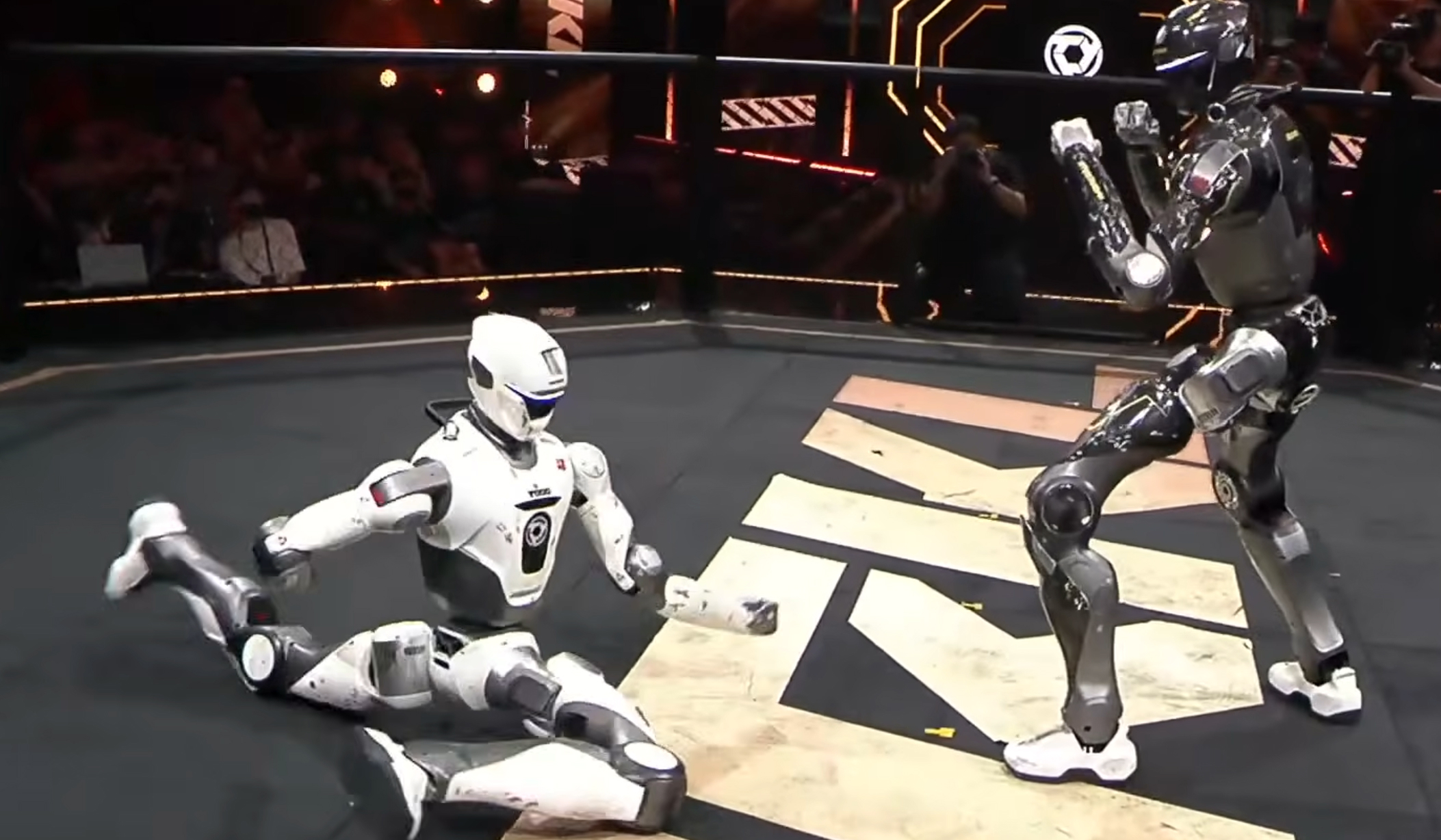
On July 17, 2026, the first matches of the Ultimate Robot Knock-out Legend, known as UKRL, took place in Shenzhen. Two identical humanoid robots, built by the Chinese robotics company EngineAI, faced off in a live combat match. During the exchange, one robot, nicknamed White Eagle, landed a high kick that dislodged the head of its opponent, nicknamed Matador. Matador kept swinging with its head hanging loose before finally collapsing under its own weight.
The footage spread fast, and for good reason. It looks equal parts unsettling and remarkable. But underneath the viral clip is a genuinely structured competition, with a real rulebook, a real prize, and real engineering behind it. For a community built around technique, judgment, and the discipline of movement, UKRL deserves a closer look than the headlines it has been getting.
What Happened on Opening Night
UKRL's opening matches were the first live combat rounds of a season that had been building since February. The White Eagle vs. Matador bout was part of that opening slate, and it became the moment that defined the league's public introduction, whether the organizers intended that or not.
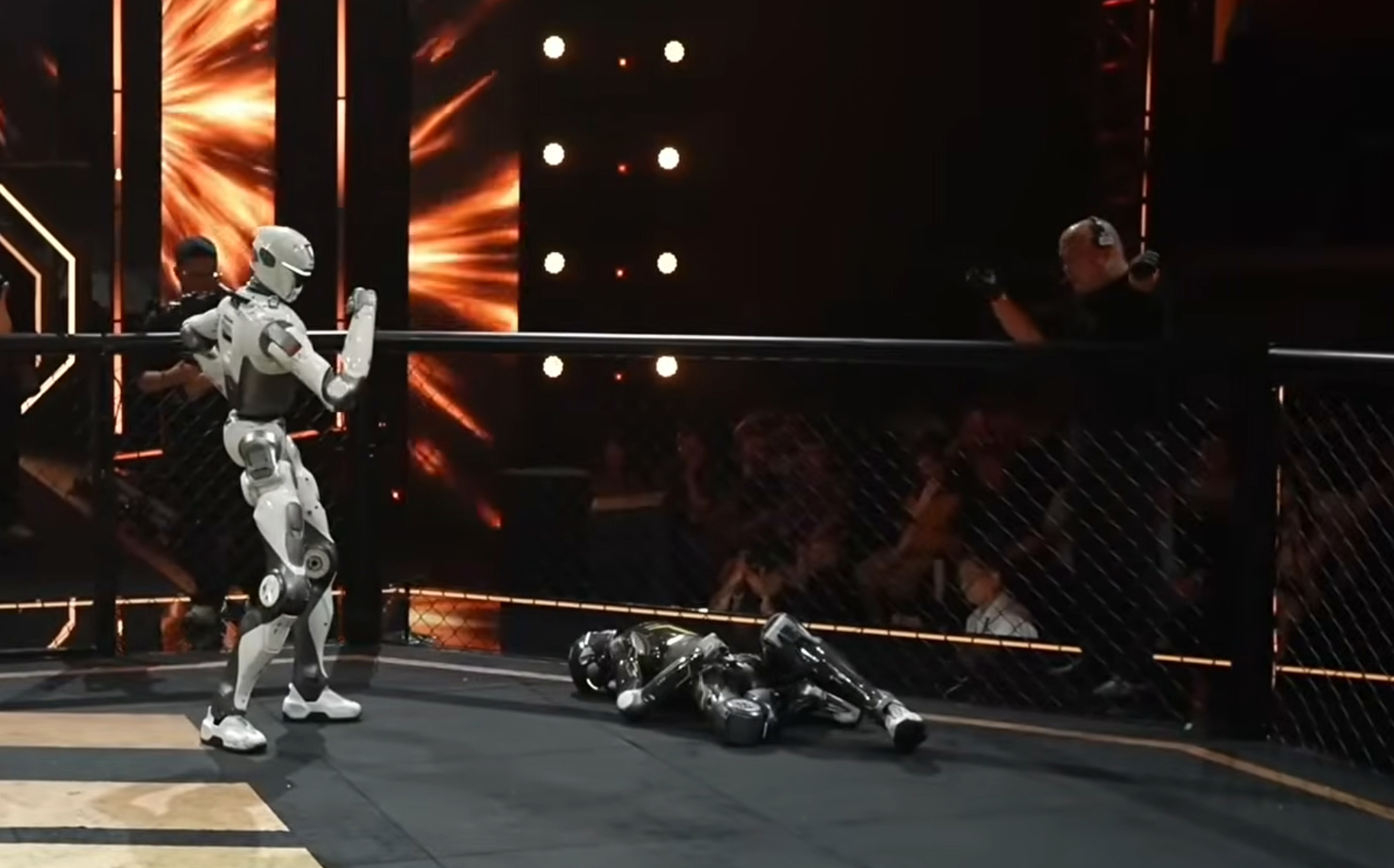
What made the clip so jarring was not just the kick itself but what followed. Matador did not go down immediately. It kept throwing punches and kicks with its head swinging loose from its neck socket, a detail that unsettled viewers precisely because it looked so much like a fighter refusing to quit on instinct. Eventually the robot toppled, crushed its own head beneath its body, and lost it entirely as it tried to scramble back up.
There is no getting around the discomfort some viewers felt watching a humanoid figure absorb that kind of damage and keep moving. It is worth separating that reaction from the substance of the competition itself, which is closer to an engineering stress test wearing a fight card's clothing than it is to a spectacle built around violence for its own sake.
What Is UKRL, and Who Is Behind It
UKRL launched on February 9, 2026, at a conference in Shenzhen, organized by EngineAI and co-organized by Shenzhen Quanmingxing Robotics Technology. The league bills itself as the world's first free humanoid robot combat competition, meaning every qualifying team receives a competition robot from EngineAI at no cost rather than having to build one from scratch.
The prize is substantial by any measure. The champion team receives a gold championship belt valued at 10 million yuan, or roughly 1.44 million US dollars, along with smaller rewards distributed to every team that reaches the final eight. Teams that advance to the top sixteen also receive ownership of their competition robot.
EngineAI has framed the league as a deliberate blend of "Technology, Sports, and Culture," and the guest list at the launch conference reflected that ambition. Alongside EngineAI founder and CEO Zhao Tongyang, the event featured a speech from Buakaw Banchamek, the Thai boxing legend widely respected across the striking world, who spoke on the league's positioning within combat sports more broadly. That is not a small detail. It signals that EngineAI wants UKRL judged, at least in part, against the standards of real fight sport, not just robotics demonstrations.
Analysts covering the launch made a similar point. Beijing-based analyst Pan Helin noted that competitions like UKRL help build public awareness of humanoid robots and expand their potential applications, while Tian Feng, former dean of SenseTime's Intelligence Industry Research Institute, argued that combat testing under real-world conditions can shorten technology development cycles significantly compared to lab simulation alone.
Meet the Fighter: The T800
Every UKRL team competes using the same platform: EngineAI's T800, a full-size humanoid robot standing 173 centimeters tall. That uniformity is intentional. Teams are not competing on hardware. They are competing on how well they can program and tune identical machines, which shifts the contest closer to a coding and control challenge than a garage-built robot brawl.
The competition-grade T800 carries up to 25 degrees of freedom throughout the body, a way of describing how many independent points of articulation the robot has, not counting its hands. Joint motors deliver up to 450 newton-meters of torque, which is what allows the robot to generate the force behind kicks and directional changes rather than simply shuffling through choreographed motion. An active cooling system built into the leg joints supports up to four hours of continuous high-intensity operation, and a multi-modal sensing system combining Light Detection and Ranging (LiDAR), stereo cameras, and rapid environmental processing gives the robot real-time spatial awareness during a live exchange.
None of that matters much on its own. What matters to a martial arts audience is what the platform can actually do with it. EngineAI's own demonstration library shows the T800 executing combination punches, roundhouse kicks, flying kicks, and capoeira-inspired sequences that chain multiple strikes together with minimal pause between them. This is not a robot walking through a single scripted trick. It is a platform built with enough range of motion and joint speed to attempt something closer to combination striking, even if the underlying decision-making is still software, not intuition.
How the Competition Actually Works
UKRL runs on a multi-stage tournament format, and the structure has more in common with an esports league than a traditional martial arts bracket.
Registration opened in March 2026 and closed in May, drawing more than 200 team entrants from ten countries. Teams first go through an online preliminary stage, judged on simulation footage of their robot executing a full combat sequence inside a physics simulator called MuJoCo. Judges score submissions on completion, motion fluidity, and whether the team relied on official motion datasets or built independent, custom movement libraries.
Teams that clear the qualifying stage move into on-site hardware deployment, where their simulated performance has to hold up on a physical T800 in the real world, not just inside a simulation. From there, sixteen surviving teams enter a group stage, competing in a double round-robin format across four groups. The top eight advance to a double-elimination final bracket to determine the champion.
Each team must field between three and ten members, including at least one lead operator and personnel responsible for technical maintenance and deployment. Every team submits a technical proposal outlining its planned modifications to the T800's control software before it is approved to compete, and the rulebook is explicit that dangerous modifications and malicious attacks are strictly prohibited. The current season runs through the group stage in the fall, with the finals scheduled for late this year into early 2027.
Detailed competition rules can be found here: UKRL Complete Competition Rules
How Judges Score a Robot's Fighting Skill
This is the part of UKRL that will resonate most with anyone who has spent time on a mat, and it is the part most coverage of the story has skipped entirely.
UKRL's judging criteria do not simply reward whichever robot lands the hardest hit. The rulebook scores teams on motion fluidity, specifically looking for clearly distinguishable initiation, execution, and recovery phases within a technique, the same three-part structure a coach looks for when correcting a student's kick. A robot that generates power but collapses its structure on the way out of a motion scores lower than one that completes the full arc of the technique cleanly.
Robustness is scored separately, measuring whether a robot maintains stability when hit with external interference during a live exchange. Fall recovery is its own category entirely, and the rulebook specifically rewards a robot that can execute a smooth, human-like recovery motion after going down, rather than simply reactivating in a static reset position.
Strip away the fact that the "athlete" is a machine, and this rubric would not look out of place in a striking sport's judging criteria. Balance under pressure. Structural integrity through a full technique. The ability to recover and reset rather than staying down. These are the same qualities a Shihan watches for, expressed here as engineering benchmarks instead of martial principles. That overlap is not an accident. Building a robot that can absorb a hit and recover its footing is, functionally, the same problem as teaching a human fighter to do the same thing, even if the solutions look nothing alike.
Is This a Sport, or a Stress Test?
The honest answer is that it is both, and EngineAI has not tried to hide that.
Tian Feng's comments at the launch were direct about the purpose behind the format: combat testing under real, unpredictable conditions exposes weaknesses in balance algorithms, joint durability, and recovery behavior that a controlled lab environment simply will not surface. A robot destined for warehouse or hospitality work benefits from every one of those stress points being found and fixed early, and a live fight against an equally capable opponent is an efficient way to find them.
At the same time, dismissing UKRL as pure marketing misses what actually happened on July 17. The teams are not remote-controlling toys. They are writing original control software, training motion policies, and tuning how an identical robot balances, strikes, and recovers, then testing that work against another team's approach under real physical stress. Whether that qualifies as a "sport" in the traditional sense is a fair question to leave open. It is closer to a technical proving ground wearing the presentation of one, and it is worth judging on those terms rather than on the shock value of a single viral clip.
Where This Leaves Us
A robot losing its head mid-fight will always get more views than a scoring rubric. But the rubric is the more interesting story, because it reveals what EngineAI and the UKRL judging panel actually consider "good" robotic movement: fluid technique, structural integrity under pressure, and the ability to recover and keep going. Those are not new ideas. They are the same principles that have guided martial arts instruction for centuries, now being applied to a machine that is still, by its own engineers' admission, in an early and unpolished stage of development.
Whether UKRL becomes a legitimate fixture in combat sports or fades as a novelty will depend on what happens through the rest of this season, not on one viral kick. The group stage runs into the fall, with the finals set for later this year and into early 2027. For now, it is worth watching less for the spectacle and more for what it reveals about how far machine movement still has to go before it earns the word "technique."