

Top 10 Highest Grossing Martial Arts Movies of the Last Decade
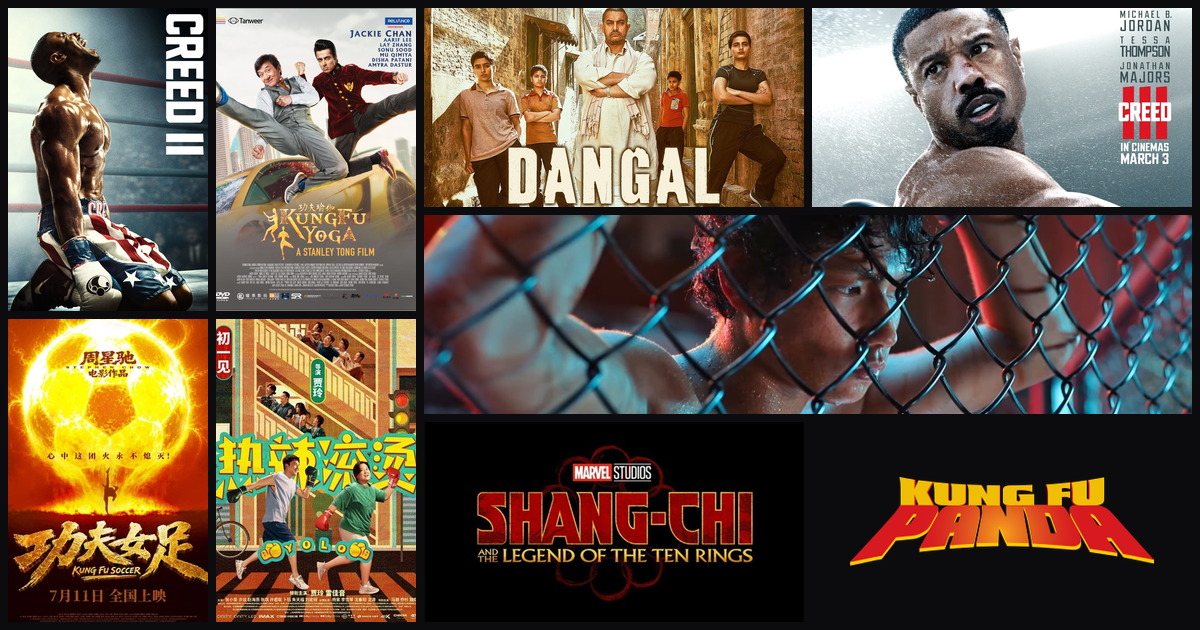
Ask a room full of practitioners to name the best martial arts films of the last ten years and you will hear the same handful of titles. Ip Man 4. The Raid sequels. Maybe Everything Everywhere All at Once, if the room skews younger. These are the films we argue about on the mats.
They are not the films the world actually paid to see.
When you rank the highest grossing martial arts movies from 2016 through to 2026, a different picture appears. Four of the top ten are Chinese productions. Two of those are combat sports dramas that barely registered outside Asia. A wrestling film from India earned more in China than it did at home. And the single biggest earner in the category is animated.
This is not a list of the best films. Box office measures attention and access, not craft. But attention is worth understanding, because it tells you where the audience for our disciplines is growing and where it has quietly moved. Here is the ranking, the method behind it, and what the numbers suggest about the state of fighting on screen.
How We Ranked the Highest Grossing Martial Arts Movies
Any list like this lives or dies on its inclusion rule, so ours is stated plainly: a film qualifies when trained fighting is the subject, not the setting.
That means one of two things. Either a martial art is practiced as a craft, and that practice drives the story and the spectacle, or a combat sport provides the narrative spine. A film about a wrestler preparing for competition qualifies. A film where a soldier happens to throw good elbows does not.
Applying that rule removes some very large numbers from consideration, and we will come back to those. It also settles a question readers will reasonably ask about animation. Kung Fu Panda is included because kung fu is the entire subject of those films, not a flavour applied to something else. The training montages, the lineage, the relationship between student and master: these are the plot, treated with more respect than many live-action efforts manage.
Figures throughout are worldwide theatrical gross in nominal US dollars, sourced from The Numbers and cross-checked against reporting from Variety, Deadline and The Hollywood Reporter. Nominal means not adjusted for inflation, which quietly favours recent releases. Non-US grosses are converted at prevailing exchange rates and do vary between sources, sometimes by tens of millions.
One figure is still moving. Kung Fu Soccer opened in China in July 2026 and may not have finished earning.
The Full Ranking, 2016 to 2026
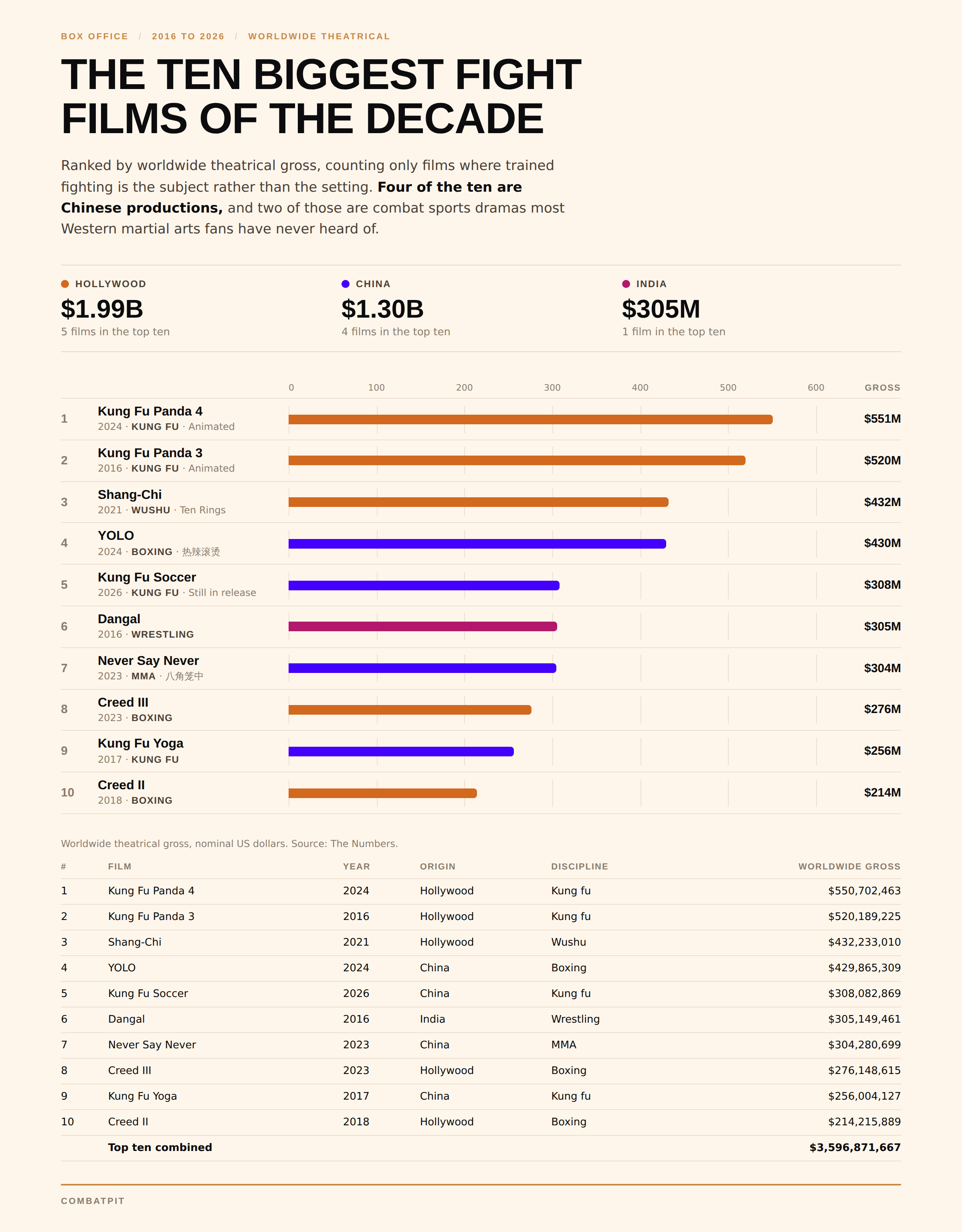
Three things are worth pointing out before you study the chart.
Ranks five, six and seven are effectively a three-way tie. Kung Fu Soccer, Dangal and Never Say Never sit within four million dollars of each other across grosses above three hundred million. At that margin, exchange rate movements and reporting differences matter more than any real difference in audience. Treat them as one cluster rather than a strict order.
The top of the list is a DreamWorks franchise. Kung Fu Panda 4 and Kung Fu Panda 3 together earned over a billion dollars, which is more than the combined total of every live-action kung fu film in the decade that follows them.
And the combined top ten comes to roughly $3.6 billion. Hollywood accounts for $1.99 billion of that across five films, China for $1.30 billion across four, and India for $305 million from one.
Why Are Four of the Top Ten Chinese Films?
Because the audience moved, and the Western conversation did not move with it.
China has been either the largest or second largest theatrical market in the world for most of this decade, and its domestic films now earn the majority of that box office. A Chinese film with a strong Lunar New Year or summer release can clear three hundred million dollars without ever opening widely in Europe or North America. That is exactly what happened to three of the four titles here.
YOLO is the clearest example. Directed by and starring Jia Ling, it follows a woman in her thirties who takes up boxing after her life comes apart. It earned $429.9 million, almost all of it in China, and Variety reviewed it as a megahit that could have used more punch in the ring. It also prompted a measurable spike in gym interest across China, which is the kind of cultural effect most fight films claim and few produce.
Never Say Never is the one that should interest practitioners most. Wang Baoqiang directed and starred in a story about a coach who takes in a group of orphaned boys and trains them in mixed martial arts, loosely drawn from real events in Sichuan. Reporting at the time noted its record presales and its unusually grounded treatment of hardship and mentorship. It finished at $304.3 million and remains largely unknown to English-speaking MMA audiences.
Kung Fu Soccer arrived in July 2026 as Stephen Chow's long-delayed return to the world of Shaolin Soccer, twenty-five years on. It opened to roughly $74 million in China and has reached $308.1 million so far.
None of this is new information in the industry. It is simply absent from the way most martial arts media, including much of the English-language coverage, still frames the genre. If you want the broader context for how seriously China treats fighting disciplines, our guide to China's Olympic combat sports record covers the competitive side of the same story.
What the Rankings Say About Combat Sports on Screen
Half the top ten is a combat sport rather than a martial art in the traditional sense. That is a meaningful shift.
Boxing accounts for three entries. Creed III at $276.1 million and Creed II at $214.2 million show that the Rocky lineage still carries a paying audience nearly fifty years on, and YOLO shows the same premise working in a completely different culture. The appeal is structural. A fight with a bell, a scorecard and a clear opponent gives an audience something a choreographed duel cannot: stakes they can read without instruction.
Wrestling accounts for one, and it is the most quietly remarkable film on the list. Dangal tells the story of Mahavir Singh Phogat training his daughters in freestyle wrestling against considerable social resistance. It earned $305.1 million worldwide, and roughly $193 million of that came from China alone. A Hindi-language film about Indian women's wrestling outperformed itself in a market with no obvious connection to the sport. If you want to understand the competitive framework it depicts, our breakdown of wrestling styles and their rules is a useful companion.
Mixed martial arts accounts for exactly one entry, Never Say Never, and that scarcity is telling. Despite MMA's competitive prominence, the sport has produced very few theatrical successes. The films that do land tend to be about the people around the cage rather than the cage itself, which is a theme we explored in our review of The Smashing Machine from a practitioner's perspective.
For accuracy, incidentally, boxing cinema has a longer record of getting the corner right than the ring. Our look at what a cutman actually does, and whether Rocky's famous cut scene holds up, is a good example of where these films earn their credibility and where they invent it.
Which Big Films Did Not Qualify, and Why?
This is where a ranking earns trust, so the exclusions are listed rather than buried.
Wolf Warrior 2 is the closest call. Wu Jing fights hand-to-hand for a substantial portion of the runtime, and including it would place it first by a wide margin. It stays out because the film's engine is military conflict, not the practice of a discipline. Reasonable people will disagree, and that disagreement is the point of publishing the rule.
Two films missed the cut while satisfying every rule: Raging Fire at $211.2 million and Ip Man 4: The Finale at $192.6 million. The absence of Ip Man 4 from a top ten of the highest grossing martial arts movies says less about that film than it does about the scale of the Chinese market it was competing inside.
Does Box Office Tell Us Anything About the Quality of a Martial Arts Film?
Very little, and it is worth being direct about that.
Box office measures how many people bought a ticket. It rewards distribution, marketing budget, release date, franchise recognition and the size of the market a film opens in. It does not measure choreography, technical honesty, or whether a film respects the discipline it depicts. Kung Fu Yoga sits ninth on this list at $256 million. Few practitioners would place it in the top fifty martial arts films of the decade on merit.
The reverse also holds. The Raid 2, Ip Man 3 and any number of Indonesian, Thai and Hong Kong productions with superior fight work earned a fraction of these totals, because they opened in fewer cinemas with less behind them.
What the numbers do reveal is where the audience lives. Read this way, the ranking becomes useful rather than decorative. It shows that combat sports narratives travel more easily than traditional martial arts narratives, that animation reaches families in a way live action does not, and that the commercial centre of the genre now sits in Asia while much of its critical conversation remains in the West. Treating Hollywood's output as the genre itself has become a genuine blind spot, and the same pattern of looking in one place shows up whenever we assume the familiar version of something is the whole picture, much as it does with the gap between Okinawan weapons tradition and its Hollywood reputation.
If you want to follow the practitioners and creators working outside that Western frame, our Martial Arts and Combat Sports Media Directory is a good place to start.
Conclusion
Three takeaways are worth carrying away from this ranking. The commercial heart of martial arts cinema has moved to Asia, and four Chinese films in the top ten make that difficult to dispute. Combat sports stories, with their bells and scorecards and readable stakes, now travel further than traditional martial arts stories. And the highest grossing martial arts movies of the decade are not its best, which is worth remembering the next time a box office figure is offered as evidence of quality.
Numbers describe the room. They do not describe the craft.
Watch widely, and look past the titles your feed hands you. The films worth studying rarely arrive with the biggest marketing budget behind them. Stay curious. The path rewards those who look beyond the obvious.