

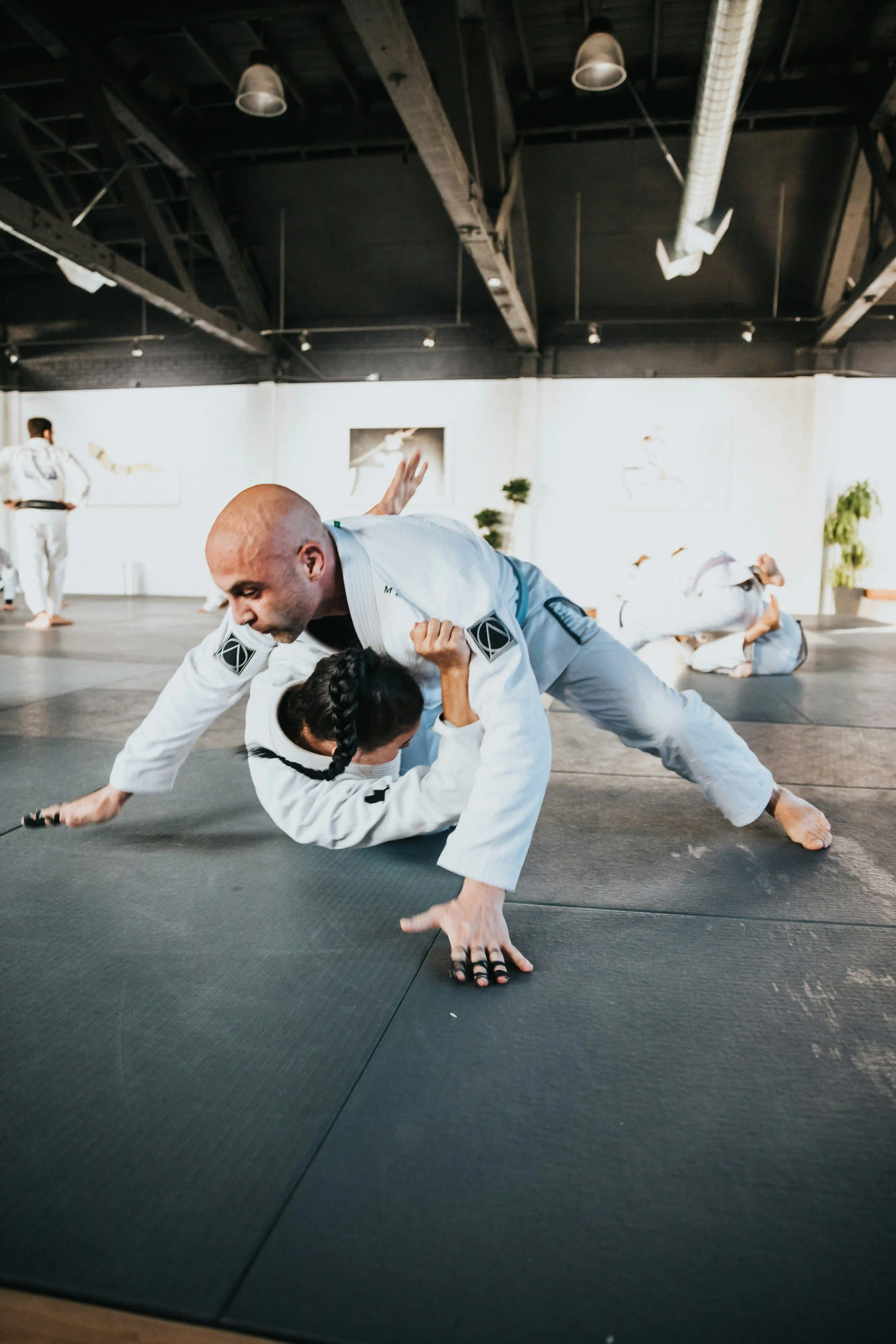
Your first month in a Brazilian jiu-jitsu (BJJ) gym is a particular kind of humbling. Whether you walk in reasonably fit and confident in your own body or you are starting out a new phsycial fitness or martial arts journey, within ten minutes someone considerably smaller will have folded you into a shape you did not know your spine permitted. Then class ends, you go home, and the internet offers you ten thousand videos, most of them covering techniques you will not be able to apply for years.
That volume is the problem. Not your athleticism, not your age, not your flexibility. As a jiu jitsu white belt, your limiting factor is almost never a shortage of available information. It is the absence of a filter.
So here is the filter. Five things, in order. Work on these and everything else you learn will have somewhere to attach itself. Skip them and you will spend a year collecting techniques you cannot use.
None of this is a shortcut. All of it is foundation.
What Should a Jiu Jitsu White Belt Focus On First?
A jiu jitsu white belt should focus on surviving, moving, and understanding position, in that order, before giving any serious attention to submissions. Attack is the last thing you build, not the first.
The five priorities in sequence:
1. Survive Before You Try to Win
For your first several months, you will spend most of your rolling time underneath someone. This is not a sign that something has gone wrong. It is the correct experience for your level, and the most productive place you could be.
Survival has three components, all learnable in your first week.
Protect your neck. Your chin stays down, your hands stay near your collar and jaw. Most early submissions arrive at the neck, and most of them arrive because the neck was left unattended while you were busy trying to escape somewhere else.
Build frames. A frame is a structure, usually forearm and elbow, placed between you and your partner to preserve space. It is skeletal, not muscular. If your frame is burning, you are pushing rather than framing, and it will fail the moment you tire.
Breathe. New practitioners hold their breath under pressure without noticing. Breathing steadily under load is a trainable skill, and it is the difference between a five-minute round and a five-minute ordeal.
The practical takeaway: for your first month, set your goal for each round as "do not get submitted." Not "win." Not "sweep." Just survive the round with your neck intact and your breathing under control. That is a real, measurable, achievable objective, and clearing it consistently means you are progressing.
2. Build Two Movements: The Bridge and the Hip Escape
Nearly every escape in jiu-jitsu is assembled from two base movements. The bridge, sometimes called the upa, drives your hips upward off the mat through your feet and shoulders. The hip escape, commonly called the shrimp, moves your hips laterally away from pressure to recreate space.
That is the whole vocabulary at the start. Two movements.
What makes them worth isolating is that they are rarely the limiting factor in understanding and almost always the limiting factor in execution. A white belt can describe a mount escape accurately and still fail it, because the bridge underneath it is shallow, mistimed, or driven by the arms instead of the legs. The technique was never the issue.
Practise these outside of live rolling, when you are not under pressure and not out of breath. Five minutes before class, five minutes at home, slowly and with attention. You are building a movement pattern, not conditioning.
One caution worth taking from sports science. Skill acquisition principles used across sport suggest that mindless repetition of an identical movement is less effective than repeating the same problem under varied conditions. So bridge from the floor, bridge with a partner's weight on you, bridge from different angles. Same movement, different circumstances. That variation is what makes it available to you when you need it.
3. Learn the Positional Hierarchy Before the Techniques
Jiu-jitsu makes very little sense until you understand that positions are ranked, and that every position carries a specific objective.
The hierarchy is straightforward:
Dominant positions are back control, mount, and side control. Here your goal is to hold what you have, stay heavy, remove space, and advance only when the position is genuinely secure.
Neutral positions are the guards: closed, half, open. Here your goal is to control your partner's posture and work toward a sweep or an attack.
Defensive positions are the underside of all of the above. Here your goal is to escape to neutral, not to attack.
This map is worth more than any five techniques, because it turns a chaotic scramble into a series of legible situations. When you know where you are and what that position is worth, you stop making the most common white belt error: attacking from a position that does not support an attack.
It also explains why competition scoring rewards what it rewards. Points follow positional value almost exactly, which confirms the hierarchy is real and not merely instructional convention.
After every round, name the positions you passed through. Not the techniques, the positions. If you cannot name them, that is the gap to close first.
4. Choose Two Escapes and Drill Them Until They Are Boring
You will spend more time under mount and side control than anywhere else in your first year. So choose one escape from each, and commit to them.
Two is not a compromise. It is the point.
The instinct at white belt is to gather widely, learning a new escape every week from every position. It feels productive. It rarely produces skill. A scoping review of skill acquisition research in sport points toward depth and structured practice over breadth of exposure, and motor learning research on practice scheduling consistently finds that varied and randomised practice of a small set of skills produces better retention and transfer than repetitive blocked drilling of many.
Translated to the mat: two escapes, drilled against different body types, pressures, and levels of resistance, will serve you better than twelve escapes drilled once each.
You will know an escape has become yours when you execute it without narrating it to yourself. Until then, it is a technique you have seen rather than a skill you own.
Ask your instructor which two they would choose for your body type. That conversation is worth more than another hour of video.
5. Keep Your Legs Between You and Your Opponent
Guard retention is the skill of stopping the pass before it happens, and it is the highest-leverage defensive skill in the art.
The logic is arithmetic. Every escape you drilled in the previous section is expensive: it costs energy, time, and a partner momentarily willing to let you have space. Guard retention is cheaper than all of it, because the position you never lose is the position you never have to escape from. Easily said, extremely hard to master.
Mechanically, it is an extension of the hip escape. The principle is that your legs, knees, and hips stay oriented toward your opponent, forming a barrier they have to solve. When they move to one side, you turn to face them. When they clear one leg, you reinsert a knee or a foot on the hip. The moment your legs end up on the wrong side of their body, the guard is gone.
Two habits do most of the work. Keep your feet and knees active rather than flat, because a guard that is not moving is a guard being passed. And learn to concede the small position to keep the larger one: giving up closed guard to recover half guard is a good trade, while refusing to move until you are flattened under side control is not.
Work this in isolation. Ask a partner to pass at half speed while your only objective is keeping your legs in front of them. No sweeps, no submissions, no escapes. Five minutes twice a week will do more for your first year than any technique you learn in the same period.
How Long Does It Take to Get Good at Jiu Jitsu?
Longer than you want, and the honest answer is that most practitioners describe a genuine sense of competence somewhere around two to three years of consistent training.
Most people who begin jiu-jitsu do not reach blue belt, and the reasons are ordinary rather than dramatic: schedules change, injuries interrupt, motivation thins during the stretch where progress is real but invisible.
Which reframes the question. The practitioners who improve are, overwhelmingly, the ones still on the mat in month eighteen. Consistency is not a supplement to skill development at this stage. It is the mechanism.
Two classes a week for two years will take you further than five classes a week for four months.
Where This Leaves You
Five things: survive, move, understand position, own two escapes, try to retain guard. That is the entire list, and it is enough to occupy your first year honestly.
Notice what is missing. There is not a single submission on that list, and that is deliberate. Submissions are not unimportant; they are downstream of everything else. You cannot finish from a position you cannot reach, you cannot reach a position you cannot move into, and you cannot move well while you are panicking and out of air.
Here is the part nobody tells new practitioners clearly enough. This will take a long time. Not weeks, not months, but years of steady, unglamorous practice, and there will be long stretches where you cannot feel yourself improving at all. That is not a sign you have chosen wrong or that jiu-jitsu is not for you. It is simply what the timeline looks like from inside it.
So do not worry about the distance. These five are a jumping-off point, not a curriculum. As you train, your instructor will refine them, your body will argue with some of them, and your own game will start to pull you in directions this list never anticipated. That is exactly as it should be.
Mastery is not achieved in moments of applause. It is built in repetition, correction, and patience. Stay consistent. The path rewards those who respect it.