

Proving Yourself in Karate: Four Ways Karate Measures Skill
Every karateka reaches a point where training alone is no longer enough to answer the question. You have drilled the combinations, refined the kata, and logged hundreds of hours on the dojo floor. And still, somewhere underneath all of it, a quieter question surfaces: how do I actually know where I stand?
I have been training karate for many years. I am a black belt and part of the Combatpit team, and I want to share something I have noticed across the different schools and environments I have trained in. There is no single answer to that question. But there are four distinct pathways through which karate practitioners measure themselves, and each one reveals something the others cannot. Which one serves you best depends, more than anything else, on who you are.
.avif)
Why Karate Has No Single Answer for Measuring Skill
Karate is not a uniform art. The style you train, the lineage of your instructor, and the culture of your specific dojo all shape what skill is expected to look like and how it is meant to be demonstrated. A Shotokan practitioner and a Kyokushin practitioner both call themselves karateka, but the environments they train in, and the methods by which their schools measure ability, can be vastly different.
This is not a problem. It is one of karate's defining characteristics. The art has always contained multitudes.
What matters is that you understand the testing environment you are in, and that you eventually develop a clear sense of which environment matches the kind of practitioner you want to become.
Competition: The External Benchmark
Competition is the most visible form of skill testing in karate, and for many practitioners, it is the most appealing precisely because it is the most objective. You step onto the mat, face someone who wants to win, and the result is immediate and unambiguous.
But "competition" covers a wider range of demands than the word implies, and understanding those differences is important.
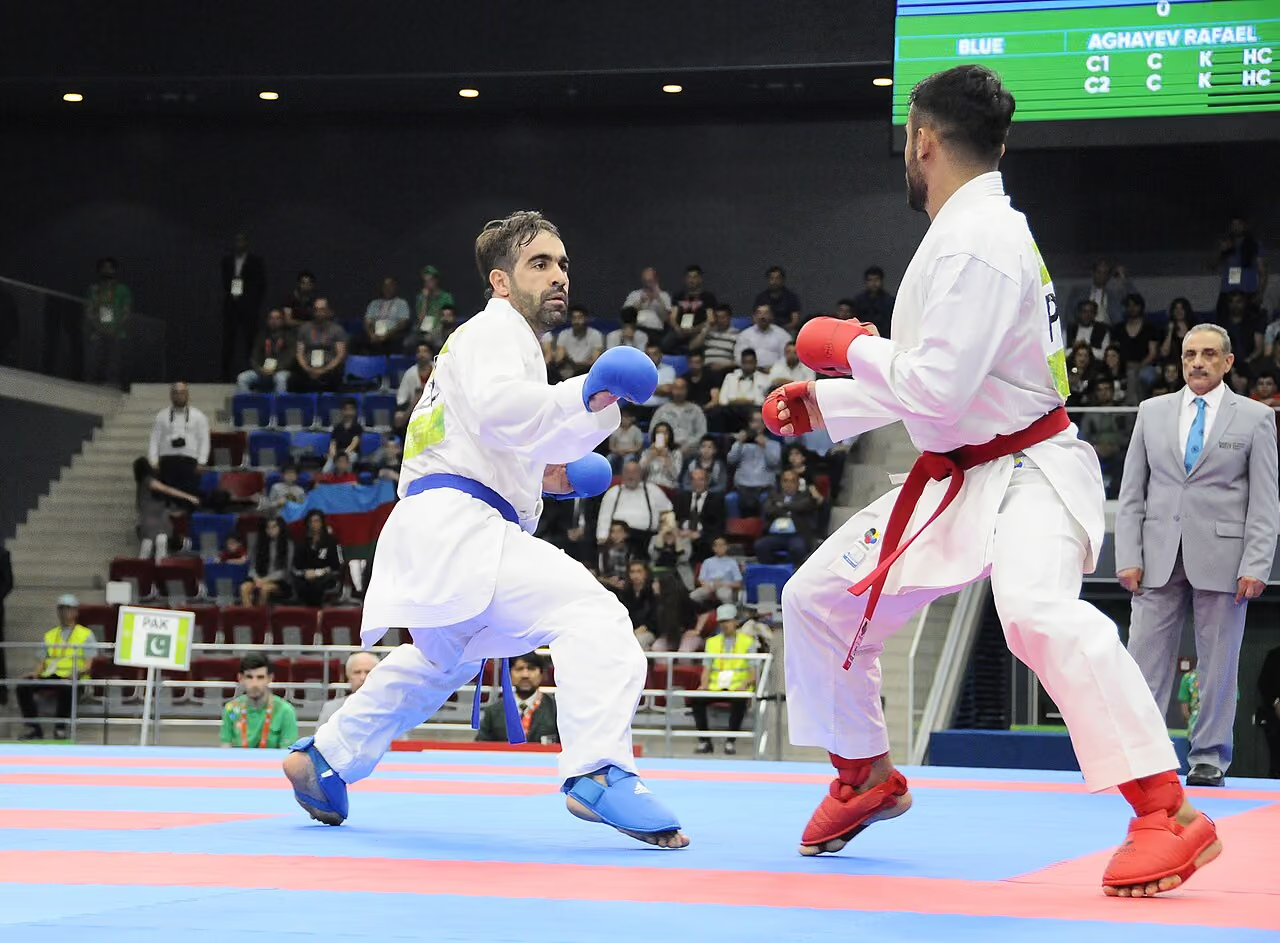
Point-fighting kumite, as practiced under World Karate Federation rules, rewards speed, timing, and the ability to control distance. It is a technical discipline with its own internal logic. What it tests is real, but it is a specific kind of readiness: explosive, precise, governed by rules that shape how techniques are selected and executed.
Knockdown and full-contact formats, most notably the system developed by Kyokushin founder Mas Oyama, test something different. The absence of face punches does not make these formats less demanding. Body conditioning, durability, and the capacity to keep moving under sustained physical pressure are tested in ways that point sparring simply does not reach.
Then there is kata competition, where two practitioners are not fighting each other at all. They are being evaluated on the depth and precision of their solo performance, which is a different cognitive and physical challenge entirely.
Competition, in all its forms, gives you external confirmation against a clear standard. It can be a powerful measure of where you are. But it measures within a defined frame. What it does not capture is the full picture of a karateka's development, and it is worth keeping that distinction honest.
My own relationship with competition has been shaped more by observation than by extensive personal participation. That experience taught me to respect what competition reveals, without overstating what it can tell you.
Demonstration: Skill as Visible Mastery
In some schools, the primary form of skill testing is not combat-oriented at all. It is performative in the most traditional sense of that word.
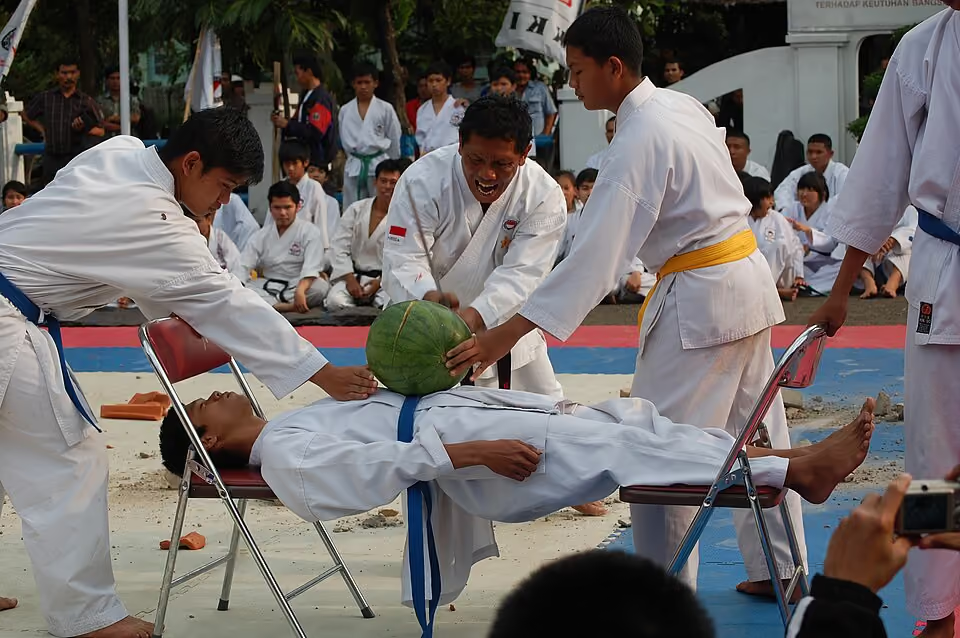
Kata, when practiced as the core discipline of a school rather than a competitive add-on, becomes something genuinely demanding. It requires not just technical accuracy but the ability to embody the movement, to make intent visible without an opponent to react to. Embu, choreographed partner demonstration, adds timing and synchronisation to that requirement. Public demonstrations, at dojos, cultural events, and ceremonies, require composure and presence under observation. Demonstration as a testing framework extends well beyond solo kata and partner embu: it encompasses grading-panel performances, ceremonial demonstrations at cultural events, showcasing drills and techniques widely practiced at the dojo and kobudo weapon demonstrations where applicable.
I have trained in schools where demonstration was the central test of skill, and I have a deep respect for what that environment produces. The precision demanded in those settings exposes technical weaknesses that sparring can sometimes hide. When you are moving fast in a fight, imperfect mechanics can still work. In a kata and bunkai performed in front of experienced eyes, they do not pass unnoticed.
There is sometimes a tendency to undervalue demonstration-based testing as somehow less authentic than contact-based testing. I think that tendency misses something. The practitioner who can perform with precision and presence, whose movement reveals genuine understanding rather than memorized sequence, is demonstrating something real. It is not the same thing as fighting ability. But it is a legitimate form of mastery, and for many practitioners it represents the core of what karate is.
If you trained in a school where demonstration was the standard, you were not training a lesser form of the art. You were being asked to meet a different, and in some ways more exacting, kind of test.
Belt Examination: The Structured Threshold
The formal belt examination is the testing format most universal to karate. Whatever style you practice, some version of this structured assessment almost certainly exists.
What vigorous testing reveals is genuinely difficult to replicate in regular training. When a student performs under examination conditions, after hours of physical demand, in front of senior instructors who know exactly what to look for, something shifts. The technical knowledge that exists comfortably in a rested, familiar environment has to survive fatigue, pressure, and scrutiny.
The depth of that experience varies enormously across schools. A black belt examination at a serious traditional dojo, one that involves multiple hours of continuous physical and technical testing, knowledge demonstrations, and a panel of senior examiners, is a different undertaking from a lighter assessment at a more commercially oriented school. Both are real examinations, but they produce different kinds of confidence.
I have experienced examination environments that were genuinely demanding, where the physical and psychological pressure of the test itself was part of what was being evaluated. Those moments clarified things about my own capacity that training alone had not surfaced. There is something instructive about discovering what your technique looks like when you are running out of reserves, and whether your composure holds under sustained external assessment.
That kind of self-knowledge is valuable. It is one of the things a serious examination gives you that no other format quite replicates.
Dojo Sparring: The Honest Daily Mirror
Before I get to my closing thoughts, I want to give proper attention to something that does not fit neatly into the other three categories, but deserves to be named clearly.
In many dojos, the most honest ongoing test of skill is not a formal event at all. It is the regular practice of sparring within the school.
There are two quite different versions of this, and the distinction matters.
In a well-run dojo with a thoughtful training culture, sparring is cooperative in a specific sense. A more experienced practitioner does not use their technical advantage to shut down a less experienced partner. They create challenge while creating opportunity. They adjust the level of pressure to what the other person can grow through. This is not a lesser form of training. It is a more demanding one, because it requires constant awareness and control, not just skill.
But that is not the only kind of dojo sparring. In some schools, particularly those oriented toward fighting ability as the central value of karate training, sparring functions as ongoing proof. It is intense, regular, and in some cases quite uncompromising. Practitioners in those environments are tested continuously in a way that formal examinations only approximate periodically. The question of where you stand is answered, implicitly, every time you step on the floor.
What I can say is that both versions of dojo sparring, the cooperative model and the more demanding fighting dojo model, produce real practitioners. They simply produce different strengths, and they exist within schools that have made different choices about what karate is fundamentally for.
Which Path Fits You?
I have trained in environments where demonstration was the standard and in environments where demanding belt examination was the primary measure. Both gave me something I value. Neither was a substitute for the other, and neither was a substitute for the fighting environment I was temperamentally drawn toward and never fully experienced.
That gap has been worth sitting with. Not every practitioner ends up in an environment that matches their instincts. Sometimes circumstances determine the dojo, not the other way around. That is not a failure of the practice. It is part of the path.
What I would encourage you to consider is this: which of these four frameworks actually speaks to who you are?
If you are drawn to the clarity of external competition, pursue it seriously and understand what it measures and what it does not. If you are the kind of practitioner who finds deep meaning in precision and form, a school that tests through demonstration will ask things of you that no opponent can. If you want structured, cumulative proof of growth, a dojo with rigorous examination standards will give you thresholds worth crossing. And if what you want most is to know, consistently and honestly, exactly where you stand against another person, find a school where the floor itself is the test.
Karate is broad enough to contain all of these approaches. The question is not which one is correct. The question is which one is correct for you.
The author is a karate black belt and member of the CombatPit editorial team.