

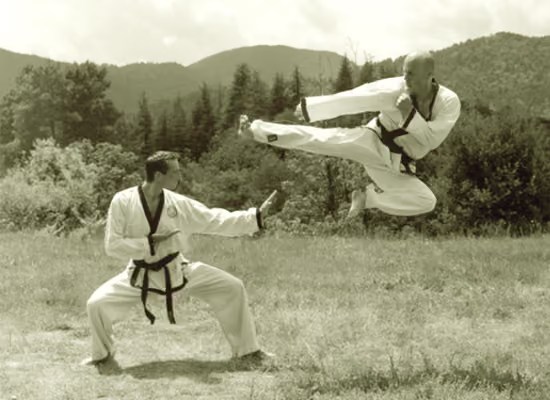
Tang Soo Do did not begin with a tournament. It did not begin with a movie. It began in silence, practiced in secret during decades of occupation, kept alive by practitioners who understood that an art, like a people, can survive if it is passed down with enough care.
Before Taekwondo became the official martial art of Korea, before Korean martial arts had a unified name or a governing body, there was Tang Soo Do. And before Tang Soo Do had a modern form, there were the older Korean fighting arts it grew from — Soo Bahk Ki, Taekkyon, the warrior traditions of the Hwa Rang.
This is the story of one of the most significant and often misunderstood Korean martial arts: where it came from, what it looks like in practice, and why it is still worth training today.
What Does Tang Soo Do Mean?
The name itself reveals the art’s layered origins.
“Tang” refers to the Tang Dynasty of China (618–906 AD) — the period when Chinese martial methods spread across Asia and influenced fighting traditions from Korea to Okinawa to Japan. “Soo” means hand. “Do” means way or path. Together: the Way of the China Hand.
What makes the name linguistically interesting is that the same Chinese characters — 唐手道 — were also used in Japan, where they were pronounced karate-do before Gichin Funakoshi changed the first character to mean “empty” rather than “China.” The Korean pronunciation of those original characters is Tang Soo Do. The Japanese pronunciation of the revised characters became the karate most people recognize today.
This shared etymology is not a coincidence. It reflects the reality that the striking arts of East Asia share deep common roots, shaped by geography, trade, and the movement of practitioners across borders over centuries.
The Origins and History of Tang Soo Do
Ancient Foundations
The earliest traces of the fighting art that would eventually be codified as Tang Soo Do appear in the Three Kingdoms period of Korean history. Murals found in Koguryo royal tombs — dating to as early as 37 BC — depict warriors engaged in unarmed combat in postures consistent with what practitioners would recognize today.
During the Silla Dynasty (57 BC–935 AD), the Hwa Rang — an elite warrior class — trained in Soo Bahk Ki (foot and body fighting) as part of their preparation for battle. These warriors combined physical training with a strict ethical code derived from Confucian principles, a framework that would influence Tang Soo Do’s philosophy over a thousand years later.
The art evolved through the Koryo and Yi dynasties, appearing under various names: Soo Bahk, Taekkyon, Kwon Bop. It was documented as a military discipline, a public practice at festivals, and a mark of warrior identity.
Japanese Occupation and Suppression
When Japan occupied Korea beginning formally in 1910, the practice of traditional Korean martial arts was restricted. Some were outright forbidden, punishable by death. The arts went underground, practiced in secret, kept alive through personal transmission rather than institutional teaching.
This period of suppression paradoxically preserved something important: the practitioners who continued training did so out of genuine devotion, not obligation. The art that emerged after liberation carried that intensity.
Hwang Kee and the Birth of Modern Tang Soo Do
The modern form of Tang Soo Do was codified by Grandmaster Hwang Kee, one of the most important figures in Korean martial arts history.
Born in 1914, Hwang Kee was captivated by martial arts from childhood. He studied indigenous Korean arts, then traveled to Manchuria in 1936 where he trained under a Chinese martial arts master, absorbing Northern Chinese methods including footwork patterns and circular striking principles. He also encountered and studied Okinawan karate texts during the occupation, incorporating Shotokan patterns into his developing system.
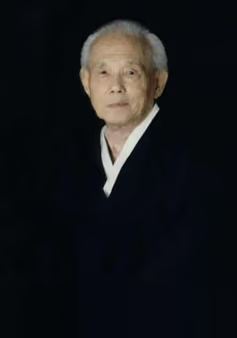
On November 9, 1945 — his 31st birthday and just weeks after Korea’s liberation — Hwang Kee formally opened the Moo Duk Kwan, meaning “Institute of Martial Virtue.” The art he taught there blended Korean indigenous fighting with Chinese methods and Okinawan karate influence. He initially called it Hwa Soo Do, but adopted the name Tang Soo Do to connect with the broader Korean martial arts conversation of the era.
The Moo Duk Kwan grew to become the largest martial arts organization in Korea, and most Tang Soo Do schools worldwide trace their lineage directly back to Hwang Kee’s system.
The Split That Created Taekwondo
In the 1950s and 60s, the South Korean government sought to unify the various kwans (schools) under a single national martial art. This political effort eventually produced Taekwondo — a name and system designed to represent Korea’s martial heritage on the world stage.
Most kwans complied. Hwang Kee did not. He fought to keep Tang Soo Do independent, refusing to absorb the Moo Duk Kwan into the new Taekwondo Association. A 1966 South Korean Supreme Court ruling confirmed his right to remain separate.
The result was a divergence. Taekwondo became an Olympic sport, backed by government infrastructure and international federation support. Tang Soo Do continued on its own path — less institutionalized, more traditional, and for many practitioners, more connected to what Korean martial arts had been before politics reshaped them.
Tang Soo Do vs Taekwondo: What Is the Difference?
This is the question most people come in with, and it deserves a direct answer.
Both arts share the same ancestral lineage. Both emphasize kicking, particularly high and spinning kicks. Both use forms (called hyung in Tang Soo Do, poomsae in Taekwondo). At a surface level, a class in either art can look similar to an uninitiated observer.
The differences are technical, philosophical, and institutional. Technically, Tang Soo Do retains more influence from Chinese circular movement and places greater emphasis on hand techniques alongside kicks. Taekwondo, shaped partly by its development as a competition and Olympic sport, evolved toward higher kicks, faster scoring techniques, and less emphasis on hand strikes. Philosophically, Tang Soo Do practitioners often describe their art as more traditionally rooted — less shaped by the demands of competition and more aligned with the original Moo Duk Kwan emphasis on character development alongside physical skill. Institutionally, Taekwondo has the World Taekwondo Federation, Olympic recognition, and government backing. Tang Soo Do has multiple independent organizations, no Olympic status, and a community held together more by lineage loyalty than institutional infrastructure.
Neither is better. They are different answers to the question of what a Korean striking art should be.
What Tang Soo Do Looks Like in Practice
A Tang Soo Do class typically has a recognizable structure: warm-up, line work, forms, one-step sparring, and free sparring. The training is methodical rather than frenetic.
Hyung (forms) are the backbone of the curriculum. These are pre-arranged sequences of techniques practiced alone, encoding the art’s principles in movement that can be trained without a partner. Moo Duk Kwan Tang Soo Do uses both Korean-origin forms and forms adapted from Okinawan karate, reflecting the art’s composite lineage.
Kicking is where Tang Soo Do’s identity is most visible. Front kicks, side kicks, roundhouse kicks, spinning back kicks, jumping kicks — the kicking vocabulary is extensive and built for practical application rather than purely acrobatic display. The emphasis is on controlled power and clean mechanics.
Hand techniques draw from multiple influences: the straight punching of Shotokan, the circular blocks of Chinese arts, and wrist-grab self-defense techniques with elements similar to aikido or jiu-jitsu. This breadth is part of what makes Tang Soo Do a well-rounded striking system rather than a purely kicking art.
Sparring in traditional Tang Soo Do is typically light contact or no contact. The emphasis is on technique, control, and reading an opponent — not on scoring points through impact.
The philosophical layer is not decorative. The Five Codes of Tang Soo Do — rooted in the ethical principles of the Hwa Rang warriors — establish loyalty, respect for elders, honor among peers, no unjust retreat, and no unnecessary killing. These codes are taught alongside technique, not as separate curriculum.
Notable Tang Soo Do Practitioners
Hwang Kee (1914–2002) is the central figure — founder of the Moo Duk Kwan, the man who codified the modern art and spent decades defending its independence. Most Tang Soo Do practitioners worldwide trace their lineage through him.
Chuck Norris began his Tang Soo Do training at Osan Air Base in South Korea in 1958. He earned a 9th-degree black belt in Tang Soo Do and went on to found his own system — Chun Kuk Do — with Tang Soo Do as its foundational base. He also founded the American Tang Soo Do system in 1966, formalizing his own lineage. He passed away on March 20, 2026, at 86. The art he carried from Korea to America and onto cinema screens worldwide is a significant part of his legacy. You can read our full tribute to him here.
Billy Blanks, creator of Tae Bo, began his martial arts journey in Tang Soo Do before expanding into other styles. His early Tang Soo Do training shaped the kicking emphasis that made Tae Bo distinctive.
Korea’s martial arts legacy in combat sports and traditional arts more broadly is explored in our piece on South Korea’s Olympic Combat Sports Legacy.
Can You Train Tang Soo Do Today?
Yes — and more easily than many people expect.
Tang Soo Do is taught in over 36 countries. The major governing organizations include the World Tang Soo Do Association, the International Tang Soo Do Federation, and the United Fighting Arts Federation (UFAF). Each maintains active school networks and competitive events.
What to look for in a school: a clear lineage — who taught the instructor, and what organizational affiliation do they hold. Tang Soo Do’s strength is in its traditionalism, so schools that maintain the hyung curriculum, the philosophical codes, and the light-contact sparring culture tend to reflect the art most faithfully.
If you are new to martial arts and considering Tang Soo Do as a starting point, the guidance in our beginner’s guide to choosing the right martial art will help you evaluate fit beyond the style itself.
A Living Tradition
Tang Soo Do survived Japanese occupation, a government-ordered merger it refused, and decades in the shadow of Taekwondo’s global rise. It did this not through institutional power but through the commitment of practitioners who valued the art enough to keep training it as it was meant to be trained.
That persistence is itself a form of teaching. An art that survives on its own terms, passed down practitioner to practitioner without political support or Olympic prestige, is telling you something about the people it produces.
The path is still open. It rewards those who walk it with respect.