

A Kid from Oklahoma Who Learned to Fight in Korea
Carlos Ray Norris passed away on March 19, 2026, in Hawaii. He was 86 years old, surrounded by family, and at peace.
_(cropped).avif)
Chuck Norris did not begin as a movie star. He began as a shy, self-described unathletic kid from Ryan, Oklahoma, the son of a World War II veteran and a determined mother who raised three boys largely on her own.
He joined the United States Air Force at 18. Stationed at Osan Air Base in South Korea in the late 1950s, he encountered Tang Soo Do and something in him shifted permanently. He didn't just study it. He absorbed it. He came home and built a career out of it before most Americans knew what a roundhouse kick was.
He became a martial arts champion. He opened schools. He trained celebrities — Steve McQueen among them, who reportedly encouraged Chuck to try acting. From there came Breaker! Breaker!, then Lone Wolf McQuade, then Missing in Action, then The Delta Force, and eventually nine seasons of Walker, Texas Ranger — a show that ran until 2001 and still airs in syndication somewhere on the planet at any given moment.
By then, he had earned black belts across multiple disciplines — Tang Soo Do, Brazilian jiu-jitsu under the Machado brothers, and others. He also developed his own hybrid system, Chun Kuk Do, meaning "The Universal Way." He was inducted into the martial arts hall of fame. He received a star on the Hollywood Walk of Fame in 1989. Texas made him an actual Ranger in 2010.
He was training well into his eighties. His last public post, on March 10 — his 86th birthday — showed him dropping an opponent in Hawaii, captioned: "I don't age... I level up."
The Mythology
Somewhere in the early 2000s, the internet did something unusual with Chuck Norris. It turned him into a legend.
Not a celebrity. A legend. In the old sense of the word — a figure whose abilities had grown beyond documentation, beyond logic, and certainly beyond what physics would allow.
The format was simple. The punchline was always him. And the "Chuck Norris Facts," as they became known, spread across message boards, email chains, and eventually every social media platform that followed. Billions of impressions. Dozens of languages. Every continent.
We know, because we were some of those people. The CombatPit editorial team grew up across different countries. Different languages. Different martial arts traditions. But we all knew Chuck Norris. We all heard the jokes. We all laughed. And somewhere in that laughter was genuine respect — the kind you extend to someone whose mythology you've chosen to keep alive.
A few of the classics, offered here as the cultural artifacts they truly are.
"Chuck Norris doesn't do push-ups. He pushes the Earth down."
This one captures it perfectly. The joke isn't really about Chuck Norris. It's about what we want physical mastery to look like. Not effort, but effortlessness. Not training hard, but training so far past hard that the rules change. Every serious martial artist knows the only way to seem that capable is to have worked longer and more honestly than anyone watching. The joke lands because somewhere in it is a real principle.
"Chuck Norris counted to infinity. Twice."
Discipline has no ceiling. That's the thing about a committed martial artist — the practice never ends. Chuck trained at 85. He trained at 86. If the joke makes you smile, let it also remind you what consistent dedication actually looks like across decades.
"Death once had a near-Chuck Norris experience."
This one won't land the same way today. And that's okay. Because the real version of this joke is that a kid from Oklahoma — shy, unathletic, uncertain — trained his way into one of the most recognizable figures in global popular culture, worked well into old age, and lived on his own terms. That's not invincibility. That's something better. That's a life built with intention.
"Chuck Norris doesn't read books. He stares them down until he gets the information he wants."
For the record, Chuck Norris did read. Widely. He was vocal about his faith, his philosophy, and his values. The joke is funnier when you know the man was actually thoughtful. The mythology worked because the real person had enough dimension to support it.
"When Chuck Norris enters a room, he doesn't turn the lights on. The darkness leaves."
We'll admit: this one still holds up. Not as hyperbole, but as a metaphor for presence. Real martial artists carry themselves differently. Not with swagger or threat — with calm. The kind of calm that comes from knowing what you're capable of and having nothing left to prove. Chuck Norris had that. Anyone who watched him on screen or read accounts of his in-person manner understood it.
The Screen Career
Chuck Norris did not plan on becoming a movie star. He became one by accident, and then by commitment.
His first screen appearance came in 1968, a minor role in The Wrecking Crew — a Dean Martin spy comedy that needed a martial artist on set. The role was small enough to be forgettable. What it opened was not.
In 1972, Bruce Lee cast him as Colt in The Way of the Dragon — the American fighter hired to stop Lee's character in a climactic showdown set in the Roman Colosseum. Norris was the villain. He was also the only man on screen who looked like he could genuinely have given Lee a contest. Their fight sequence remains one of the most technically honest in martial arts film history. Lee's character wins. But the scene made Norris.
That visibility, combined with a nudge from his student Steve McQueen to take acting seriously, led to Breaker! Breaker! in 1977 — a low-budget trucking action film shot in eleven days that turned a profit. Its success was modest. Its significance was not. Chuck Norris was now a leading man.
What followed through the late 1970s and 80s was a body of work that defined a genre. Good Guys Wear Black. The Octagon. Forced Vengeance. Silent Rage. Lone Wolf McQuade. Then the Cannon Films era: Missing in Action and its sequels, Invasion U.S.A., The Delta Force, Code of Silence — a run of action films built on one consistent premise: one man, a credible threat, and a moral code that didn't bend.
He was not the most versatile actor of his generation. He did not try to be. What he offered was something specific and rare — a screen presence grounded in real physical capability. Audiences understood, instinctively, that the man doing the kicking actually knew how to kick. That authenticity is harder to manufacture than most studios acknowledge, and it carried his career through two decades of leading roles.
The 1990s brought Walker, Texas Ranger — nine seasons, 196 episodes, a character who dispensed justice with roundhouse kicks and a weathered sense of right and wrong. It remains in syndication. A generation that never saw the Cannon Films era grew up watching Walker.
He was not chasing prestige. He was doing the work. And the work lasted.
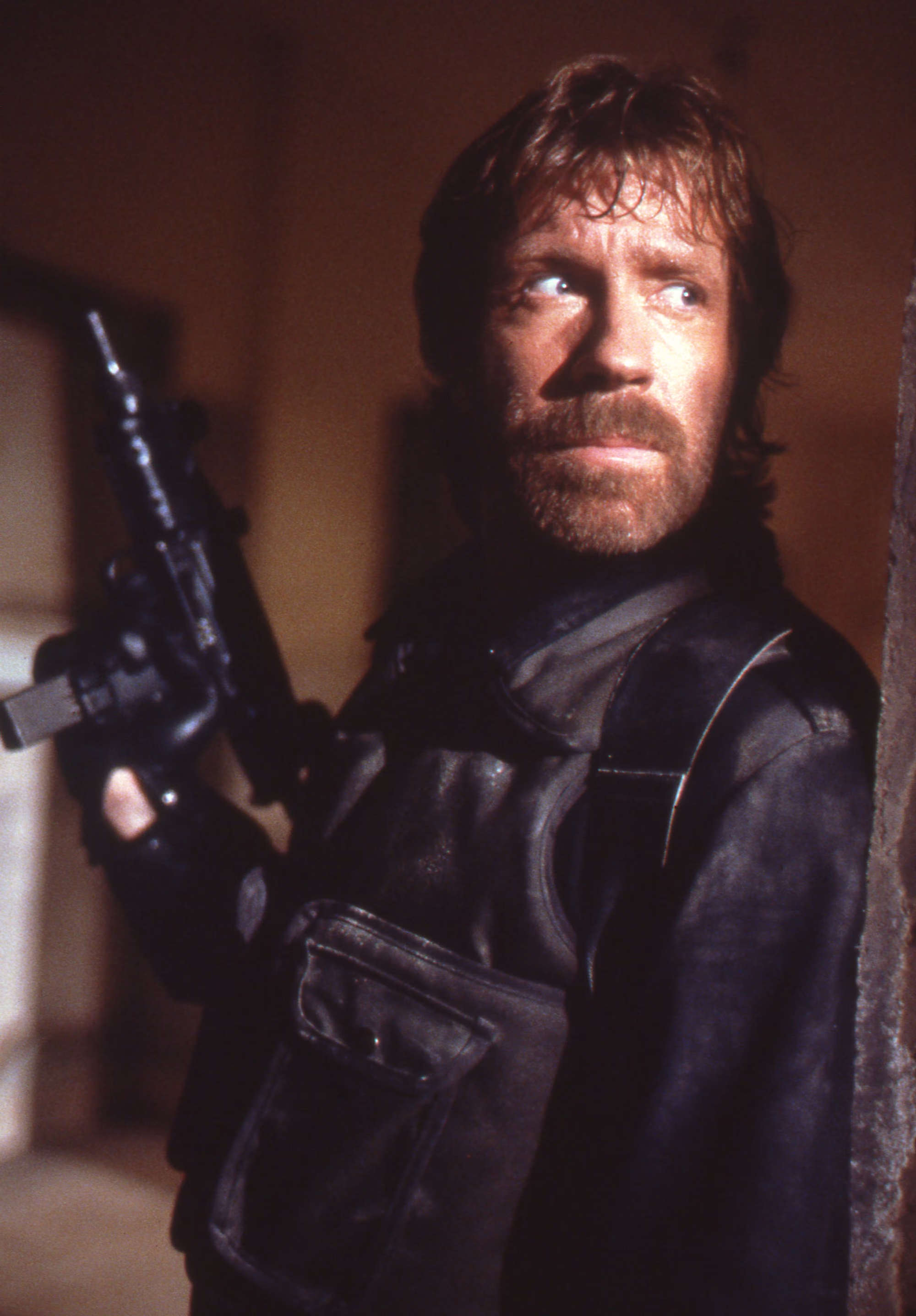
What He Leaves Behind
Chuck Norris was not a perfect figure. His political views were often controversial. Some of his later years were spent in spaces where his name was used more as a cultural shorthand than as a tribute to the actual man.
But the actual man trained hard, built something from very little, honored the disciplines he studied, and showed up in the dojo until the end.
That gap between the myth and the man is worth sitting with. Not to deflate one or inflate the other. But to understand what it means that millions of people on every continent chose to build that mythology around a martial artist.
They were telling us something about what they value. About what the practice of martial arts can represent when it's done with commitment, with humility, and over a lifetime.
Chuck Norris gave them something real to build it on.
Rest well, Walker. The path honors those who walk it honestly.
.avif)