

Are Nunchucks Effective? Separating Okinawan Tradition from Hollywood Myth
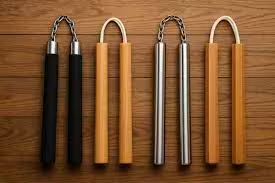
Few weapons in martial arts carry more cultural weight than the nunchaku. And few have been more thoroughly distorted by the screen.
For many people, the image is fixed: Bruce Lee in a yellow tracksuit, spinning two sticks through the air with impossible speed. The nunchaku became a symbol of martial arts mastery almost overnight. Governments banned them. Emergency rooms filled with self-inflicted injuries. An Okinawan training tool became a global pop culture icon before most of the world had any idea where it actually came from.
The dojo has always held a different perspective. The nunchaku is a demanding instrument with a specific place in traditional practice. Its value is real, but it is not what the movies suggested. This guide explores the full picture: the origins, the honest assessment of effectiveness, the training benefits, the legal landscape, and where the nunchaku fits in martial arts today.
The Origins of the Nunchaku
From Okinawan Kobudo to the World Stage
The nunchaku belongs to a weapons tradition known as Okinawan Kobudo, a system developed under exceptional historical pressure. When the Ryukyu Kingdom came under the rule of the Satsuma clan in 1609, Okinawans were prohibited from carrying conventional weapons. What followed was a quiet act of adaptation. Practitioners continued training in secret, building a weapons system around everyday tools: the bo, a six-foot long staff, the sai, the tonfa, the kama. The nunchaku was among them.
The exact origin of the nunchaku is debated among historians. One theory holds that it evolved from a rice threshing flail. Another points to its similarity to the horse bridle used in Okinawan stables. A related weapon, the tabak-toyok from the northern Philippines, bears a close resemblance, suggesting the two may share common roots. What is consistent across theories is the nunchaku's identity as a tool first, a weapon second. It was practical, concealable, and available.
In traditional Kobudo, the nunchaku is taught alongside the other core weapons as part of a complete system. Styles including Isshinryu Kobudo, Matayoshi Kobudo, and Shorin-Ryu incorporate the nunchaku into their formal curriculum to this day. It has never disappeared from Okinawan practice. It was only ever distorted by what happened to its image elsewhere.
For context on how these weapons connect to the broader evolution of karate, see Karate Styles.
Bruce Lee and the Hollywood Effect
How Three Films Changed Everything
In 1972, Bruce Lee used the nunchaku in Fist of Fury. In 1973, he brought them to a global audience in Enter the Dragon, the first kung fu film produced by a Hollywood studio. His technique in that film was developed in part through work with Kobudo practitioner Tadashi Yamashita, who helped Lee deepen his understanding of the weapon during production. What appeared on screen was not improvised showmanship. It was grounded in real skill, refined through disciplined training.
The problem was not Bruce Lee. The problem was what the world did with what it saw.
By the late 1970s and early 1980s, nunchucks were everywhere. Toy stores sold them. Kids swung them in backyards. Emergency rooms began reporting a wave of self-inflicted injuries as untrained enthusiasts attempted to recreate what they had seen on screen. The gap between Lee's years of training and what the average person could do after twenty minutes with a cheap pair of chucks was vast, and the consequences were not subtle.
The cultural ripple continued well beyond cinema. The Teenage Mutant Ninja Turtles embedded the nunchaku into an entirely new generation's imagination. The weapons appeared in video games, comics, and countless television shows. Michelangelo made them look effortless. They were not.
The reaction was swift in several countries. In the United Kingdom, the British Board of Film Classification cut the nunchaku sequences from Enter the Dragon for its 1974 release, and those scenes did not appear in the uncut version available to UK audiences until 2001. The censorship was not about the film. It was about what the scene represented in a moment of mass public anxiety about martial arts weapons.
Bruce Lee's skill was real, deeply trained, and worth studying. The mythology that grew around the nunchaku because of that skill is a different matter entirely. Separating the two is where honest assessment begins. For more on his legacy, explore the Shannon Lee quotes page.
Are Nunchucks Effective? An Honest Assessment
What Nunchucks Do Well
In trained hands, the nunchaku offers genuine advantages that are easy to underestimate.
The weapon generates striking force through momentum rather than raw muscle. A controlled swing builds speed along the chain arc, delivering significant impact at the point of contact with relatively little physical effort from the wielder. The force transfer is efficient. One well-placed strike to a joint or the side of the head can cause serious damage.
Concealability has always been part of the nunchaku's design logic. Folded together, a pair fits under clothing or inside a jacket. This was relevant in its historical context and remains a practical point for those thinking about legal carry today.
The chain or rope connecting the two handles is not only for swinging. Historically, the nunchaku was also used for joint control, trapping an opponent's wrist or ankle in the rope and applying pain compliance leverage. This application was recognized formally as recently as 2015, when police in Anderson, California were trained and deployed with the Orcutt Police Nunchaku as a non-lethal control tool. At their peak, Orcutt-style nunchaku were adopted by more than 200 law enforcement agencies across the United States, used primarily for restraint rather than striking.
Where They Fall Short
The honest counter-argument is substantial.
The learning curve for the nunchaku is steep, and the margin for error is unforgiving. New practitioners regularly strike their own hands, knuckles, shins, and faces. This is not a failure of the weapon. It is a natural consequence of an instrument that requires precise timing and consistent muscle memory to control. Without that foundation, the nunchaku is a liability rather than an asset.
Space is also a significant constraint. The nunchaku requires room to generate its arc. In a hallway, elevator, or crowded space, that room disappears. The scenarios where someone might actually need a self-defense tool are often exactly the scenarios where a nunchaku becomes difficult to use properly.
Against multiple opponents, the weapon's limitations become more pronounced. Managing distance, timing strikes, and switching between hands demands a level of skill that takes years to develop. For a trained practitioner, these challenges are workable. For anyone else, they represent serious risk.
Compared to other tools, the investment required to make the nunchaku reliably effective in a real-world scenario is significant. That investment is worth making. But it should be made honestly, with clear understanding of what the training process demands.
The Real Value of Nunchaku Training
Should You Train With Nunchucks?
If you approach the nunchaku as a combat shortcut, it will disappoint you. If you approach it as a training instrument within a broader martial arts practice, it offers something genuinely valuable.
Okinawan masters consistently characterized the nunchaku as a training weapon first. The qualities it develops in a practitioner, including hand speed, wrist control, coordination between both hands, and spatial awareness of the weapon's arc, are not incidental. They are the point. A practitioner who has spent time training seriously with the nunchaku moves differently. Their hand speed increases. Their coordination sharpens. Their awareness of weapon dynamics transfers to empty-hand practice in ways that are difficult to replicate through other drills alone.
The discipline required to manage the nunchaku safely also cultivates focus in a specific way. The feedback is immediate and honest. Lose concentration, and the weapon finds you. There is no way to fake proficiency.
Modern Kobudo schools continue to teach the nunchaku as part of a formal curriculum. Isshinryu Kobudo incorporates it alongside the bo, sai, and tonfa. Matayoshi Kobudo and Shorin-Ryu Shorinkan maintain dedicated nunchaku kata. The World Nunchaku Association has developed a competitive discipline around freestyle nunchaku performance, which has expanded interest in the weapon internationally among practitioners who may never study traditional Kobudo.
The place of kata in this context matters. Nunchaku kata are not performance routines. They encode principles of movement, timing, and control that a practitioner internalizes through repetition. The kata is the curriculum. The martial application follows from understanding the kata deeply, not from improvising around it.
The Legal Reality of Nunchucks Around the World
Are Nunchucks Legal Where You Live?
The legal status of the nunchaku varies considerably, and the history behind the laws is worth understanding.
In the United States, a wave of state-level bans passed in the 1970s directly in response to the Bruce Lee films and the emergency room incidents that followed. California, New York, Arizona, and Massachusetts all enacted restrictions. In the years since, most of those bans have been reversed or overturned on constitutional grounds. California repealed its ban in 2021. New York's ban was ruled unconstitutional in 2018. Arizona legalized the nunchaku in 2019. Massachusetts remains the only state that still classifies nunchucks as dangerous weapons, with possession outside of authorized martial arts contexts subject to criminal charges.
Internationally, the picture is more varied. Germany, Russia, Spain, and Norway maintain outright bans on nunchaku possession. Canada prohibits hard-material nunchaku connected by chain or rope, though foam practice versions are generally permitted. The United Kingdom allows ownership but prohibits carrying them in public outside of legitimate training contexts. France classifies the nunchaku as a sixth-category weapon, legal to own but not to carry openly. The Netherlands and Poland permit foam versions while restricting wooden and metal construction.
The consistent thread across most of these laws is their origin. They were written in reaction to a cultural moment, not to a documented pattern of nunchaku-related crime. That does not change the legal reality. It simply provides useful context for understanding why the landscape looks the way it does.
Before training with or traveling with nunchaku, verify the current law in your specific jurisdiction. Regulations continue to shift.
The Nunchaku in Modern Martial Arts
Do Serious Martial Artists Still Train With Nunchucks?
Yes, and in greater numbers than the popular narrative suggests.
Across Okinawa, the birthplace of the weapon, Kobudo schools continue to teach the nunchaku as part of the complete weapons curriculum, alongside the bo, sai, tonfa, kama, and other traditional tools. The Okinawa Karate Kaikan, a facility built by the prefectural government to preserve and transmit Okinawan martial arts, treats Kobudo and karate as inseparable disciplines. The nunchaku is part of that living tradition.
Outside Okinawa, dedicated Kobudo organizations operate globally. The Ryukyu Kobudo Hozon Shinko Kai, founded by grandmaster Taira Shinken, helped codify and preserve the weapons tradition at a time when it was at risk of being lost. That lineage continues through contemporary schools and instructors who maintain the kata and principles with care.
The World Nunchaku Association runs an international competitive discipline that has introduced the weapon to practitioners who might not have encountered it through traditional Kobudo. Freestyle nunchaku competition focuses on fluid movement and control rather than combat application, but it has contributed to keeping skill and interest alive.
The nunchaku persists not because of movies, but because of what it genuinely offers to a practitioner who trains with it seriously. That has always been the real story.
Conclusion
The nunchaku is not what the movies made it. It is something more interesting and more demanding than that.
It is a piece of living Okinawan history, developed under occupation by practitioners who built an entire weapons tradition around what was available to them. It is a legitimate training instrument that builds hand speed, coordination, and body awareness in ways few other tools replicate. It is also a humbling weapon, one that will not conceal a lack of preparation.
The Hollywood version of the nunchaku was never the real one. The real one requires time, patience, and honest practice within a structured tradition.
Respect the tradition. Train with purpose. The path rewards those who take it seriously.
Explore more terms and concepts in the CombatPit Glossary, or browse the full Blog Posts Directory to continue your study.