

Ninja Weapons: How Japan's Shadow Warriors Armed Themselves From the Fields Up
When most people picture ninja weapons, they see throwing stars, sleek black swords, and exotic gear designed for one purpose: killing in the dark. It is a compelling image. It is also, in large part, wrong.
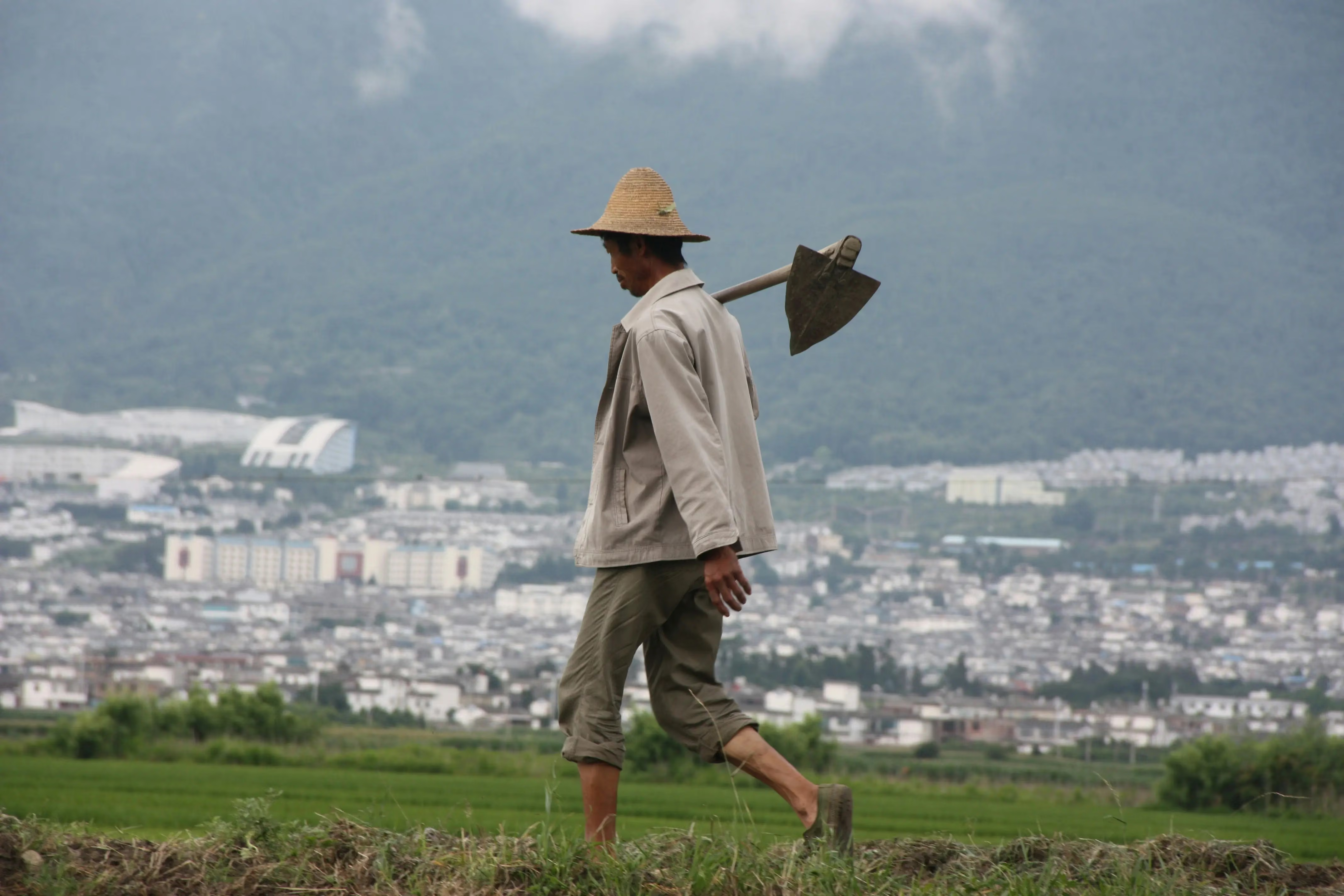
The real story of ninja weapons is not one of specialized armories and secret forges. It is the story of farmers, laborers, and lower-order warriors who could not legally carry swords, could not afford to draw attention, and had to find ways to defend themselves and carry out covert operations using whatever was already in their hands.
The kama hanging in a field. The trowel stuck in the garden soil. The grain thresher leaning against a barn wall. These were ninja weapons before anyone called them that.
Understanding where these tools came from, and why they were chosen, reveals something important about the nature of ninjutsu itself: it was never about the weapon. It was about the person holding it.
The Peasant Origins of Ninjutsu
Ninjutsu did not emerge from an elite martial lineage. It grew out of necessity, in the mountains of central Japan, among people who occupied a precarious position in feudal society.
The shinobi, known in English as ninja, were most densely concentrated in the provinces of Iga and Koga during Japan's Sengoku period, roughly the 15th to early 17th centuries. This was an era of near-constant civil war, shifting alliances, and political instability. The central authority of the shogunate had fractured, and local warlords competed fiercely for land and influence.
The people who became shinobi were largely jizamurai, a class of minor landholding warriors who sat at the boundary between the samurai class and the farming population. They were not the privileged sword-bearing elite. They were closer to peasant-warriors, people who worked the land and also had to defend it. When the political chaos of the Sengoku era created demand for spies, saboteurs, and covert operatives, these communities answered.
Because they operated outside the recognized warrior class, they had no standing access to the weapons reserved for samurai. They also could not afford to be seen armed. Their effectiveness depended entirely on not being noticed. So they used what they had, or what looked ordinary to the people around them.
This is the origin of the ninja weapon. Not invention, but adaptation. Not craftsmanship for war, but creativity under constraint.
The Logic of the Farm-to-Weapon Conversion
There is a practical logic to arming yourself with tools that do not look like weapons. A farmer walking to market with a kama at his belt raised no questions. A laborer carrying a wooden staff along a road was invisible. A mason with a kunai tucked into his clothing was just doing his job.
For the shinobi, this inconspicuousness was not just convenient. It was the whole strategy. The ability to move through populated areas, pass checkpoints, and infiltrate locations depended on looking like someone who belonged there. A visible weapon destroyed that advantage immediately.
This logic shaped everything about ninjutsu's weapons culture. Rather than developing purpose-built arms that announced themselves, the shinobi trained to draw maximum capability from tools that had no obvious martial identity. The adaptability required to do that became a foundational principle of the art. You trained with a kama not just to learn how to use a kama, but to understand how to extract function from any object of similar shape and weight.
It is a philosophy that practitioners of traditional weapons arts still recognize today. The weapon teaches you principles. The principles apply everywhere.
The Weapons: From Field to Fight
What follows is not a comprehensive list of every tool in the ninjutsu arsenal. It is a focused look at the weapons with the clearest agricultural and working-class origins, and how each one made the transition from everyday object to martial instrument.
The Kama: The Rice Sickle
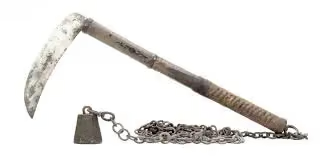
The kama is one of the most straightforward examples of a farming tool becoming a weapon. It is a short-handled sickle, used across East and Southeast Asia for harvesting rice and cutting grass. Its curved blade and compact size made it well-suited for field work. Those same qualities made it effective in close-quarters combat.
As a weapon, the kama was used for striking, hooking, and trapping. A skilled practitioner could use the inside curve of the blade to catch an opponent's wrist or weapon, controlling distance and creating openings. Military use brought some modifications, including an indent near the base of the blade that could lock an enemy weapon in place. But the tool itself needed no fundamental redesign to serve its new role.
The kama's evolution did not stop there. At some point, a weighted chain was attached to the handle, transforming it into the kusarigama. This combination weapon could swing the chain to entangle an opponent's arms or weapon at range, then close the distance and use the sickle for the finishing strike. It was an inventive solution that took an ordinary harvest tool and dramatically expanded its tactical range.
The Kunai: The Mason's Trowel
The kunai is probably the most recognizable ninja weapon in modern popular culture, largely due to its prominence in anime and video games. Its actual origins are considerably less dramatic. It was a masonry and gardening tool, used to dig, pry, and work soft materials like plaster and wood. The blade was made of soft iron and was typically left unsharpened along its edges, with only the tip honed to a point.
What made the kunai valuable as a weapon was not its cutting edge, which was modest, but its versatility. Because it had been a common tool, it could be carried openly without drawing attention. It could be thrown over short distances, used as a climbing aid when driven into wood or stone, or wielded as a close-quarters stabbing weapon. A rope attached through the ring at the pommel extended its utility further, allowing it to function as a retrieval line, an anchor, or a binding tool.
The kunai reflects something important about the shinobi's approach to weapons: a skilled practitioner could turn one simple object into a dozen different tools. The object mattered less than the knowledge of what to do with it.
.avif)
The Nunchaku: The Grain Thresher
The origin story of the nunchaku is more layered than it first appears, and it differs somewhat from the ninja narrative. The weapon is most closely associated with Okinawa rather than the Japanese mainland, and its martial development came from a specific historical circumstance.
In the 1470s, the Ryukyu Kingdom banned civilian ownership of swords. When the Satsuma clan from Japan invaded Okinawa in 1609, the weapons ban was expanded and enforced more strictly. This left a class of formerly trained warriors, now reduced to laboring roles, without access to their traditional arms. They turned instead to everyday implements: sickles, mill handles, horse bits, and threshing tools used to separate grain from straw.
The nunchaku is believed to derive from one of these threshing tools, two short sections of wood or bamboo connected by a cord or chain. As a weapon, it offered speed, unpredictability, and the ability to strike from multiple angles. It was also, to anyone watching, just a piece of farm equipment.
The same disarmament pressure that produced ninjutsu's characteristic weapons culture produced the kobudo weapons of Okinawa. Different geography, different political context, same underlying logic: when people in subordinate positions need to defend themselves, they adapt what they already have.
The Tekko-kagi: The Weeding Claw
The tekko-kagi, sometimes called hand claws or tiger claws, were agricultural implements before they were weapons. Used in various sizes for raking weeds, scooping hay, and working soil, they consisted of curved metal spikes mounted on a hand grip or band worn across the knuckles.
As a weapon, the tekko-kagi offered defensive and offensive capability simultaneously. The claws could block incoming sword strikes, potentially trapping or deflecting the blade. They could be used to slash, rake, or grapple in close combat. And like other tools in the shinobi arsenal, they could be worn without drawing immediate suspicion from anyone who assumed the wearer was heading to a field rather than a fight.
The Bo Staff: The Walking Stick
The bo staff stands somewhat apart from the other weapons here, because it was never really a specialized agricultural tool. It was simply a long wooden pole, present everywhere in the rural world because everyone needed one. Farmers used poles to carry loads across their shoulders. Travelers used them to walk. They were so ubiquitous as to be essentially invisible.
Shinobi trained with the staff not because it was a particularly covert weapon, but because the skill transferred. Learning to control range, timing, and leverage with a staff translated directly to the ability to use any long object, whether a broom handle, a fence rail, or an actual weapon picked up in the field. The staff was a training foundation as much as a weapon choice.
What Separates Ninja Weapons From Samurai Weapons?
The contrast between the weapons culture of the samurai and that of the shinobi reflects a deeper difference in how each operated.
Samurai were defined by their swords. The katana was a legal marker of status, a visible symbol of belonging to the warrior class. Samurai fought openly, within recognized codes of conduct, in roles that society sanctioned and celebrated. Their weapons were designed to project power and identity as much as to inflict damage.
Shinobi worked in the spaces that open conflict could not reach. Their effectiveness depended on not being identified as combatants at all. A weapon that announced itself was a liability. A sword strapped to the hip meant questions, checkpoints, and exposure. The shinobi needed tools that passed the first inspection, the moment when a guard or a local official looked at someone and decided whether they were a threat.
This is why there was never a signature ninja weapon in the way there was a signature samurai weapon. The whole point of the shinobi's approach was adaptability. You used what was available, what was appropriate to your cover, and what you had trained extensively enough to use well under pressure.
For a deeper look at how another martial tradition built its weapons culture around working-class tools and colonial resistance, the history of Eskrima offers a striking parallel. Read more: Eskrima: The Complete Guide to the Philippines' Ancient Martial Art.
Are These Weapons Still Trained With Today?
Several of the weapons that originated as farm tools have found lasting homes in formal martial arts practice.
The kama is trained in modern ninjutsu schools and in various kobudo systems, particularly those with Okinawan lineages. It appears in kata and in competitive kobudo demonstrations, where practitioners work through precise sequences that preserve the original techniques while developing timing and control.
The nunchaku, thanks in part to its prominence in popular culture, is one of the most widely practiced traditional weapons in the world. It appears in karate and kobudo curricula, in competitive forms, and in training systems focused on coordination and reaction speed.
The bo staff remains foundational across many martial arts traditions, from Japanese budo to Korean systems to Southeast Asian arts. Its principles inform weapon work at every level.
The kunai and tekko-kagi are trained in specialized ninjutsu schools and have found a secondary life as objects of collector and historical interest. They are less common in mainstream martial arts training, but still present in schools with a serious commitment to traditional weapons practice.
What unites all of these is the continuity of principle. The techniques developed for these tools, the angles, the entries, the transitions between range, remain instructive regardless of whether the weapon itself is ever used outside a training hall.
Were Ninja Actually Peasants? Addressing the Historical Debate
The image of the ninja as a common farmer who picked up a sickle and taught himself to fight is a useful shorthand, but it simplifies a more complicated reality.
The jizamurai class occupied a middle position in feudal Japan, not fully samurai, not purely peasant. Some shinobi came from families with genuine martial training passed down through generations. The Iga and Koga communities were not random collections of agricultural laborers who stumbled into covert warfare. They were organized, skilled, and recognized enough for their abilities that powerful warlords sought to hire them.
What is accurate is that they operated outside the privileged sword-bearing class. Their weapons choices reflect that reality. They could not rely on the tools of the samurai, and they could not afford the visibility that openly carrying those tools would have brought. The farm-tool origins of their weapons are not a myth, but they are the product of social constraint as much as agricultural identity.
The shinobi, as a historical figure, is most accurately understood as someone who existed in the margins of feudal Japanese society and turned that marginal position into a specific kind of power. Their weapons are an expression of that position. Every kama and every kunai carries the mark of people who worked within limits and found ways to exceed them.
Conclusion
The farm-tool origin of ninja weapons is not a footnote to the history of ninjutsu. It is the foundation of it.
The shinobi built an entire weapons system around the principle of concealment, adaptability, and function from whatever was at hand. They could not walk into a market as soldiers. So they walked in as farmers, and they knew what to do with what farmers carried.
That philosophy, train broadly, adapt to context, extract maximum function from minimum equipment, is as relevant to martial arts practice today as it was in 15th-century Iga Province. The tools have changed. The principle has not.
Mastery is not about the weapon you carry. It is about the knowledge you have developed and the discipline to apply it under pressure. The shinobi understood that. The farm tools they carried were proof of it.