

The Makiwara: Okinawa's Striking Post and Its Place in the Modern Dojo
Walk into most modern training facilities and you'll find heavy bags hanging in rows, foam targets mounted on walls, and free-standing dummies bolted to the floor. The makiwara is none of these things.
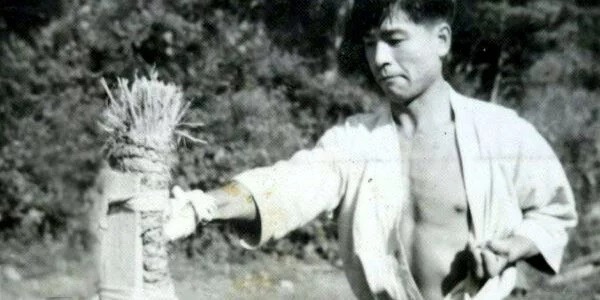
It's a tapered wooden post, traditionally driven into the ground and wrapped at the striking surface with rice straw. It doesn't swing. It doesn't fall over. It doesn't absorb your mistakes. It pushes back, harder the harder you hit it, and it tells you immediately when your structure is wrong.
Makiwara training is one of the oldest conditioning methods in Okinawan karate. But the story of this tool is not a story of replacement. Modern training gear didn't push the makiwara aside. The two developed alongside each other, each answering different questions about what it means to strike with intention. This article explores where the makiwara came from, what it develops that other tools cannot, and why serious traditional practitioners still return to it today.
What Is a Makiwara? Origins in Okinawan Karate
The Name and the Object
The word makiwara is formed from two Japanese characters: maki (to wrap or wind) and wara (straw). Translated directly, it means "wrapped straw." This describes the tool accurately. The makiwara is a padded striking post used as a training tool in various styles of traditional karate, thought to be uniquely Okinawan in origin, and one form of hojo undo, the method of supplementary conditioning used by Okinawan martial artists.
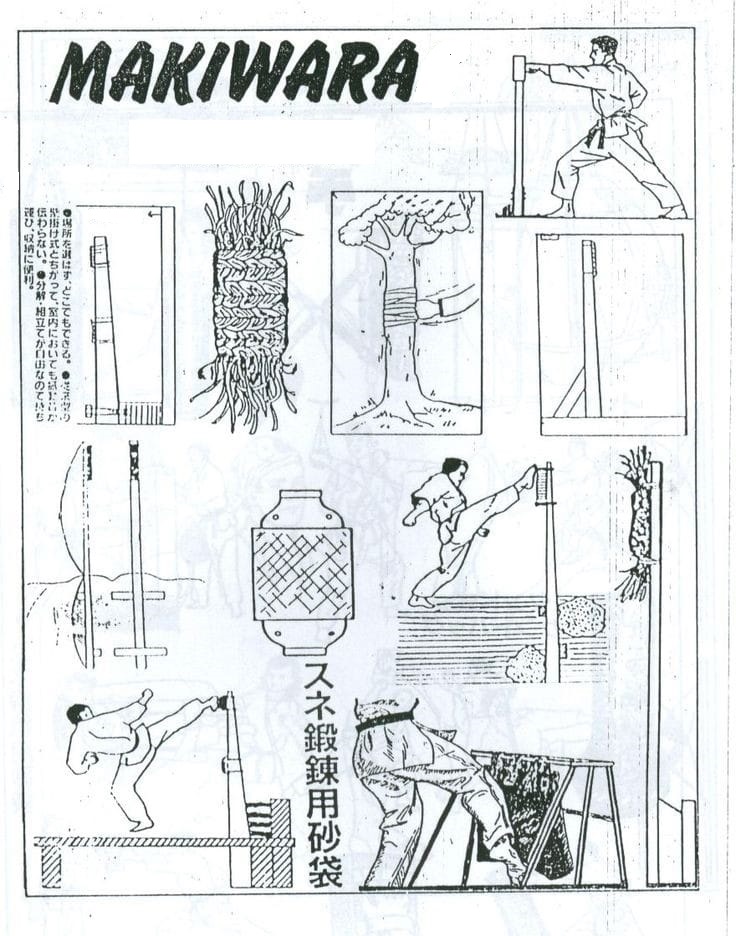
The most common traditional form is the tachi-makiwara: a single post, tapered from base to top, buried in the ground to approximately shoulder height. The post was traditionally padded at the top with rice straw bound with rope, creating the striking surface. Modern versions use leather pads, foam, or rubber over wood, often mounted to floors or walls with bolts.
A Tool Born from a Specific Context
Understanding the makiwara means understanding Okinawa's martial history. Okinawa was deeply influenced by trade and cultural exchange with Japan, China, and Southeast Asia. In 1609, after the Satsuma Domain invaded, weapon bans contributed to the refinement of empty-hand techniques, which continued to be trained in secret. Karateka trained without the public dojo culture that would come later, and tools like the makiwara were developed to condition the body for bare-knuckle striking against real resistance.
Until the early twentieth century, Okinawan masters trained in secret, spending years on each kata and training extensively on a makiwara board. Sparring as practiced today was not common. The makiwara was not a supplementary tool. For many practitioners, it was the primary method of developing striking power.
In 1908, master Anko Itosu wrote formally to the Okinawan Prefecture education department. In his proposed karate curriculum, Itosu wrote that hands and feet must be strengthened through makiwara use, emphasising low shoulders, open lungs, strong stance, and energy settled in the lower abdomen before each strike, recommending 100 to 200 repetitions per hand and foot.
For more on how Okinawan karate developed into its modern forms, see the distinct styles that emerged from this lineage.
What Does Makiwara Training Actually Develop?
Structure Before Power
The defining characteristic of a makiwara is not its hardness. It's its responsiveness. The two things that set a makiwara apart from all other striking tools are progressive resistance and the forceful spring back. Progressive resistance means the harder you hit or push it, the more resistance the makiwara offers. A heavy bag weighs the same whether you strike it softly or with full force. The makiwara scales with you.
This creates an immediate feedback loop around your structural alignment. When you strike a makiwara, it resists, and the harder you hit it, the harder it pushes back. Your wrist or elbow may buckle, your shoulder might be pushed back, or you may be rocked back on your heels. These are direct signals of what needs to improve in your striking form.
You can work a heavy bag with poor mechanics and still generate enough mass to make it move. The makiwara does not permit this. If your base is unstable, your wrist collapses, or your shoulder rotates forward prematurely, the tool tells you through resistance and discomfort. This is what traditional practitioners mean when they say the makiwara develops kime, the focus and penetrating quality of a strike.
The Spring Mechanic and What It Asks of You
A proper makiwara is essentially a wooden spring, functioning much like an automotive leaf spring. It provides constant pressure, and this constant pressure forces the practitioner to notice structural weaknesses that would otherwise go undetected.
The spring loading of the makiwara means there is constant force against your strike, which allows you to feel how stable your structure is at every moment. If your form breaks down, you feel it immediately. The way the makiwara springs back to straight is also useful for developing good punch retraction.
Traditional Okinawan makiwara practice is performed without gloves or wrist wraps. This is deliberate. The hands must learn to align correctly and to relax at the moment of impact. The makiwara teaches how to relax when striking, which is essential for optimal power generation, and provides progressive resistance that allows the practitioner to learn proper joint alignment and the correct sequencing of muscles across different strikes.
Did Modern Gear Replace the Makiwara?
When karate spread from Okinawa to mainland Japan in the early twentieth century, and later to the West through the post-World War II period and the martial arts boom of the 1960s and 70s, training culture shifted. Sport karate emphasised movement, combinations, and engagement at range. Heavy bags, focus mitts, and Thai pads answered those needs well. They allow combination work, timing development, footwork, and the simulation of a moving, responding target.
The only way to activate the deep muscles responsible for power striking is to hit against a resisting target. Traditionally in Okinawa, the makiwara played that role, but the punching bag is more convenient in modern training environments. The distinction is not one of quality. It's one of purpose.
Heavy bags are used with wrist wraps, gloves, and combination work. Makiwaras are used with no hand support at all, and very little combination work. The differences are deliberate choices that serve the karateka differently.
The heavy bag excels at developing timing, rhythm, and the feel of a moving target. The makiwara excels at developing structural integrity, alignment, and penetrating power from a stable base. Combination work is trained through kata. Power generation is developed at the post. Many traditional practitioners who have trained with both found that once a quality makiwara was available, it became the daily tool, with the heavy bag used for specific combination sessions.
If you're interested in how traditional Okinawan weapons training developed alongside empty-hand conditioning, the development of tools like the nunchaku reflects similar principles of disciplined solo practice. Explore how the nunchaku developed from agricultural roots into a refined martial tool.
.jpeg)
Is the Makiwara Still Relevant Today?
Yes, though its presence has become more selective.
Traditional Okinawan styles including Shorin-Ryu, Goju-Ryu, and Uechi-Ryu have maintained the makiwara as a core training tool. University karate clubs in Japan, particularly those aligned with traditional curricula, continue to use it. And there's a small but dedicated community of craftspeople building quality makiwara for home and dojo use, often citing difficulty in sourcing them from commercial suppliers.
The tool itself has evolved without losing its essential character. Modern makiwara use metal or concrete floor bases, leather pads, spring-loaded beginner versions, and portable designs that can be used without permanent installation. The mechanics remain the same. The spring, the resistance, the feedback.
The concern most practitioners raise about makiwara training is injury. Gichin Funakoshi warned specifically against approaching the makiwara with enthusiasm before technique is sound. Overtraining, using a post that is too stiff, or striking with poor alignment can damage the joints, particularly the knuckles and wrists. The tool is not forgiving of misuse. This is precisely why traditional instruction emphasises starting with light contact, progressing gradually, and building the 50 to 100 daily strikes per hand over weeks and months, not days.
The makiwara rewards patience. That's not a limitation. That's the point.
Should You Incorporate Makiwara Training?
If you train a traditional Okinawan or Japanese style, the makiwara should already be part of your practice. If your dojo doesn't have one, that's worth raising with your instructor. The tool is available in floor-mounted, wall-mounted, and portable versions, and building one is well within reach for a committed practitioner.
If you train for sport competition or MMA, the makiwara is not your primary tool. Bag work, pad work, and partner sparring will serve those goals better. But even in these contexts, spending time on a makiwara periodically can identify structural weaknesses in your striking that combination drills simply don't surface.
If you're a beginner, start with a softer version and supervised instruction. The goal in early makiwara training is not conditioning the skin or hardening the knuckles. It's learning to feel what a correctly aligned, properly delivered strike actually feels like under resistance. That education, once internalized, doesn't leave you.
The makiwara is a precise instrument. It asks an honest question with every contact: is your structure sound? Those who spend time with it regularly find that the question becomes harder to answer dishonestly.
Closing
The makiwara didn't disappear when modern training gear arrived. It receded from sport-focused gyms that had different questions to answer. In the dojo spaces where traditional karate still moves at its original pace, the post remains.
Its lesson is the same one it has always carried: power is not generated by aggression alone. It's built through alignment, patience, and the willingness to let honest feedback correct what effort alone cannot.
Mastery is not achieved in moments of applause. It is built in repetition, correction, and patience. The makiwara has always known this.