

What Calais's Monument to Thierry Jacob Says About Fame, Memory, and the Fighters We Choose to Remember
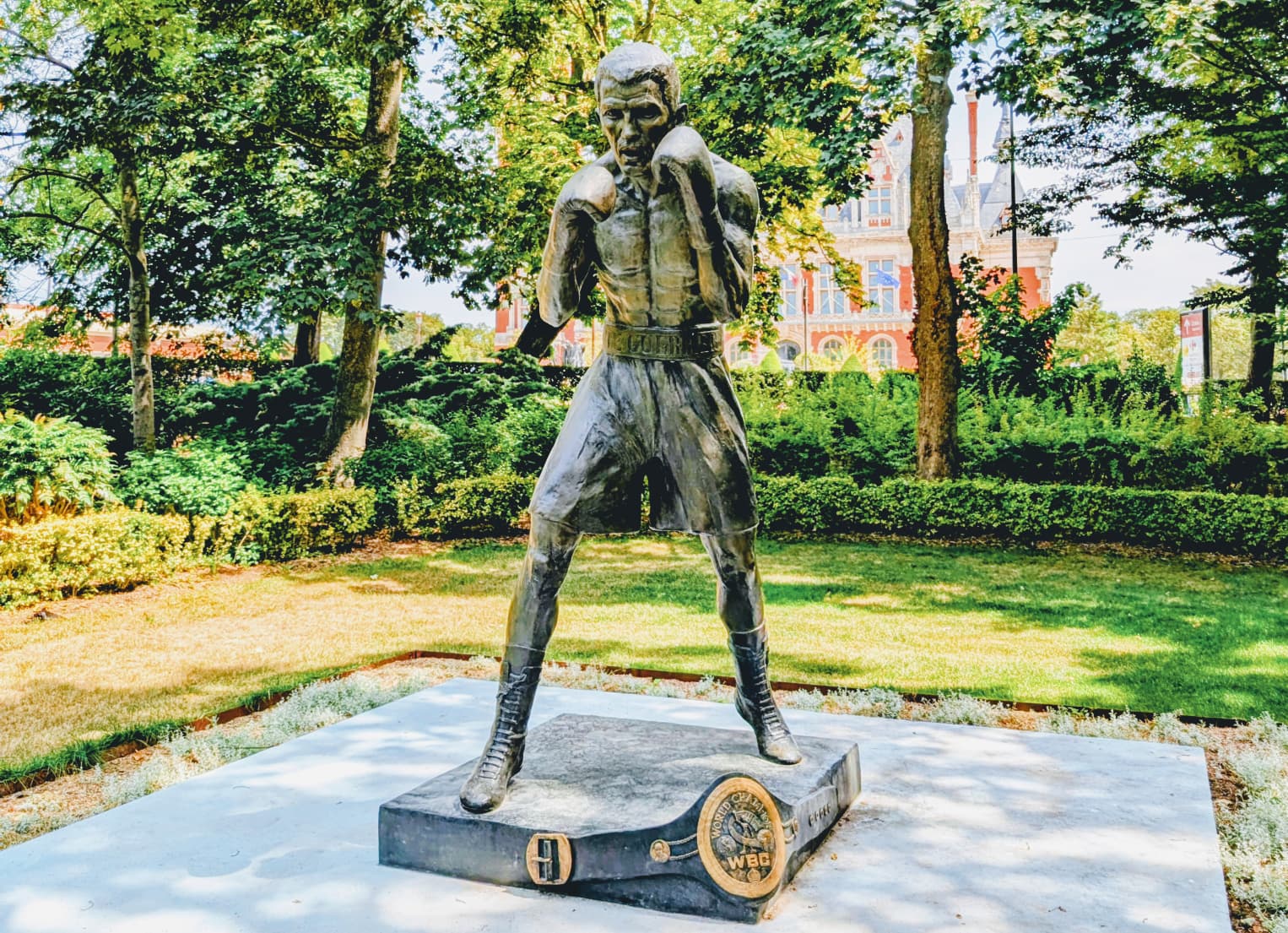
There is a bronze statue at the entrance to Parc Saint-Pierre in Calais, larger than life, showing a fighter mid-combat rather than mid-celebration. It is easy to walk past without knowing the name, and easier still to assume, given the scale of the tribute, that the man depicted was a global superstar of the sport. He was not. Thierry Jacob held a world title for exactly three months in 1992. Outside France, and outside boxing circles even within France, his name means little.
And yet Calais built him a monument in bronze, at a cost of 100,000 euros, unveiled in April 2026 in front of several hundred people who came specifically to see it. That gap, between the modest scale of Jacob's international fame and the permanence the city chose to give him, is worth sitting with. It says something about what a statue is actually for.
A Fighter Who Never Left Calais
Boxing runs in the Jacob family the way a trade runs in some families: passed down, practiced daily, treated as inheritance rather than choice. Thierry's father, Jacques Jacob, took over training at the ABC Calais boxing club, and his children grew up inside it. Thierry showed unusual aptitude early, entering amateur competition at 16 and winning a French championship the following year, at 17.
His professional record is solid without being extraordinary by world standards: 45 fights, 39 wins, 20 of them before the final bell. He won the French bantamweight title in 1987 and the European (EBU) title in 1990, successfully defending it in Calais before his moment came. On March 20, 1992, in his own city, Jacob defeated Mexican boxer Daniel Zaragoza to become World Boxing Council super bantamweight champion. He lost the belt three months later, in his first defense, stopped in the second round by American fighter Tracy Harris Patterson. He retired in 1994, at 29, and later became a trainer and manager alongside his brother, guiding the next generation of Jacobs, including his own sons, toward French and European titles of their own. He died in December 2024, at 59.
By the numbers, this is a respectable career, not a legendary one. World titles have been won and lost by hundreds of fighters whose names carry no weight beyond their own era. What makes Jacob's story worth telling is not the record. It is what the city did with it afterward.
The Company He Keeps: Carpentier and Cerdan
According to boxing journalist Jean-Philippe Lustyk, Jacob is only the third French boxer to be honored with a statue, following Georges Carpentier and Marcel Cerdan. Both names carry far more international weight than his, and the contrast is instructive.
Georges Carpentier, born in 1894 in Liévin, a mining town in the same Pas-de-Calais region as Jacob's Calais, became France's first world boxing champion in 1920 and fought Jack Dempsey in 1921 in front of boxing's first million-dollar gate. He was a war hero, a decorated aviator, and later an actor and music hall performer known across Europe and the United States as "the Orchid Man." His likeness was sculpted by Paul Landowski, the same artist who later created Christ the Redeemer in Rio de Janeiro. Landowski's piece, titled Le Pugiliste, depicted Carpentier nude, caused controversy at the 1920 Salon des Artistes Français, and went on to win a gold medal in the art competitions held alongside the 1928 Amsterdam Olympics. It is a remarkable piece of sporting art history, but it does not stand in a public square. It lives in a museum, the Musée des Années 30 in Boulogne-Billancourt, a gallery dedicated to Landowski's work.
Marcel Cerdan's fame needs even less introduction. Born in 1916 in Sidi Bel Abbès, Algeria, and raised in Casablanca, Morocco, he became world middleweight champion in 1948 with a dominant win over Tony Zale, part of a career that saw him lose only four of 123 fights. He was romantically linked to Édith Piaf, and his death in a transatlantic plane crash in October 1949, en route to a rematch in New York, turned him into something closer to national tragedy than sports story. Cerdan is remembered in two places: a bronze bust in Levallois-Perret, near Paris, where he trained, unveiled in 2003, and a striking oversized boxing glove marking his grave in Perpignan, where visitors still stop regularly, decades later.
Set against Carpentier's museum piece and Cerdan's split memorials, spanning a training ground and a graveyard hundreds of kilometers apart, Jacob's statue is different in a specific way. It stands in the open, in the public park, in the one city where his entire story took place. He never fought his way onto the world stage the way Carpentier and Cerdan did. He brought the world stage to Calais instead, for one night, and the city has chosen to remember him standing exactly where that happened.
Why Small Cities Build Statues to Local Fighters
There is a documented pattern in how public sporting statues get commissioned, and it is not really about fame at all. Researchers who study sports statuary have noted that these monuments tend to appear less often in major capitals than in smaller towns, and particularly in towns that have lost the industry that once defined them. Ashington, a former coal mining town in Northumberland, England, put up a statue of footballer Jackie Milburn after its mines closed. Stoke-on-Trent, whose pottery industry declined sharply through the twentieth century, has one of Stanley Matthews. In both cases, the statue was not really a tribute to athletic greatness measured against the world. It was a way for a city that had lost its defining industry to reclaim an identity through the person who, for a while, made the rest of the country pay attention.
Calais fits this pattern closely. It is a port city, historically defined by fishing, lace-making, and cross-Channel trade, all of which have faced real pressure in recent decades. A statue of a world champion does something specific for a place like this: it says the city produced something, and someone, that mattered beyond its own borders, even briefly. It does not need Jacob to have been the greatest bantamweight of his era. It needs him to have been unmistakably, permanently Calais's.
A Night Under a Tent at Fort Nieulay
The specifics of Jacob's title fight make the case better than any general argument could. He did not win his world title in a purpose-built arena in Las Vegas or Madison Square Garden. He won it at Fort Nieulay, a historic fortification on the edge of Calais, under a tent, in front of 5,500 spectators who packed in to watch a local fighter challenge for a world title on home ground. Regional radio carried the fight live. People who had watched Jacob grow up in the sport were in the crowd.
Sculpting a Fighter Without a Photograph
The statue itself came from an unusual constraint. Sculptor Élisabeth Cibot, who had previously created Calais's monument to Charles de Gaulle, took on the Jacob commission without access to usable photographs of him in his fighting prime. Rather than working from stills, she reconstructed his stance and movement from archival video footage, spending long hours studying how he actually moved in the ring before translating that motion into bronze. The result deliberately shows Jacob in the intensity of combat rather than the relief of victory, a choice the city said was made specifically for its expressive clarity.
It is a reminder that a monument like this is not simply a copy of a photograph enlarged and cast in metal. It is an interpretation, built from motion rather than a single frozen instant, of what a fighter actually looked like when the stakes were real.
What Earns a Permanent Place
None of this required Jacob to have been a legend of the sport in any global sense. Carpentier and Cerdan earned their places in bronze and museum collections through fame that reached far beyond France. Jacob earned his through something smaller and, in its own way, harder to manufacture: a city's decision, generations after the fact, that what he gave it mattered enough to stand in the open air, permanently, where anyone walking through the park might stop and ask who he was.
That is worth remembering the next time a statue seems disproportionate to a record. The bronze is rarely measuring the fighter against the world. More often, it is measuring how much of himself he left behind in one particular place.
Calais Today: A City Defined by Crossing
Calais has always been a city built around passage rather than permanence, and that is still true today. Its population sits around 64,000 to 68,000, down from roughly 75,000 two decades ago, a steady decline that mirrors what has happened across much of the old industrial north of France. The Port of Calais remains France's busiest passenger port and accounts for more than a third of the town's economic activity, moving millions of ferry passengers and a large volume of freight across the Strait of Dover each year, at its narrowest point just 34 kilometers from the White Cliffs of Dover. Since 1994, it has shared that role with the Channel Tunnel, whose operator has become one of the region's largest employers.
Lace-making, once the trade that defined Calais internationally, still exists but on a much smaller scale than in its heyday. Metalworking, food processing, and chemical manufacturing have filled some of the gap. Calais is also, in recent decades, a name associated with something heavier: since the late 1990s, the city and its surroundings have periodically hosted large informal camps of migrants and asylum seekers attempting to cross to the United Kingdom, a situation that has drawn international attention and strained relations between France and Britain. It is part of the city's contemporary reality, and it exists alongside, not instead of, the working port town that Jacob grew up in.
This is also, notably, a city that already carries one of the world's most recognized public monuments. Auguste Rodin's The Burghers of Calais, depicting six townsmen who volunteered to be executed to save the city during the Hundred Years' War siege of 1346 to 1347, has stood in Calais since 1895. It is a monument about collective sacrifice under siege, cast in the same bronze tradition Jacob's statue now belongs to, a few streets away and roughly 130 years apart.
Continue reading: France's Olympic boxing history