

What a City's Gyms Say About Its Soul
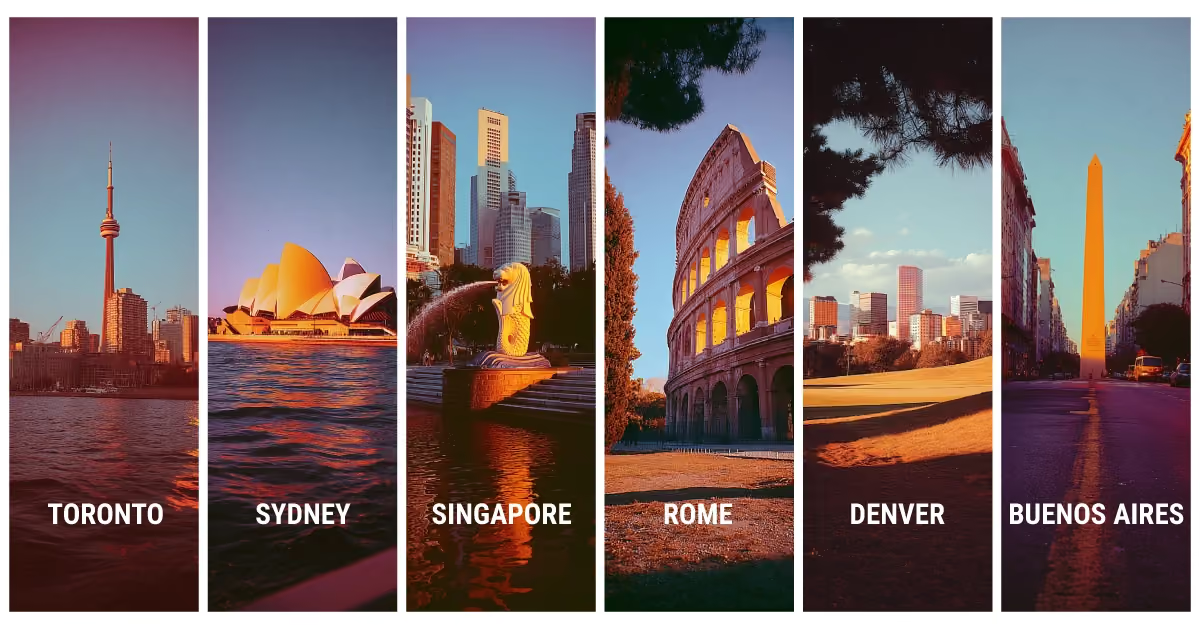
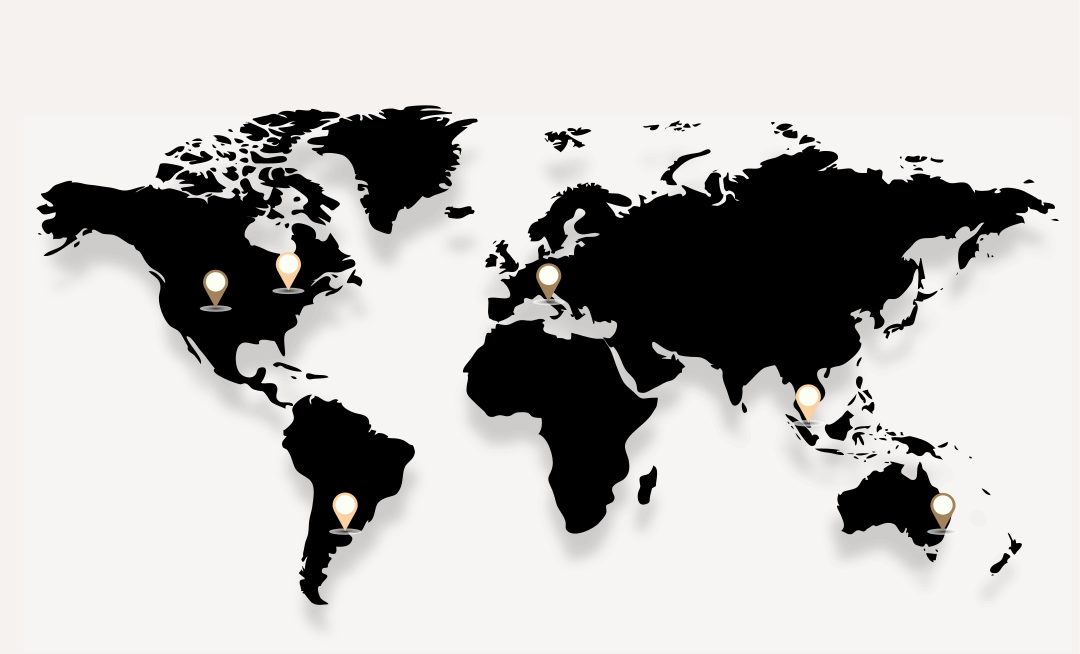
Six cities. Four continents. 2,909 dojos, academies, and fight clubs. One question.
Walk into a martial arts gym and you will know something about the city it lives in. Not from the sign above the door. Not from the style on the wall. From the people on the floor — who they are, where they came from, what they decided was worth learning.
That idea drove the World Dojo Index. We wanted to know whether you could read a city's identity through its gyms. Whether the data would tell a story that matched what you already sensed about those places — or surprise you entirely.
We analyzed 2,909 martial arts gyms and dojos across six cities on four continents. Toronto, Sydney, Singapore, Rome, Denver, and Buenos Aires. We looked at what disciplines they teach, how often those arts appear, which ones pair together, which ones are nearly absent. We looked at where immigrant communities left their fingerprints. Where the old world held its ground. Where the combat sports revolution arrived in full force, and where it barely knocked on the door.
What we found was not a ranking. There is no better city, no superior martial arts culture. What we found were portraits. Six different cities wearing their histories on their mats.
A note on our data: We have made every effort to collect and analyze this information accurately. Gym listings were gathered programmatically and processed individually to identify the disciplines taught at each location. Some venues may have been missed, some disciplines may have been misidentified, and listings change over time. We present these findings as a meaningful, directionally accurate portrait — not an error-free census. If you train somewhere we missed, we would genuinely like to know.
Toronto — The City That Never Picked a Side
Boxing leads in Toronto. Not Muay Thai, not BJJ, not Karate. Boxing — the oldest combat sport in the English-speaking world, the art of the working class, the discipline with deep roots in the city's immigrant neighbourhoods and its amateur athletic culture. Ninety-six gyms. More than any other discipline, in a city of nearly three million people.
What follows boxing in Toronto's rankings is where it gets interesting. BJJ at 78. Karate at 72. Muay Thai and MMA closely behind. The gaps between them are narrow. Toronto is not a city that chose one tradition and committed to it. It is a city where dozens of traditions arrived from dozens of places, found commercial space, and quietly coexisted.
Toronto is the most hybrid martial arts city in this study. It has the lowest ratio of single-discipline gyms — meaning its schools are the most likely to combine arts under one roof, to blur the lines between traditions.
The immigrant community signals are visible throughout. The Japanese community's presence — Karate, Judo, Aikido combined — forms the largest cultural martial arts bloc in the city. The Korean community built forty-eight Taekwondo schools. The Chinese community sustains Kung Fu, Wing Chun, and Tai Chi across dozens of locations. The Brazilian community drove BJJ into the city's top three. The Filipino community, despite its size, remains underrepresented — a gap we will return to.
What Toronto does not have is a dominant voice. No single art, no single community, no single tradition speaks louder than the others. In a city that often describes itself as a mosaic rather than a melting pot, the gym landscape reflects that honestly.
The most popular combination of arts in Toronto is Kickboxing and Muay Thai — 33 gyms teach both. That pairing is a marker of the MMA era, the post-UFC world in which striking arts found new commercial life as training partners to grappling. Toronto absorbed that wave without abandoning what came before it. The old schools and the new gyms share the same postcodes.
Sydney — Where Grappling Leads and Everything Connects Through Kickboxing
Sydney surprised us. Of all six cities, it has the highest density of martial arts gyms per capita — one gym for every 4,237 residents. It is also the only city in the study where BJJ leads the rankings outright, ahead of Karate, ahead of Boxing, ahead of everything else.
Australian combat sports culture runs deep. The country has produced world-class boxers, MMA champions, and BJJ competitors. It has a physical, outdoor, contact-sport identity that creates natural demand for martial arts training. But the scale of Sydney's gym ecosystem — 956 schools with identified disciplines across a population of 5.3 million — still stands out.
Sydney treats Kickboxing the way other cities treat MMA — as the universal connector. It appears in seven of the city's top ten discipline combinations. No other city in this study shows anything like it.
The Kickboxing signature is Sydney's most distinctive data point. In Toronto, BJJ serves as the connective tissue between arts. In Denver, it is MMA. In Sydney, Kickboxing is the discipline that bridges everything — it pairs with BJJ, with Boxing, with Muay Thai, with Karate, with MMA, with Taekwondo. Gyms in Sydney use Kickboxing as the common language between traditions, a curriculum anchor that makes other arts accessible.
The traditional arts presence in Sydney is also significant. Karate at 226 gyms is the highest absolute count of any traditional art in any city in this study. The Japanese community's influence on Australian martial arts culture goes back decades — Karate arrived in Australia in the 1950s and 1960s and built an institutional foundation that has not eroded. Today it sits alongside BJJ and Boxing in Sydney's top three, a traditional art holding its ground in a deeply combat-sports-oriented city.
The Brazilian cultural imprint on Sydney's BJJ numbers is real, but it does not explain them entirely. BJJ's adoption in Sydney, as in Toronto and Denver, has largely decoupled from Brazilian immigration. The art spread because it works — because it became the technical foundation of MMA training globally, and because gyms followed demand rather than diaspora. Sydney took to it with particular enthusiasm.
Singapore — One Discipline, One Community, One Unmistakable Signal
The first thing the Singapore data tells you is that Taekwondo leads. By a significant margin. One hundred and fourteen gyms. The second-place discipline, Muay Thai, has fifty-four. The gap is not close.
The second thing it tells you is why.
Singapore has one of the largest Korean communities in Southeast Asia, shaped by decades of Korean corporate investment, educational presence, and cultural influence in the city-state. The Korean community's relationship with Taekwondo is not casual — it is institutional. Schools, academies, community programs, and commercial clubs have collectively built a martial arts infrastructure around a single discipline that dwarfs everything else in a city of 5.9 million people.
Taekwondo's dominance in Singapore is the single clearest immigrant community signal in this entire study. No other art tracks a single diaspora community so directly across so many cities.
What makes Singapore particularly interesting is the contrast between that dominance and the city's overall density. At 6.2 martial arts gyms per 100,000 people, Singapore is the least dense market in this study — lower than Denver, lower than Rome, lower than every other city we analyzed. For one of the wealthiest and most urbanised city-states in the world, that is a striking number.
The likely explanation is structural. Singapore's martial arts culture is not primarily a commercial gym culture. Community centres, schools, and government-affiliated sports clubs absorb much of the demand that in other cities would flow into standalone commercial gyms. The data we collected reflects the commercial surface; the full practice is larger and less visible.
Below Taekwondo, Singapore's combination patterns reveal a city with a healthy combat sports minority operating alongside the dominant traditional sector. Boxing and Muay Thai is the leading pairing — a Southeast Asian pattern that reflects geographic and cultural proximity to Thailand. BJJ, MMA, and Wrestling all appear in the top ten combinations. There is a functional MMA gym culture in Singapore; it simply exists in the shadow of something much larger.
Silat's presence at twelve gyms is the highest count of any city in this study — a quiet but meaningful marker of Singapore's Malay community and its connections to the Indonesian archipelago. It is a reminder that even in a city shaped by one dominant signal, other traditions find their place.
Rome — A City That Did Not Get the Memo
Rome is the outlier. In every other city in this study, the combat sports revolution of the past twenty-five years left a visible mark on the gym landscape. The UFC changed how people thought about martial arts training. BJJ became a global discipline. Muay Thai moved from a regional tradition to a worldwide curriculum staple. MMA gyms appeared in cities that had never seen anything like them.
Rome received all of this. And then filed it under secondary.
The five most popular disciplines in Rome are Karate, Kung Fu, Boxing, Aikido, and Tai Chi. In that order. The entire top five consists of traditional arts — a pattern that does not appear in any other city in this study. BJJ sits at twenty-seven gyms. Muay Thai at nineteen. These are not small numbers in isolation, but in a city of 2.87 million people, they represent a martial arts culture that has not yet made combat sports its primary language.
Rome is the only city where the leading combination of arts is Kung Fu and Tai Chi — Chinese internal arts clustering together in schools that teach both as a unified curriculum.
The Chinese community's influence on Rome's gym landscape is deep. Kung Fu at 67 gyms, Tai Chi at 52, Wing Chun at 30 — the last figure is the highest Wing Chun count of any city in this study. Rome's Chinese community has been present for generations, long enough to build institutions, long enough for those institutions to outlast the trends that came and went around them.
The Japanese martial arts — Karate leading at 85, Judo at 40, Aikido at 57 — tell a different story. These arts arrived in Italy in the post-war decades and were adopted by Italian practitioners who had no Japanese lineage. The tradition was absorbed into Italian sports culture and held there. Aikido's ranking at fourth overall is unique to Rome; no other city in this study places it that high. It speaks to a particular institutional commitment that developed over decades and proved durable.
Capoeira at seventeen gyms deserves a mention. For a European city, that is a meaningful number — a sign of Brazilian cultural presence that expressed itself through Capoeira rather than BJJ. The arts of a diaspora do not always follow the same paths.
Rome is not a city that resisted the combat sports era. It is a city where the traditional arts establishment was simply strong enough, and established enough, to absorb the new arrivals without ceding the top of the rankings. The path here was already well-worn before the UFC existed.
Denver — Compact, Grappling-Forward, and Missing Its Own Wrestling Tradition
Denver is the smallest city in this study by population — 715,000 people in the city proper — and the data reflects that scale. Ninety-one gyms with identified disciplines. Enough to see the shape of the market clearly, not enough to read every nuance within it.
What the shape shows is a city with a genuine MMA-era identity. BJJ leads at twenty-two gyms. The top combinations — BJJ and Muay Thai, Kickboxing and Muay Thai, BJJ and Kickboxing — are the pairings of a combat sports culture. The gym landscape is multi-discipline, hybrid, oriented toward the kind of training that became mainstream in the wake of the UFC's growth.
The Easton Training Center chain carries significant weight in Denver's BJJ numbers. A well-regarded academy with multiple locations, it accounts for a meaningful portion of the top ranking. Remove those locations and the field tightens. But the pattern holds — Denver leans toward grappling.
Colorado is one of America's premier wrestling states at high school and collegiate level. Denver has two commercial wrestling gyms. That gap is the most counterintuitive finding in the Denver data.
The wrestling absence deserves to sit with you for a moment. Colorado produces some of the strongest high school and college wrestlers in the United States. The sport is embedded in the state's athletic identity. And yet, as a commercial gym discipline — the kind of place you walk into off the street and pay to train — it is essentially invisible in Denver. Two gyms.
This is not unique to Denver. Wrestling is underrepresented in commercial gym data across every city in this study. The sport thrives in institutional settings — schools, universities, clubs with membership structures — that do not appear in the kind of listings we analyzed. The commercial gym model has not taken hold for wrestling the way it has for BJJ or Muay Thai, and Denver's data illustrates that gap with particular clarity because the contrast with its own wrestling tradition is so sharp.
The Latino community's influence on Denver's boxing numbers is real. Boxing at fourteen gyms, with deep roots in the city's Mexican-American neighbourhood culture, reflects a sporting tradition that predates the MMA era and will likely outlast whatever comes next. Capoeira at four gyms is disproportionately high for a city of this size — a signal worth noting, even if the dataset is too small to draw firm conclusions from it.
Buenos Aires — The Korean Heart of a Latin American Giant
Argentina is a BJJ nation. It has produced world champions. Its academies have exported talent internationally. The country's relationship with grappling runs through communities, competitions, and a practitioner culture that is real and active.
And yet in Buenos Aires, BJJ ranks seventh.
Taekwondo leads at 123 gyms — the highest absolute count of any single discipline in any city in this entire study. Karate follows at 75. Kung Fu at 56. Boxing at 55. MMA and Tai Chi are virtually tied in fifth and sixth place. BJJ comes next, at 45 gyms, in a city of 3.1 million people.
Buenos Aires has the highest single-discipline ratio in this study — 87% of its gyms operate as focused, single-art schools. It is a city of specialists, not hybrids.
The Korean community in Argentina is one of the largest in Latin America. Its presence in Buenos Aires goes back decades, shaped by successive waves of immigration and a community that invested heavily in cultural institutions. Taekwondo was one of those institutions. One hundred and twenty-three commercial gyms is not an accident. It is the result of a community that treated martial arts as something worth building infrastructure around.
The Chinese community's influence is equally visible. Kung Fu, Tai Chi, Qi Gong, and Wing Chun — combined, over 139 gyms. The top combination of arts in Buenos Aires is Qi Gong and Tai Chi, at eighteen gyms. That is a pairing you do not see leading any other city in this study. Buenos Aires's Chinese community has sustained internal arts schools long enough for them to become fixtures of the city's martial arts landscape.
The Japanese community's presence flows through Karate, Aikido, and Kobudo. The Karate-Kobudo pairing at ten gyms reflects a traditional Japanese weapons curriculum that is largely absent from other cities — evidence of schools that maintained the full syllabus rather than trimming it for commercial appeal.
And then there is the BJJ question. Forty-five gyms in a country that is globally recognised for its grappling culture. The answer is probably structural. Argentine BJJ training happens in academies, clubs, and informal settings that do not show up as commercial listings the way a Taekwondo school or a Karate dojo does. The culture is real. The commercial footprint is smaller than the reputation would suggest.
Buenos Aires is a city where immigration wrote the gym landscape more clearly than in almost any other city we studied. Every tier of the rankings carries a community's signature.
What All Six Cities Have in Common
Across four continents and six very different cities, several patterns appeared consistently enough to be worth naming.
Taekwondo follows the Korean community everywhere
No other discipline tracks a single diaspora as consistently as Taekwondo tracks Korean communities. It leads in Singapore. It leads in Buenos Aires. It is top-six in every other city in this study. The Korean community invested in Taekwondo as a commercial and cultural vehicle, and that investment produced results at a global scale that no other martial arts community has matched.
Wrestling is the invisible discipline
Across all six cities, wrestling is dramatically underrepresented in commercial gym data. Denver, despite being in one of America's premier wrestling states. Rome, despite ancient traditions that predate the discipline's modern form. Buenos Aires, despite a Lucha Libre cultural tradition. The sport lives in schools, universities, and clubs — institutional settings that do not appear in the listings we analyzed. The commercial gym model has not found wrestling, and wrestling has not found the commercial gym model.
BJJ globalised without its community
Unlike Taekwondo, BJJ's spread did not follow Brazilian immigration. Sydney leads the world in BJJ gym density by this study's measure, despite a modest Brazilian community. Toronto's numbers are high. Denver's are present. The art spread because it proved itself in competition, because it became the technical foundation of MMA training, and because commercial gyms followed demand. Buenos Aires — geographically closest to Brazil — has lower BJJ penetration than cities on the other side of the world. The art moved on its own terms.
Filipino martial arts remain commercially invisible
Toronto, Sydney, Singapore, and Buenos Aires all have significant Filipino communities. In every city, Arnis, Kali, and Escrima register at one or two gyms. The arts are practiced — they are taught in self-defence contexts, in law enforcement training, in community settings — but they have not made the transition into the commercial gym model that Taekwondo and Karate and BJJ have made. That gap is consistent enough across enough cities to suggest it reflects something structural rather than something accidental.
Traditional arts are more resilient than the combat sports era suggested
The rise of MMA and the global spread of BJJ were widely understood to be reshaping martial arts culture. And they did reshape it. But Karate, Judo, Aikido, Kung Fu, and Tai Chi did not disappear. In Rome they dominate. In Buenos Aires they hold the top of the rankings. In Tokyo — a city we will study next — the expectation is they would be overwhelming. Even in combat-sports-forward cities like Sydney and Toronto, the traditional arts have maintained strong institutional presence. The dojo did not lose to the gym. They found ways to coexist.
The Path Continues
This is the first iteration of the World Dojo Index. Six cities. One methodology. Enough data to see patterns and enough gaps to know the picture is incomplete.
The study will grow. Cities will be added. The comparison will deepen. Buenos Aires will return with data from a more thorough scrape. Cities we have not yet visited — Tokyo, London, Lagos, São Paulo — will each bring their own portrait.
But even at six cities, something is clear. The gym is not just a place to train. It is an institution. It carries lineage. It reflects who moved somewhere, what they decided was worth teaching their children, what found commercial viability and what stayed underground. The martial arts landscape of a city is one of the most honest maps of its cultural history that you can draw.
Every white space in this data is an invitation. Every underrepresented discipline is a story waiting to surface commercially, or a tradition surviving quietly in forms that data cannot yet reach.
We will keep looking. We hope you will tell us what we missed.