

Compression Wear for Martial Artists: What the Science Actually Says About Performance, Recovery, and Protection

Compression wear has migrated from hospital wards to MMA mats in less than two decades. What began as a medical intervention for patients with circulatory issues is now standard equipment in gyms and dojos around the world. Walk into any no-gi class, kickboxing session, or strength training room and you'll see compression shorts, tights, and rash guards worn as casually as hand wraps.
But how much of the claimed benefit is real? Compression wear for martial arts carries a reputation built partly on science, partly on marketing, and partly on that feeling you get when everything fits right and stays in place. This guide examines what current research supports, where the evidence falls short, and what actually matters when selecting compression gear for combat sports training.
How Compression Garments Work
The underlying mechanism is mechanical. Compression garments apply graduated pressure to the skin, underlying soft tissue, and blood vessels. This external pressure interacts with the body's circulatory system in measurable ways — though the magnitude and practical significance of those interactions is where things get complicated.
The original medical application targeted venous insufficiency. Graduated compression, tighter at the extremities and decreasing as it moves toward the heart, assists the veins in returning blood more efficiently. A 2023 systematic review and meta-analysis published in Sports Medicine confirmed that sports compression garments enhance overall venous blood flow at rest and during physical activity in healthy athletes.
A separate study on elite junior basketball players found that full-length compression tights were the most effective garment type for improving markers of venous return and muscle blood flow, likely because they cover a larger body surface area than shorts or socks alone. For martial artists who train with high-volume lower body movement — kicking, sprawling, shooting for takedowns — this has practical relevance.
Does Compression Wear Improve Athletic Performance?
This is where honesty matters more than marketing.
The most comprehensive review to date, a 2022 scoping review in Sports Medicine covering 183 studies, found that the majority of research reported no ergogenic effect of compression garments on jump height, sprint speed, agility, time trial performance, or strength output. The evidence for direct performance enhancement during exercise is, at best, inconsistent.
However, a 2023 meta-analysis examining 42 studies did find statistically significant improvements in speed, endurance, and functional motor performance when compression was worn during activity — particularly among moderately trained adults rather than elite athletes.
A 2024 study on balance, sprinting, and change-of-direction tasks found a small but significant improvement in change-of-direction speed with compression tights. For combat sports practitioners, where the ability to shift direction rapidly under load defines much of the competitive landscape, even marginal gains in agility deserve attention.
The critical takeaway: compression garments have not been shown to hurt performance in any study. At worst, they're neutral. At best, they provide a small, measurable benefit in specific movement patterns. Combined with the other advantages outlined below, the risk-to-reward equation favours wearing them.
Where the Science Gets Stronger — Recovery and Delayed Onset Muscle Soreness
If the performance research is mixed, the recovery data is considerably more consistent.
A 2017 meta-analysis published in Sports Medicine, pooling data from 23 studies, found that compression garments enhanced strength recovery between 2 to 8 hours and again beyond 24 hours post-exercise. The benefits were most pronounced following resistance exercise, which is directly relevant to the conditioning demands placed on martial artists who incorporate strength and conditioning into their weekly training.
A more recent 2025 meta-analysis of 27 studies confirmed significant restorative effects on both muscle strength and power following exercise-induced fatigue. The benefits were evident at rest intervals of 1–24 hours for lower limbs, making compression garments a practical tool for fighters training multiple sessions per day or competing across consecutive days.
The mechanisms behind these effects include reduced muscle oscillation during movement, improved venous return that promotes metabolic waste clearance, and limited space for post-exercise swelling to develop. A controlled study on eccentric exercise found that participants wearing compression garments reported lower muscle soreness and faster recovery of maximal isometric strength compared to controls.
Importantly, a 2022 study published in Scientific Reports demonstrated that compression-induced recovery benefits coincided with measurable increases in blood flow — and were not explained by the placebo effect. This is a meaningful distinction in a field where subjective perception often clouds objective assessment.
The practical implication for martial artists is straightforward: wearing compression gear after training — not only during — appears to be the higher-value application. Keeping compression shorts or tights on for one to four hours post-session aligns with the timeframes where the strongest recovery effects have been observed.
Proprioception — The Underrated Benefit for Fighters
Beyond circulation and recovery, there's a less-discussed mechanism that may carry particular weight for martial artists: proprioception.
Proprioception is the body's awareness of its own position in space. It's what allows a wrestler to feel a shift in an opponent's weight distribution before seeing it, or a striker to adjust mid-combination without conscious thought. Compression garments interact with cutaneous mechanoreceptors — the sensory receptors in your skin — and this interaction appears to enhance proprioceptive feedback.
A 2024 meta-analysis published in the Annals of the New York Academy of Sciences, which included 27 studies and 671 participants, found that wearing compression garments significantly reduced absolute error during joint position sensing. In practical terms, this means athletes wearing compression demonstrated better accuracy in detecting and reproducing joint positions.
Research from the Journal of Neurophysiology offered a potential explanation: compression may function as a sensory filter, reducing irrelevant mechanoreceptor noise and allowing the nervous system to obtain higher-quality proprioceptive information. Reaching accuracy improved when participants wore compression sleeves in that study, and the effect was consistent regardless of limb position.
For martial artists, this has direct relevance. Improved joint position sense contributes to balance, reactive movement, and the kind of body awareness that separates a controlled technique from a sloppy one. Whether you're defending a takedown, throwing a hook, or recovering from a sweep, the quality of your proprioceptive feedback influences the outcome. This is closely related to the broader role that wearable technology plays in modern combat sports training — using tools that enhance the information your body processes, not just the effort it produces.
Skin Protection and Hygiene in Grappling Sports
For practitioners of BJJ, wrestling, judo, and MMA, compression garments serve a function that no amount of performance data can override: they reduce direct skin-to-skin contact.
Skin infections are among the most common health concerns in grappling sports. Ringworm, staph, herpes gladiatorum, and impetigo thrive in the warm, moist environments created by close contact training. The primary transmission pathway is direct skin-to-skin contact, followed by contact with contaminated surfaces like mats and shared equipment.
Compression tights, spats, and rash guards create a physical barrier that limits pathogen transfer between training partners. This doesn't replace proper hygiene practices — showering immediately after training, washing gear after every session, keeping cuts and abrasions covered — but it adds an important layer of protection. In grappling environments where you're spending extended periods in close physical contact with multiple partners, that barrier matters.
Many academies now require or strongly recommend compression layers for no-gi training for exactly this reason. It's a community responsibility as much as an individual one.
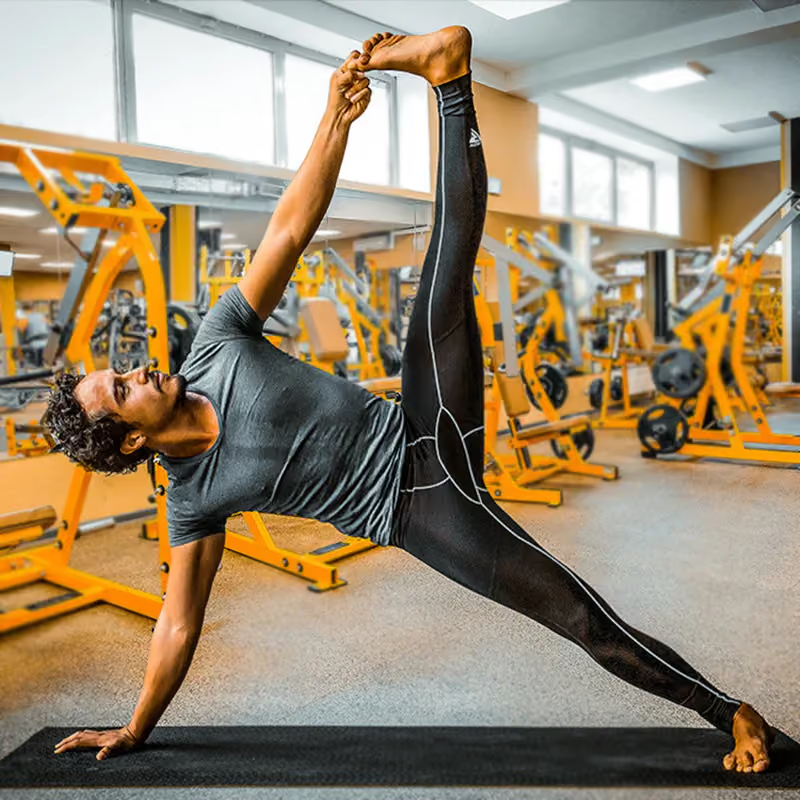
What to Look for in Compression Gear for Combat Sports
Not all compression garments are designed with combat sports in mind. The demands placed on gear during grappling, striking, and ground work differ significantly from running or cycling. Here's what matters.
Fit and sizing. Compression should feel snug — like a second skin — without restricting movement or digging into joints. Sizing directly influences the pressure applied, and incorrect sizing can reduce or negate the garment's benefits. Take measurements rather than guessing, and consult the brand's size chart.
Material composition. A polyester-spandex or polyester-lycra blend offers the best combination of durability, stretch, and moisture management. Look for fabrics with four-way stretch and moisture-wicking properties that pull sweat away from the skin.
Construction. Flat-lock stitching is non-negotiable for grappling applications. Traditional raised seams cause chafing during the friction-heavy movements of ground work. Flat-lock seams sit flush against the skin and hold up under repeated stress.
Functional features. Expansion panels in the groin and thigh areas improve range of motion for high kicks and hip escapes. Pelvic compression zones keep the garment in place during explosive movement. Some models include integrated groin cup pockets for striking and sparring — a feature worth considering if you train multiple disciplines.
Can You Wear Compression Gear Under a Gi?
Yes, and many practitioners do. Wearing compression shorts or tights under gi pants is common practice, primarily for hygiene and skin protection. The additional layer reduces direct contact with training partners and keeps the gi fabric from irritating the skin during extended sessions.
Check your gym's rules and, if you compete, review the relevant competition ruleset. Most organizations permit compression layers under the gi provided they don't extend past the gi's sleeves or pant legs and don't carry additional grips or textures that could affect grappling exchanges.
Should You Wear Compression During or After Training?
Both have value, but for different reasons.
During training, compression garments primarily serve comfort, skin protection, and the proprioceptive benefits discussed above. The direct performance effects during activity are modest and variable based on the type of movement.
After training is where the strongest evidence sits. The recovery research consistently points to wearing compression for one to several hours post-exercise as the period where measurable benefits to strength restoration, power recovery, and perceived soreness are most pronounced. For martial artists who train in resistance training alongside their combat sport practice, this recovery window is particularly relevant.
If you only have one pair, wear them during training for the skin protection and proprioceptive benefit, then keep them on for at least an hour or two after you finish.
Compression Wear vs. Rash Guards: What's the Difference?
The short answer: all rash guards provide some compression, but not all compression wear is a rash guard. They overlap but are designed for different primary jobs.
Compression wear is engineered around graduated pressure on muscles. Its primary purpose is circulatory support, muscle stabilisation, and recovery. The fabric is typically thinner, more breathable, and optimised for moisture wicking. It originated in medical applications. Compression garments are built in fewer panels (often 4) and use standard stitching — fine for gym work, running, or wearing under a gi, but more prone to riding up and tearing under the friction and pulling of grappling.
Rash guards are engineered around abrasion resistance and skin protection. They originated in surfing. The fabric is thicker, uses reinforced flatlock stitching throughout, and is constructed with more panels for a better anatomical fit that stays in place during ground work. Rash guards are built to withstand the constant pulling, stretching, and mat friction of grappling. They provide some compression, but it's not their primary function.
In combat sports context:
- Rash guards are the better choice for no-gi training — they're the standard uniform, more durable against mat burns, and stay put during inversions and scrambles
- Compression wear works well under a gi, for recovery post-training, or for striking-only sessions where abrasion resistance is less critical
- Many practitioners use both — compression tights/shorts on the lower body, rash guard on top
Conclusion
Compression wear for martial arts is not a shortcut to better performance. The research is clear on that. But it is a tool with measurable benefits in the areas that support long-term training quality: recovery between sessions, reduced perception of soreness, improved joint position awareness, and a physical barrier against the skin infections that sideline grapplers more often than injuries do.
The best gear decisions are the ones informed by evidence rather than marketing. Know what compression can and can't do, choose garments built for the specific demands of combat sports, and integrate them into both your training and recovery routines with intention.
The path rewards those who prepare intelligently — not just those who train the hardest.