

Wearable Technology in Boxing: What the Science Says About Smart Gloves and Technique Feedback
A coach with thirty years of experience can watch you throw a jab and know something is wrong. The elbow drops. The hip doesn't follow. The fist arrives before the body is behind it. They have seen enough repetitions to recognize the pattern before you complete the movement.
What happens when a glove can do something similar?
Wearable technology in boxing has been developing steadily for over a decade. What began as simple punch counters has evolved into research-grade equipment capable of measuring force, identifying technique type, and flagging mechanical inconsistencies in real time. For practitioners who take their craft seriously, this is not a gimmick. It is a developing tool with genuine training applications.
This article examines what the science currently says about smart boxing gloves, how the technology actually works, what it can realistically offer your training, and where the limits remain.
From Punch Trackers to Smart Gloves: How Wearable Technology in Boxing Has Evolved
The first wave of wearable boxing technology arrived as small IMU sensors designed to slip into wrist wraps or sit inside glove pockets. Devices from companies like Hykso and Corner entered the market with a straightforward proposition: track how many punches you throw, how fast, and with what intensity. The data fed into smartphone apps that let athletes and coaches review session volumes and compare training blocks over time.
These tools filled a genuine gap. Before them, tracking punch output meant manual counting or video review. The sensors automated the process and gave coaches an objective number to work with.
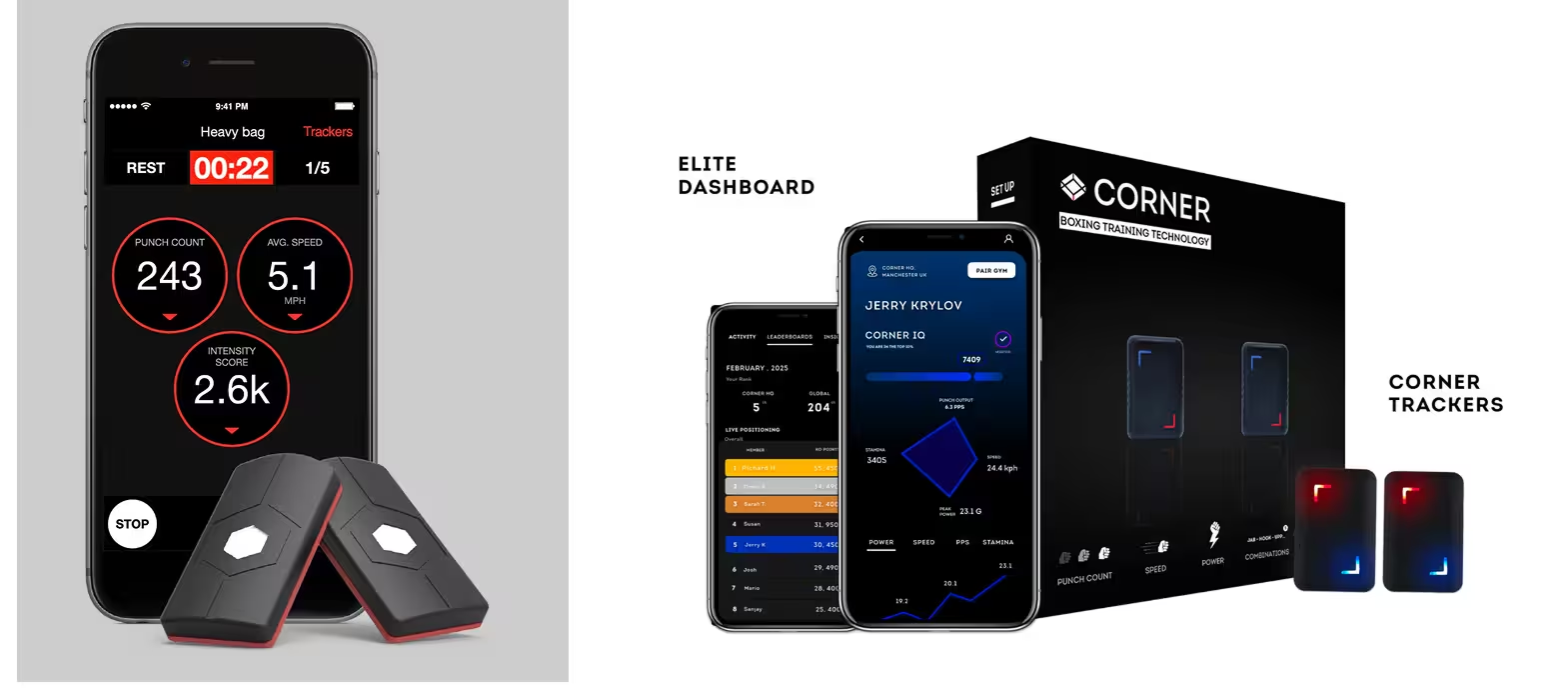
What Early Punch Trackers Measured
The core technology in these early devices is the inertial measurement unit, or IMU. An IMU combines an accelerometer, which measures linear acceleration across three axes, with a gyroscope, which measures angular velocity, also across three axes. Together, they capture how the hand moves through space during a punch.
From this data, early trackers calculated punch speed, volume per round, and rough estimates of output intensity. What they could not do was measure the actual force of impact. They tracked motion, not contact. Two athletes throwing the same jab at the same speed but with very different levels of body weight and structural alignment behind the punch would produce similar IMU readings, despite generating meaningfully different impacts.
The Leap to Force Measurement
A newer class of research-grade smart gloves has moved beyond motion tracking to include direct force measurement. This is a significant development. Force data captures what actually happens at the point of contact, not just the mechanics of the arm on the way there. Most commercial wearable products for boxing calculate only acceleration and its derivatives, without directly measuring the punching force.
The Rise Dynamics Alpha (RD Alpha) gloves, developed at the Vienna University of Technology, represent this more advanced category. They embed both a validated force sensor and an IMU, giving the system data from two distinct measurement channels simultaneously. This combination is what makes technique recognition through machine learning feasible.
Inside the Technology: How a Smart Glove Knows What Punch You Threw
Understanding how a smart glove identifies your jab from your hook requires a brief look at the biomechanics involved.
Every punch type produces a distinct movement signature. A straight jab travels in a largely linear path from the guard position. A hook involves arm extension followed by rotation, with the forearm parallel to the ground at contact. An uppercut requires a lowering of the body before the hand moves upward. These different trajectories result in different patterns of acceleration, angular velocity, and force across the sensors inside the glove.
A research team at the Vienna University of Technology conducted a study examining whether machine learning models could use this sensor data to accurately classify striking techniques. The study, published in Applied Sciences in 2023, built a dataset from 3,453 labeled punch samples collected from thirteen kickboxing athletes of varying experience levels. The participants performed five technique types: straight punches, hooks, uppercuts, backfists, and ridge hands, executed on four different target types including punching bags, punch pads, gloves, and a concrete wall.
Eight supervised machine learning algorithms were trained on the dataset. After optimization and significance testing, the support vector classifier performed best. On athletes whose data was used in training, the model achieved 93.03% accuracy for striking technique classification and 98.26% accuracy for identifying which target type was struck. When tested on a completely new group of eight athletes the model had never seen, accuracy for technique classification held at 89.55%. Target object classification dropped to 75.97% on the new group, indicating that force signatures vary more between individuals when identifying surfaces than when identifying technique type.
These figures are meaningful. An 89% success rate identifying punch types in real time on athletes unknown to the system is a strong proof of concept. It is not infallible, but it is accurate enough to be a useful training reference.
What Can a Smart Glove Tell You That a Coach Cannot?
The coach's eye remains irreplaceable for contextual judgment. But sensors offer something different: precision data across many repetitions without fatigue or distraction.
Force profiles across sessions. A smart glove with force measurement can track whether your peak impact force is declining across the third and fourth rounds of a session. This kind of data is very difficult to assess visually in real time. A coach watching a sparring session manages many variables simultaneously. The sensor only watches the glove, and it does so with consistency.
Technique consistency over repetitions. If you throw fifty jabs in a session, the sensor data can show how much variation exists between them. High variation may indicate technique breakdown under fatigue. A narrowing variance over weeks of training is evidence of refinement. Both are useful signals.
Target feedback. The RD Alpha research found that force signatures differ significantly depending on what you hit. Punching a heavy bag produces a different deceleration curve than striking punch pads or a glove. A system tracking this data can provide insight into whether you are generating force efficiently against a yielding surface versus a resistant one, which has implications for technique adjustment and conditioning planning.
For gear considerations at different training stages, the discussion around choosing the right glove for your training purpose is worth reviewing alongside any conversation about sensor-based feedback.
Does Wearable Technology Actually Help Prevent Boxing Injuries?
This is where the practical value extends beyond performance analysis.
Combat sports carry inherent injury risk, particularly when techniques are executed incorrectly or when athletes train through excessive fatigue. The RD Alpha study notes this directly, identifying overtraining and incorrect technique execution as primary contributors to injury in boxing and related disciplines.
Wearable sensor data can address both risk factors.
On the technique side, a system capable of identifying punch types can also flag technique patterns that deviate from an athlete's established baseline, which may indicate compensatory movement caused by fatigue or early injury. Analyzing movement trajectory can reveal inefficiencies or deviations from an optimal movement pattern, with these parameters being fundamental to the objective evaluation of technique and the identification of movement patterns that may increase risk of both acute and chronic injury.
On the training load side, research published in Frontiers in Sports and Active Living examined how wearable analytics can be used to quantify both internal and external training load, helping practitioners and coaches determine whether an athlete is training at an appropriate level or moving toward overtraining. Internal and external workload data can determine whether an athlete is training optimally, undertraining, overtraining, or at considerable risk for injury. Declining force output and velocity across a session are objective indicators that the body's capacity for quality work has been reached.
For practitioners who already take resistance training and conditioning seriously, wearable data can function as an additional layer of load management, helping calibrate when to push and when to hold back with more precision than perceived exertion alone.
What Wearable Technology in Boxing Still Cannot Do
It is worth being direct about the limitations, because understanding them prevents misuse of the tools.
The glove only sees the hand. Because the sensors sit inside the gloves, they capture hand and wrist movement without visibility into shoulder mechanics, hip rotation, or footwork. A punch can appear biomechanically consistent at the wrist while the generating structure, the kinetic chain from foot to fist, is entirely broken. The RD Alpha study acknowledges this explicitly: because the IMUs are positioned in the gloves, a purely rule-based differentiation between techniques is not possible without knowing rest-body movement. Machine learning compensates for this limitation, but it does not eliminate it.
Accuracy drops with new athletes. The study's independent evaluation showed a meaningful decrease in target classification accuracy when testing athletes unknown to the model. The system works best when trained on diverse data. A glove purchased and used by a single athlete without a rich prior dataset will not perform at the same level as a system trained on thousands of samples.
Data requires interpretation. A number on a screen is not coaching. A force reading tells you what happened. It does not tell you why, what the tactical context was, or what adjustment is appropriate. That judgment still requires a human being with domain knowledge. Research into the BoxingPro system, which combines IMU data with large language model analysis to generate coaching feedback, found the AI-generated guidance rated above 4.0 out of 5.0 for biomechanical correctness by professional boxing coaches. Promising, but still a supplement to human coaching, not a substitute for it.
Traditional metrics remain highly valid. Experienced boxing coaches have noted that rate of perceived exertion and heart rate zone training continue to deliver reliable results independent of sensor data. These tools have decades of sports science validation behind them. Smart gloves add a layer of precision. They do not invalidate established methodology.
Should Everyday Practitioners Use Smart Boxing Gear?
Is wearable boxing technology worth it for a hobbyist?
It depends on your training goals and your relationship with data. If you train primarily for fitness or general skill development, a simple punch tracker that counts volume and speed gives you enough information to structure your sessions and track progress over time. The investment is modest and the data is immediately useful.
If you are a competitive kickboxer or boxer working on specific technique refinement, a more sophisticated system that tracks force and attempts technique classification offers genuinely valuable feedback. The cost is higher, and the value depends on how well you and your coaching team understand how to use the data.
Can AI replace my boxing coach?
No. And the research itself makes this clear. The machine learning models in the Vienna University of Technology study were trained on data labeled by domain experts with more than a decade of coaching experience at the international level. The AI can classify what punch was thrown. It cannot assess whether that punch was appropriate for the tactical situation, whether the footwork before it was sound, or whether the athlete's mental state is affecting their performance. Coaching is contextual. Sensors measure specific physical variables in isolation.
What is the most useful metric to track as a boxer?
In early training phases, volume and consistency. Are you throwing techniques with similar mechanics across many repetitions? Are you maintaining output across rounds?
As training matures, force and velocity together tell a richer story. A punch that is fast but generates low force may indicate technique breakdown. A punch with strong force but declining velocity over a session indicates fatigue. Used together, these metrics support more informed decisions about training load and recovery timing.
The Next Frontier: AI-Powered Wearables and the Future of Martial Arts and Combat Sports Training
We researched what types of wearables are most likely to be developed and released to market in the near future.
Biomechanical feedback in real time
Compression garments embedded with inertial measurement units can now track joint angles, rotation timing, and weight transfer on a punch-by-punch basis. When your hip rotation lags behind your shoulder on a cross, or your guard drops two inches in round four, that data can be surfaced immediately either through an earpiece or reviewed post-session. Adjustments that used to require years of close coaching can now be identified in a single session.
Cumulative impact and load monitoring
Smart mouthguards and sensor-equipped headgear are already being used at the elite level to track force absorption over a training camp. The insight is not just how hard any single shot was, but what the accumulated load looks like over weeks of sparring. For fighters and coaches managing training volume responsibly, this kind of data changes how rest and intensity decisions get made.
Physiological readiness
Wristbands and chest straps now track heart rate variability, respiratory patterns, and in some cases sweat-based cortisol markers. Over time, an AI model built on your individual baseline can flag when your recovery is incomplete before your performance drops, and well before injury presents. This is load management applied to the fighter's body the same way it has been applied to athletes in other professional sports for the past decade.
Grip and pressure mapping
Pressure-sensitive smart gloves can show exactly where the knuckle surface is making contact, how force distributes across the fist on impact, and whether the wrist is aligned correctly through the punch. For coaches working with large training groups, this kind of objective measurement replaces guesswork with evidence.
These technologies are still developing, and many are not yet accessible outside professional or high-level amateur environments. But the trajectory is clear. Within a training generation, the tools a serious fighters has access to will look fundamentally different from what is available today.
The Technology Serves the Craft
Wearable technology in boxing has moved well beyond novelty. The science behind systems like the RD Alpha gloves demonstrates that machine learning applied to multi-sensor data can identify striking techniques with meaningful accuracy, measure force at the point of contact, and provide data that is genuinely useful for performance analysis and injury prevention.
What it has not done, and likely will not do, is change the fundamental nature of what makes a skilled practitioner. Precision, timing, awareness, and the ability to apply technique under pressure are built through thousands of hours of deliberate practice with good coaching and honest feedback.
The best technology respects the craft it measures. Smart gloves are a more precise way to observe what is already happening in your training. They sharpen the feedback loop. They do not replace the loop itself.
Mastery is not found in data. It is built in repetition, correction, and patience. The tools that help you see your repetitions more clearly are worth understanding. The path rewards those who respect it.