

India's Olympic Legacy in Combat Sports and Martial Arts: A Journey of Triumph and Perseverance

India's journey in combat sports and martial arts at the Olympic Games represents one of the most compelling narratives in the nation's sporting history. From KD Jadhav's pioneering bronze medal in wrestling at the 1952 Helsinki Olympics to Aman Sehrawat's recent triumph at the 2024 Paris Olympics, Indian athletes have consistently demonstrated exceptional skill, determination, and resilience on the world's most prestigious sporting stage.
The Foundation: Wrestling's Golden Thread
Wrestling stands as the cornerstone of India's combat sports success at the Olympics, accounting for eight of the eleven total medals won in combat sports and martial arts. This remarkable achievement spans over seven decades, establishing wrestling as India's second most successful Olympic sport after field hockey.
The Pioneer: KD Jadhav (1952)
India's combat sports Olympic legacy began with Khashaba Dadasaheb Jadhav, who made history at the 1952 Helsinki Olympics by becoming the first Indian wrestler to win an Olympic medal and the first individual medallist for independent India. Competing in the men's bantamweight (57kg) freestyle category, Jadhav's bronze medal represented a watershed moment, proving that Indian athletes could compete with the world's best in individual combat sports.
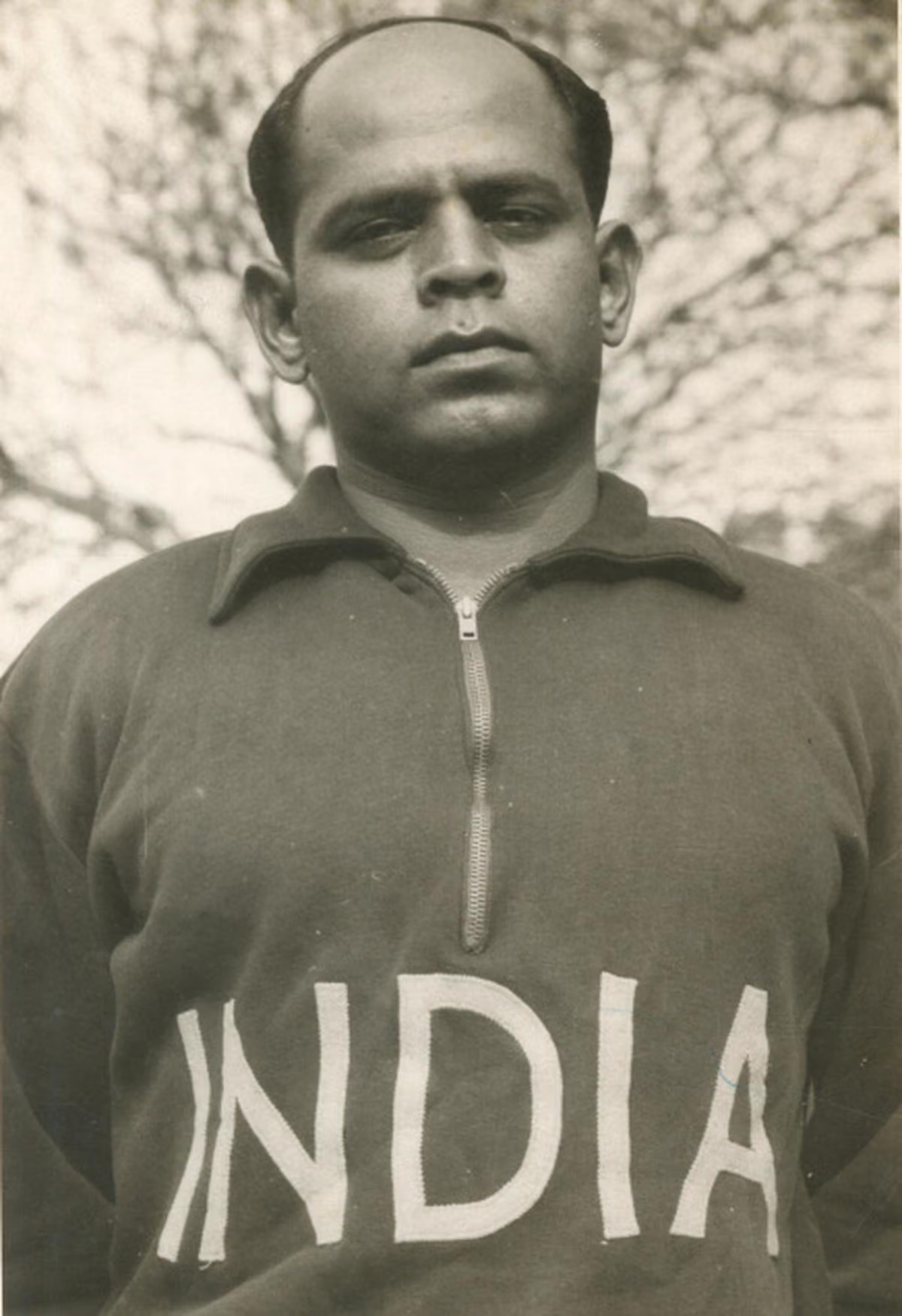
Jadhav had previously competed at the 1948 London Olympics, finishing sixth, which made his Helsinki triumph even more significant as it demonstrated his perseverance and improvement over four years.
The Renaissance: Sushil Kumar's Double Glory
After a 56-year drought following Jadhav's achievement, Indian wrestling experienced a renaissance with Sushil Kumar's breakthrough at the 2008 Beijing Olympics. Kumar won bronze in the men's 66kg freestyle category, marking India's return to Olympic wrestling success and setting the stage for a golden period in the sport.
Kumar's achievement was unprecedented as he lost his first round match to Andriy Stadnik but fought back through the repechage system, defeating Doug Schwab and Albert Batyrov before securing bronze against Leonid Spiridonov with a 3-1 victory. Remarkably, he accomplished this feat without a dedicated masseur, with team manager Kartar Singh filling that role between his three bouts within 70 minutes.
Four years later at the 2012 London Olympics, Sushil Kumar elevated his performance by winning silver in the same 66kg category, making him the first Indian to win two individual Olympic medals since independence. His journey to the final included a controversial semifinal victory over Kazakhstan's Akzhurek Tanatarov, with the opponent claiming Kumar had bitten his ear—an allegation Kumar denied.
The London Breakthrough: Yogeshwar Dutt's Complementary Success
The 2012 London Olympics marked a pivotal moment for Indian wrestling with two medals, as Yogeshwar Dutt won bronze in the men's freestyle 60kg category. Dutt's success complemented Sushil Kumar's silver medal, demonstrating the depth of Indian wrestling talent and establishing the sport as a consistent medal prospect for future Olympics.
Breaking Gender Barriers: Sakshi Malik's Historic Achievement
The 2016 Rio Olympics witnessed another historic moment when Sakshi Malik became the first Indian woman wrestler to win an Olympic medal, securing bronze in the women's freestyle 58kg category. Malik's achievement was particularly significant as she only gained her opportunity after Geeta Phogat was suspended, highlighting how she capitalized on her chance to make history.
Malik's success opened doors for women's wrestling in India and inspired a new generation of female grapplers to pursue Olympic dreams.
Tokyo 2020: Wrestling's Double Delight
The Tokyo 2020 Olympics (held in 2021) proved to be exceptionally fruitful for Indian wrestling, contributing two medals to India's record-breaking seven-medal haul. Ravi Kumar Dahiya won silver in the men's freestyle 57kg category, while Bajrang Punia secured bronze in the men's freestyle 65kg division.
Dahiya's silver medal performance was particularly impressive as he demonstrated consistent excellence throughout the qualification period and maintained his status as a top contender. Bajrang Punia's bronze came after a commanding 8-0 victory over Kazakhstan's Daulet Niyazbekov, showcasing his dominance in the 65kg category.
Punia's achievement was especially notable as he became the only Indian wrestler to win four World Championship medals, underlining his consistent international success.
Paris 2024: The Young Champion
The most recent addition to India's wrestling Olympic legacy came from Aman Sehrawat at the 2024 Paris Olympics, where he won bronze in the men's freestyle 57kg category. At just 21 years old, Sehrawat became India's youngest Olympic medallist, representing the next generation of Indian wrestling talent.
Sehrawat's success continued the tradition of excellence established at the Chhatrasal Stadium in Delhi, where he trained alongside previous Olympic medallists including Sushil Kumar, Yogeshwar Dutt, Bajrang Punia, and Ravi Dahiya. This academy has become synonymous with Indian wrestling success, earning recognition as the country's premier wrestling nursery.
Boxing: The Sweet Science's Olympic Journey
Indian boxing has contributed three Olympic medals to the nation's combat sports tally, each representing significant milestones in the sport's development. These achievements span different eras and weight categories, showcasing the sport's growing prominence in Indian Olympic success.
Vijender Singh: The Trailblazer
Vijender Singh made history at the 2008 Beijing Olympics by becoming the first Indian boxer to win an Olympic medal, securing bronze in the men's middleweight (75kg) category. Singh's achievement was groundbreaking as it opened new pathways for Indian boxing and inspired a generation of pugilists to pursue Olympic dreams.
Singh's journey to the medal was challenging, starting with a first-round exit at the 2004 Athens Olympics. He used this setback as motivation, training with renewed focus and claiming medals at the Asian Games, Asian Championships, and Commonwealth Games before heading to Beijing.
At the Beijing Olympics, Singh overcame early challenges against Badou Jack of Gambia and Angkhan Chomphuphuang of Thailand, with the Thai boxer leaving him in severe pain. However, Singh recovered within three days to defeat Ecuador's Carlos Gongora 9-4 in the quarterfinals, securing India's first boxing medal.
Although Singh lost to Cuba's Emilio Correa in the semifinals, he returned home with bronze, as two bronze medals are awarded in Olympic boxing.
Mary Kom: The Magnificent Champion
The introduction of women's boxing to the Olympic program at the 2012 London Olympics provided the perfect platform for MC Mary Kom to add to her already legendary career. Kom won bronze in the flyweight (51kg) category, becoming the third Indian woman athlete, after Karnam Malleswari and Saina Nehwal, to win an Olympic medal.
When women's boxing debuted at the London Olympics, Mary Kom was already a five-time world champion and four-time Asian champion, making her the overwhelming favorite. However, she had to adapt to competing in the flyweight division instead of her usual lower weight categories of pinweight and light flyweight.
Kom's Olympic campaign began with a victory over former world champion Karolina Michalczuk from Poland in the round of 16, setting up a quarterfinal clash with Tunisia's Maroua Rahali. She dominated the Tunisian athlete with a commanding 15-6 victory to guarantee her medal.
Although Kom lost to eventual gold medallist Nicola Adams of Great Britain in the semifinals, her bronze medal cemented her status as the greatest Indian boxer of all time. Kom's achievements extend far beyond the Olympics, as she remains the only woman to win the World Amateur Boxing Championship six times and the only female boxer to win medals in each of the first seven World Championships.
Lovlina Borgohain: The Assamese Sensation
The 2020 Tokyo Olympics saw Lovlina Borgohain add to India's boxing medal tally with bronze in the women's welterweight (69kg) category. Despite making her Olympic debut, Borgohain fought brilliantly against more experienced opponents throughout her campaign.
Heading into Tokyo as the world No. 5 in her weight category, Borgohain faced a tough opening challenge from German Nadine Apetz. She utilized her combination punching expertly to prevail in three evenly contested rounds, advancing to the quarterfinals.
Her quarterfinal performance was even more impressive, as she defeated fourth seed and former world champion Chen Nien-chin of Chinese Taipei, demonstrating her ability to compete against the world's best.
Judo: The Gentle Way's Olympic Aspirations
Despite judo's significant presence in India's martial arts landscape, the sport has yet to produce an Olympic medal for the country. However, Indian judokas have consistently participated in Olympic Games and achieved notable success in other international competitions.
Olympic Participation History
India's judo Olympic journey includes several notable participants who have represented the country with distinction. Narender Singh holds the distinction of being the first judoka to represent India at two Olympic Games, competing in both 1992 and 1996. Other Olympic participants include Sandeep Byala, Cawas Billimoria, Rajinder Singh, Sangita Mehta, Najib Aga, Sunith Singh, and Arti Kohli.
More recently, Sushila Devi Likmabam was India's sole judo representative at the Tokyo 2020 Olympics, competing in the women's 48kg division but unable to progress past the opening round. For the Paris 2024 Olympics, Tulika Maan secured India's judo quota in the women's +78kg division, finishing 36th in world rankings to earn a continental quota spot.
International Achievements
While Olympic success has remained elusive, Indian judokas have achieved significant success in other major international competitions. India's total medal count in major judo tournaments includes five bronze medals at the Asian Games, five silver and six bronze at the Commonwealth Games, and four silver and eleven bronze at the Asian Championships, totaling 31 medals across these premier competitions.
Notable achievements include Thoudam Kalpana Devi becoming the first Indian to win a World Cup top-three finish at the 2010 Judo World Cup in Tashkent. At the 2009 Asian Martial Arts Games in Bangkok, Indian judokas performed exceptionally well, with Anil Kumar winning silver in the -100kg category and five other athletes securing bronze medals.
Taekwondo: Overcoming Challenges and Building Foundations
Taekwondo in India faces unique challenges in Olympic qualification, with the sport yet to secure representation at the Games despite significant domestic development. The sport's journey toward Olympic participation has been marked by both progress and setbacks.
Olympic Qualification Struggles
India's taekwondo Olympic aspirations have faced numerous obstacles, as demonstrated during the Tokyo 2020 qualification process. The four-member national team selected for the Asian Olympic qualifying tournament in Jordan missed the competition due to COVID-19 travel restrictions and lack of awareness about mandatory quarantine rules.
The team, consisting of Kashish Malik (57kg), Margarette Regi (67kg), Akshay Hooda (68kg), and Navjeet Singh Mann (80kg), was informed only one day before departure about Jordan's 14-day quarantine requirement for Indian teams. This administrative oversight cost India a crucial opportunity to secure Olympic qualification.
For Paris 2024, India continued its quest for Olympic representation with four athletes securing spots in qualification rounds. Sania Khan (U-57kg) earned selection for the Asian qualification tournament, while Aruna Tanwar (U-47kg), Muskan (U-52kg), and Sadham Hussain (U-63kg) qualified for the Para Asian qualification round.
International Success and Recognition
Despite Olympic qualification challenges, Indian taekwondo has achieved notable international success. Rodali Barua ended India's decade-long medal drought at the Asian Taekwondo Championships in 2024, winning bronze in the women's 73kg category in Da Nang, Vietnam. This was India's first medal at the continental championships since Latika Bhandari's bronze in 2014.
The sport has also seen breakthrough performances in global rankings, with athletes like Rupa Bayor becoming the first Indian to break into the top 10 of the World Poomsae Rankings. Bayor's achievement represents a significant milestone for Indian taekwondo, especially considering her background from rural Arunachal Pradesh.
Aruna Tanwar made history as India's first taekwondo athlete to qualify for the Paralympic Games, representing the country at Tokyo 2020. This achievement highlighted the inclusive nature of Indian martial arts development and opened new avenues for para-taekwondo athletes.
Fencing: The Newest Olympic Martial Art
Fencing represents India's newest venture in Olympic martial arts, with the sport achieving its first Olympic qualification through CA Bhavani Devi's historic achievement. This milestone marked a significant breakthrough for a sport that has traditionally had limited presence in Indian Olympic campaigns.
Historic Olympic Debut
Bhavani Devi created history by becoming the first Indian fencer ever to secure an Olympic berth, qualifying for the Tokyo 2020 Olympics through the Adjusted Olympic Rankings method. Her qualification came after Hungary lost in the quarterfinals of the team event during the Fencing Sabre World Cup in Budapest, allowing her to secure the necessary ranking points.
As India's top-ranked fencer, Bhavani Devi holds the 42nd position in the world in women's sabre. Her achievement was particularly significant as she had previously won gold at the Turnoi Satellite Fencing Championship in Reykjavik, Iceland, becoming the first Indian to win an international fencing gold medal.
Developing Infrastructure and Talent
The Fencing Association of India, established in 1974 and recognized by the government in 1997, has been working to develop the sport across the country. With 30 state associations and two services associations, the federation has established a four-year strategic plan focusing on education, participation, competition, and elite performance.
Other notable Indian fencers include Kabita Devi (ranked 100th in women's senior epee), Karan Singh (bronze medallist in Junior Boys Sabre at the 2016 Asian Junior Cadet Championship), and Chingakham Jetlee Singh (ranked 48th in men's junior epee globally).
The Road Ahead: Future Prospects and Development
India's combat sports and martial arts programs continue to evolve, with significant investment in infrastructure, coaching, and athlete development programs creating optimism for future Olympic success. The success at various Olympics has created a foundation for sustained excellence across multiple combat disciplines.
Systemic Improvements and Training Centers
The establishment of specialized training centers has been crucial to India's combat sports success. The Chhatrasal Stadium in Delhi has become synonymous with wrestling excellence, producing five of India's last six wrestling Olympic medallists. Similarly, the Judo Federation of India has opened academies in Sonipat, Anantapur, Haridwar, and Mizoram to develop talent across the country.
Emerging Talent and Future Olympic Cycles
The success of young athletes like Aman Sehrawat, who became India's youngest Olympic medallist at 21, demonstrates the depth of talent emerging from India's combat sports programs. The systematic approach to talent identification and development suggests continued success in future Olympic cycles.
For boxing, the emergence of world champions like Nikhat Zareen and consistent performers like Amit Panghal indicates a bright future for Indian pugilism. The sport's inclusion of women's categories has also expanded opportunities for female athletes to achieve Olympic success.
Medal Winners by Sport
Wrestling (8 Medals)
- KD Jadhav - Bronze, Men's freestyle 57kg (Bantamweight), Helsinki 1952
- Sushil Kumar - Bronze, Men's freestyle 66kg, Beijing 2008
- Sushil Kumar - Silver, Men's freestyle 66kg, London 2012
- Yogeshwar Dutt - Bronze, Men's freestyle 60kg, London 2012
- Sakshi Malik - Bronze, Women's freestyle 58kg, Rio 2016
- Ravi Kumar Dahiya - Silver, Men's freestyle 57kg, Tokyo 2020
- Bajrang Punia - Bronze, Men's freestyle 65kg, Tokyo 2020
- Aman Sehrawat - Bronze, Men's freestyle 57kg, Paris 2024
Boxing (3 Medals)
- Vijender Singh - Bronze, Men's middleweight 75kg, Beijing 2008
- Mary Kom - Bronze, Women's flyweight 51kg, London 2012
- Lovlina Borgohain - Bronze, Women's welterweight 69kg, Tokyo 2020
Olympic Performance Analysis
India's combat sports medal count of 11 medals (comprising 2 silver and 9 bronze medals) represents approximately 26.8% of the country's total Olympic medal tally of 41 medals. Wrestling alone accounts for 19.5% of India's total Olympic medals, making it the second most successful sport after field hockey.
The distribution shows consistent growth across Olympic cycles, with particularly strong performances at the 2008 Beijing Olympics (3 medals), 2012 London Olympics (3 medals), and 2020 Tokyo Olympics (3 medals). This consistency demonstrates the systematic development of combat sports programs in India.
Related Article: Martial Arts in the Olympics