

Training at Altitude: How Bolivia's Geography Shapes Its Fighters
Step off a plane in La Paz, Bolivia, and you feel it immediately. Your lungs reach for air that isn't fully there. Your pulse climbs without warning. Your body, accustomed to the dense, oxygen-rich atmosphere at sea level, suddenly finds itself working harder just to stand still.
La Paz sits at 3,650 metres above sea level, making it the highest seat of government in the world. It is higher than most Alpine peaks. Higher than the training camps elite cyclists pay thousands to access. And it is where some of Bolivia's fighters wake up every morning, lace up their gloves, and go to work.

This is not incidental. The geography of Bolivia does not simply provide a backdrop to its martial arts story. It is part of the training itself. The altitude that leaves visiting athletes gasping is the same altitude that has conditioned Bolivian fighters for years, developing a physiological foundation that few opponents are built to understand or prepare for. Bolivia's martial arts tradition is still finding its global voice, but the conditions that have shaped it are anything but ordinary.
This article explores what the science says about training in thin air, why it matters specifically for combat athletes, and how the fighters who have emerged from Bolivia carry something earned not just in the gym, but by the land itself.
A City Built Above the Clouds
La Paz is not alone in Bolivia's high-altitude landscape. Oruro sits at 3,700 metres. Potosi, once the silver mining capital of the colonial world, reaches above 4,000 metres. Even the city of El Alto, which effectively adjoins La Paz, sits at approximately 4,150 metres. Bolivia is, in the simplest terms, a country that exists at altitude in a way few nations on earth can claim.
The implications for sport are well-documented across disciplines. FIFA spent years debating whether to ban international football matches at La Paz's Hernando Siles Stadium, situated at 3,582 metres. Visiting teams raised formal protests through their national federations, arguing that the altitude gave Bolivian players an unfair physiological advantage. In 2007, FIFA temporarily implemented a ban on competitive matches at venues above 2,500 metres, before revising the threshold following intense lobbying from Andean nations. The stadium remains one of the highest certified competitive venues in world sport, and it remains a fortress for the home side.
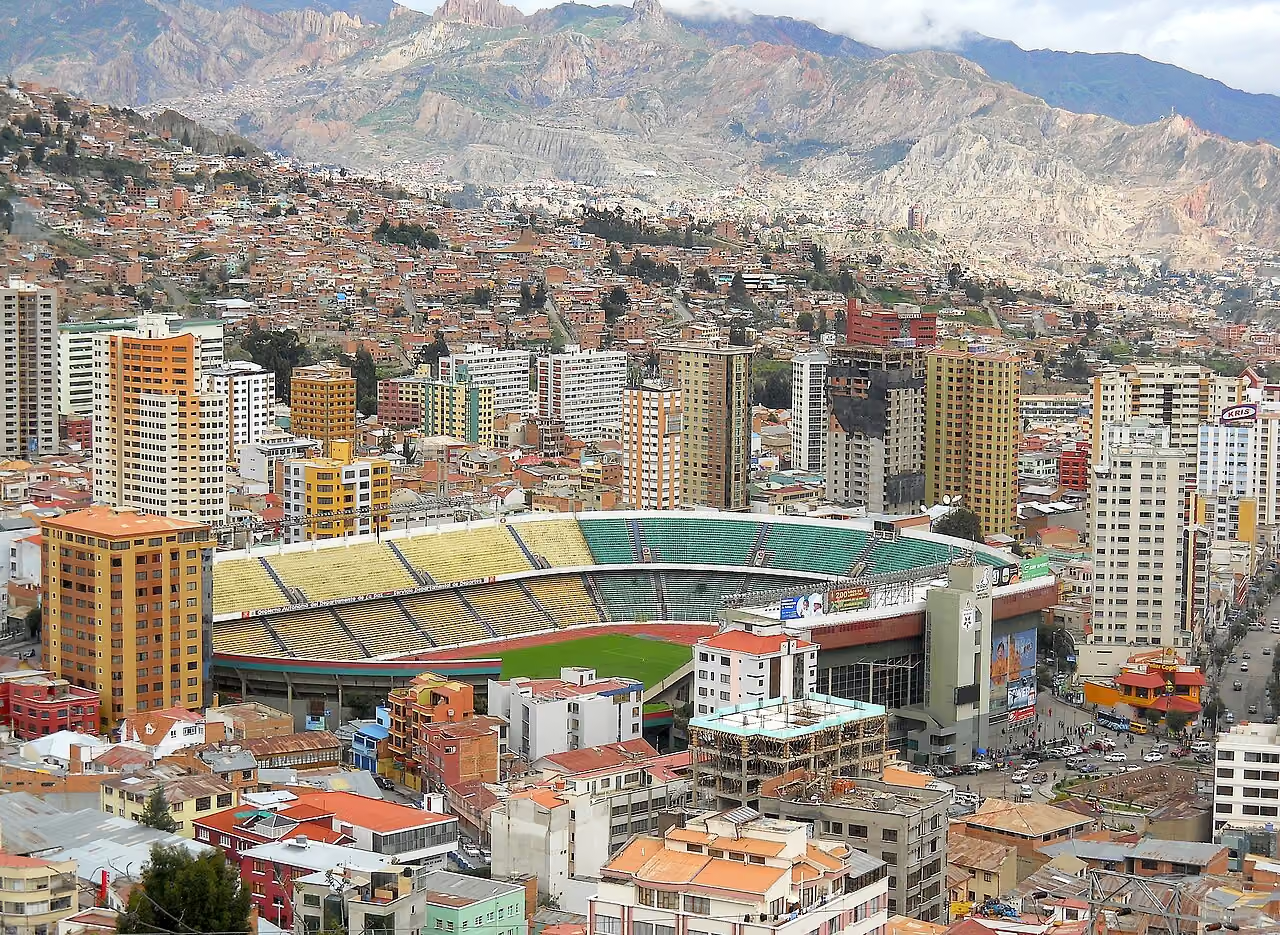
In combat sports, the same geography produces the same dynamic. Altitd MMA and Octagon La Paz are the gyms currently anchoring Bolivia's competitive MMA scene. Octagon La Paz, founded by Jaime and Hugo Cabrerathe, who hold the distinction of being the first Brazilian Jiu-Jitsu black belts in Bolivia, has operated for nearly two decades in this environment. Their practitioners do not train at altitude occasionally. They live and recover at altitude, every day, all year.
For those born there the physiological adaptation runs deep. Lung membrane development, red blood cell composition, and cardiovascular efficiency are shaped over years by the demands of altitude living. It is not a short-term camp benefit. It is a structural advantage, built into the body over a lifetime.
What Happens to Your Body at 3,600 Metres
The Oxygen Problem
At sea level, the percentage of oxygen in the air is approximately 21 percent. That percentage does not change at altitude. What changes is the barometric pressure, which determines how many oxygen molecules you actually inhale with each breath. At 3,600 metres, the partial pressure of oxygen is roughly 40 percent lower than at sea level. Your lungs take in air at the same rate, but deliver significantly less oxygen to the bloodstream.
The immediate consequence for any athlete arriving at altitude is a measurable drop in aerobic capacity. Research by exercise physiologist Jack Daniels, published through Human Kinetics, documents that an athlete's VO2max (maximal oxygen uptake, the ceiling of the aerobic engine) drops by approximately 12 to 16 percent upon arrival at moderate altitude. Performance in events lasting more than two minutes declines proportionally. A fighter used to competing at sea level who arrives in La Paz for a bout faces a cardiovascular system that is, within hours of landing, operating at a fraction of its normal ceiling.
The EPO Response
The body does not accept oxygen shortage passively. Within hours of exposure to reduced oxygen levels, the kidneys begin producing erythropoietin, commonly known as EPO, a hormone that signals the bone marrow to generate more red blood cells. More red blood cells means greater oxygen-carrying capacity. The body is rebuilding its own delivery infrastructure in response to the environment.
Wojan and colleagues, writing in the Journal of Applied Physiology (2021), demonstrated that even short intermittent exposure to hypoxia (low-oxygen conditions) produces measurable increases in EPO levels in healthy individuals. The response is not reserved for weeks-long altitude camps. It begins quickly, and with sustained exposure, it translates into structural hematological change.
Hemoglobin Adaptation and VO2max Gains
The longer an athlete remains at altitude, the more the EPO response compounds. Sustained hypoxic exposure increases both hemoglobin mass and VO2max, the two primary markers of endurance capacity. A study published in Nutrients (PMC, 2022), examining athletes training above 1,800 metres, recorded statistically significant increases in EPO values, hemoglobin concentration, and VO2max across a 30-day training block. The gains were consistent and measurable across participants.
A wider meta-analysis, published and indexed in PubMed Central, reviewed 17 studies on altitude training and confirmed that it produced higher maximum oxygen uptake and hemoglobin mass compared to sea-level training, with a standardised mean difference indicating a moderate-to-large positive effect. The evidence base for altitude-driven cardiovascular adaptation is not contested. The question, for combat sports, is what that adaptation means inside the cage.
Why This Matters Specifically for Combat Athletes
Combat sports occupy a metabolically unusual position among athletic disciplines. A five-round MMA bout demands both the short explosive energy system used in takedowns, scrambles, and striking exchanges, and the aerobic system relied upon for recovery between efforts, maintaining output across later rounds, and resisting lactic acid accumulation. Unlike a distance runner or a cyclist, a fighter cannot sustain a single effort level. The demands shift constantly within seconds.
This dual-system requirement is precisely where altitude adaptation delivers its most significant dividends. A study published in Frontiers in Physiology (2021), examining elite judo athletes following an altitude training camp, found that power-oriented training at moderate altitude produced improvements in explosive technique transfer, peak velocity, and lower-limb power output. The researchers noted that altitude's effect on motor unit recruitment and spinal excitability may enhance explosive actions, not only endurance metrics. For a grappler shooting a double-leg takedown in the fourth round, or a striker chaining combinations under fatigue, these are not abstract physiological gains. They are the difference between executing technique cleanly and watching it collapse under oxygen debt.
Additionally, training in hypoxic conditions forces the body to become more efficient at clearing lactic acid and managing energy under constraint. Fighters accustomed to recovering at 3,600 metres develop a cardiovascular system that, when brought to sea level, operates with a measurable surplus. The oxygen their body has learned to extract efficiently becomes more available. The conditioning floor rises.
The Live High, Train Low Principle and What Bolivia Reverses
In elite endurance sports, the preferred altitude training methodology is known as Live High, Train Low, or LHTL. The approach involves sleeping and recovering at altitude to stimulate hematological adaptation, while completing training sessions at lower elevation to preserve training intensity. The logic is straightforward: you capture the physiological stimulus of altitude without the performance ceiling imposed by thin air during high-intensity sessions.
Park and colleagues, publishing in the Journal of Exercise Nutrition and Biochemistry (2017), tested a four-week LHTL intervention against a sea-level control group and found significant improvements in both 3,000-metre and 5,000-metre time trial performance, alongside reduced blood lactate levels during submaximal exercise. Hemoglobin and VO2max improvements reinforced the performance data. The LHTL model is now standard preparation methodology for elite distance runners, swimmers, and cyclists worldwide.
Bolivian fighters, by necessity, invert this model. They live high and train high. The immediate disadvantage is reduced training intensity, since the same reduced oxygen that drives adaptation also limits how hard an athlete can push before the system reaches its ceiling. This tradeoff is one that sports scientists regularly flag as the primary drawback of full altitude training camps. The risk of inadequate training stimulus, early overtraining, and acute mountain sickness is real for those who arrive unprepared.
For Bolivians born and raised at altitude, however, this ceiling has already been navigated across years. Their bodies have adapted to training effectively at 3,600 metres. When they compete at sea level, they arrive with cardiovascular infrastructure built in conditions that most opponents have never experienced. The adaptation benefit is not a temporary camp gain. It is a persistent physiological baseline.
Bolivia's Fighters on the Global Stage
Bolivia's representation in the upper tiers of professional MMA is still developing, but the individuals who have reached those levels carry stories of exceptional dedication alongside their records.
The first Bolivian to compete in the UFC was Bentley "Dr. Bolivia" Syler, a flyweight who entered the promotion via The Ultimate Fighter: Latin America Season 1 in 2014 as a member of Team Werdum. Syler's path was unlike most. A medical school graduate from Santa Cruz, Bolivia, he balanced an active competitive career with his full medical studies and internship at UCEBOL (Universidad Cristiana de Bolivia), before putting his practice on hold to train full-time at American Top Team in Florida. His story set a precedent: a Bolivian fighter reaching the UFC on credentials earned through personal sacrifice rather than institutional infrastructure.
Syler's younger brother Kevin followed that path. An undefeated featherweight prospect, Kevin Syler trained at American Top Team in Coconut Creek and competed on the Dana White Contender Series, building his professional record under coaches Conan Silveira, Din Thomas, and Mike Brown. In interviews, he spoke openly about the absence of professional MMA resources in Bolivia and the sacrifices required to pursue the sport at an international level. Both brothers understood that reaching the top level meant leaving, but also understood they were building something for the fighters who would come after them.
The most recent chapter belongs to José Daniel "Chicho" Medina, born in Santa Cruz and the second Bolivian to appear in the UFC, as well as the first to enter on a fully signed contract. Medina built his career across Bolivian and South American regional competition while working as a qualified veterinarian and managing a poultry farm to fund his training. His entry into the UFC came through Dana White's Contender Series in October 2023, where he earned a contract despite losing his bout. Dana White cited his resilience. That contradiction, a contract awarded in defeat, became the defining entry point for Bolivia's first fully contracted UFC middleweight.
Medina competed four times under the UFC banner at middleweight before his release from the promotion in early 2026. As of mid-2026, he remains professionally active, with a scheduled bout at Champion 25 in August 2026. The UFC record does not carry wins, but the arc tells a different story: a fighter who reached the world's premier MMA organisation from a country with limited professional infrastructure, through years of self-funded preparation in a place where the environment itself demanded more from every session.
For all three of these fighters, the conditions of Bolivia are part of the conditioning inheritance. Santa Cruz sits at a lower elevation than La Paz, but the broader Bolivian athletic environment, including travel between high-altitude cities, the regional fight circuit, and the physical demands of early training years, is still shaped by a country that exists at heights most of the world visits only as a destination.
.avif)
Does Altitude Training Work for All Fighters? What the Research Clarifies
The science is consistent, but not without nuance. Individual response to hypoxic exposure varies significantly. Some athletes are high responders, showing dramatic increases in EPO and hemoglobin mass from altitude exposure. Others show modest gains from identical conditions. The underlying genetic and physiological factors driving this variability remain an active area of research, and coaches working with altitude training protocols should account for this individual variance rather than applying a single programme universally.
There are also practical risks. Acute mountain sickness, characterised by symptoms including headache, nausea, and disrupted sleep, can impair training quality during the first days or weeks at altitude. Reduced plasma volume in the early stages of altitude exposure can temporarily compromise performance before the adaptation benefits arrive. Load management becomes more demanding, because the early discomfort of acclimatisation can mask the beginnings of overtraining if not carefully monitored.
For Bolivians who have grown up at altitude, these early-stage risks are not a meaningful factor. Their physiology has already resolved the acclimatisation process. The adaptation is not a phase they pass through. It is the state they inhabit permanently.
For practitioners considering altitude training as a deliberate preparation tool, the research broadly supports its value for improving aerobic capacity and hemoglobin mass when exposure is sustained above 2,000 metres for at least three to four weeks. The LHTL model tends to produce the most favourable balance between adaptation stimulus and training quality. Altitude simulation tents and training masks, widely marketed to MMA and Brazilian Jiu-Jitsu practitioners, can develop some respiratory muscle conditioning but do not replicate the hematological adaptations generated by true altitude exposure.
What Geography Teaches
There is a tendency in discussions of fighter development to focus on lineage. The gym. The coach. The style. These things matter enormously, and no serious practitioner would argue otherwise. But Bolivia's story adds a different layer to that conversation.
Geography is a trainer. The altitude of the Bolivian altiplano asks something of every person who trains there, every day, without negotiation. It does not care about rank or record. It simply demands more, and in demanding more, it builds something that a sea-level environment cannot replicate through volume of work alone.
Bolivian fighters who reach international competition carry that demand in their conditioning. The cardiovascular baseline they bring to a bout, the efficiency of their oxygen delivery system, the late-round resilience built in an environment where every session is physiologically harder than it would be elsewhere, these are not incidental qualities. They are the product of a place.
In martial arts, the path shapes the practitioner. In Bolivia, the path happens to sit above the clouds.