

What Does a Cutman Do? Rocky Balboa's Cut Me Scene: Fact or Fiction
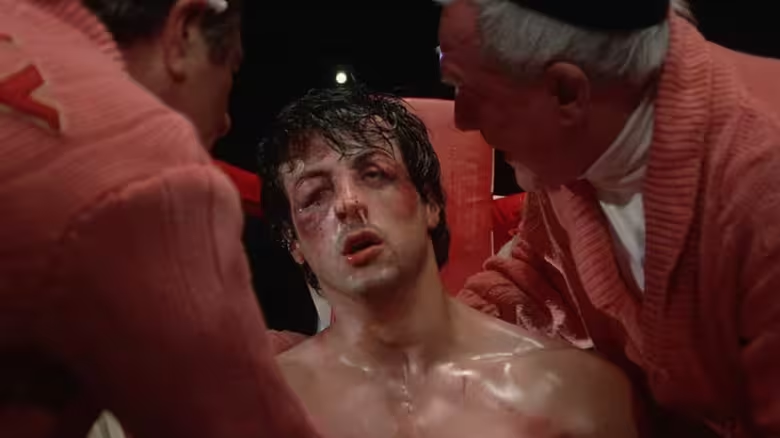
Every fighter has a version of the moment. Eyes swelling shut. Vision narrowing. Fifteen rounds of punishment pressing down like a weight.
In the 1976 film Rocky, that moment arrives between rounds 14 and 15. Rocky Balboa, battered and nearly blind from the beating Apollo Creed has delivered, turns to his corner and says the line that anyone who has ever watched the film remembers: "I can't see. Cut me."
His cutman reaches for a blade. Blood runs. Rocky's eye opens.
For decades, audiences have debated whether that scene was real, exaggerated, or pure fiction. The answer sits somewhere more interesting than either extreme. The practice was real. The desperation was real. But the era it depicts was already changing, and the craft that scene barely glimpses is far more sophisticated than a razor blade and a prayer.
This is what a cutman actually does and why their work can determine who wins and who does not.
The "Cut Me, Mick!" Scene, An Old Truth
The cutman in the original Rocky is Al, played by real life boxing trainer Al Silvani. Between rounds 14 and 15, Rocky's eyes had swollen so badly that he could not see, so Silvani famously cuts Rocky's eyelid to restore his vision.
This was not invention. Decades ago, some fighters would actually have the cutman slice a severely swollen eyelid open so that the fighter could better see the opponent. The cornerman would commonly use a razor blade to make a small incision in the swollen eyelid, allowing the blood to exit the area and allowing the eye to open up.
The logic was straightforward: drain the pressure, restore the sight, let the fighter continue.
Such dangerous methods have since been outlawed by most boxing organizations. The risks were significant. An uncontrolled incision near the eye could sever the wrong vessel entirely. This was a common practice for boxers in the 1970s, and trainers would use a razor blade to make a cut below the boxer's brow to supposedly release enough blood to ease swelling and make it easier for a fighter to see.
So when Rocky asks to be cut, the film is depicting something real. What it does not show is the generation of cutmen who quietly replaced that razor with something more precise, more controlled, and far more effective.
So What Does a Cutman Actually Do?
The title can mislead. For most of a cutman's working life, they are not cutting anything.
A cutman is a person responsible for preventing and treating physical damage to a fighter during the breaks between rounds of a full contact match such as boxing, kickboxing, or a mixed martial arts bout. Cutmen typically handle swelling, nosebleeds, and lacerations.
Their work begins before the opening bell.
Before the Fight
In the locker room, a cutman wraps their fighter's hands. This is foundational work. A poor wrap creates hot spots where bones shift on impact. It can compromise a fighter's punch mechanics, lead to fractures, and turn a minor hand injury into a serious one.
Once wrapping is done, the cutman studies their fighter's face. They are looking for anything that could become a problem: old scar tissue that splits easily, skin that is already irritated, areas of the orbital bone that sit prominently and will attract damage. With deft hands and a keen knowledge of anatomy, they apply grease around sensitive areas like the eyes and forehead to prevent cuts from worsening under relentless blows. Vaseline allows the glove to slide rather than catch.
Between Rounds
The one minute break between rounds sounds generous. It is not.
By the time the corner opens, the coach finishes talking, and the fighter has caught their breath, the cutman often has as little as 20 to 30 real seconds to work. In that tiny window, organization and communication are everything.
The priority order is consistent: address swelling that threatens vision first, then control any active bleeding, then manage the nose. Every second spent on the wrong problem is a second the right one gets worse.
The Priority Order in Practice
Swelling near the eye is urgent because a referee or ringside physician can stop the fight if a fighter's vision is compromised. The cutman presses the enswell against a fighter's skin to cool and reduce swelling from injuries, especially in areas around the eyes where swelling can impair vision.
What the enswell cannot do, contrary to a common mistake seen even at professional events, is disperse a hematoma by rubbing it. Such treatment will not move the hematoma, and may disrupt the microscopic blood vessels under the skin, causing an increase in bleeding and an enlargement of the swelled area.
Active cuts receive epinephrine, applied via cotton swab directly to the wound. Epinephrine, also called adrenaline chloride, is usually applied as a 1:1000 solution topically to decrease blood flow and is arguably the most common medication used by cutmen. Alongside epinephrine, a cutman may apply Avitene. Developed during the Vietnam War from the hides of Australian cattle, Avitene acts as a kind of magnet, drawing platelets to the wound and allowing clots to form. Together, these substances can close a wound that looks, to the untrained eye, like it should end the fight.
The Cutman's Toolkit
The kit is deceptively small. That is part of the craft.
The enswell (also called end swell or eye iron) is a flat piece of chilled metal with a handle. It is the cutman's most used tool. Cold direct pressure is the most reliable technique for controlling swelling, and the enswell delivers it with precision.
Petroleum jelly (Vaseline) is a preventive tool, not a treatment. It goes on before damage occurs. It should not go into an open wound, as it can interfere with healing and complicate any suturing after the fight.
Epinephrine (adrenaline chloride) is the chemical workhorse of the corner kit. It constricts blood vessels fast enough to be meaningful inside a sixty second window.
Avitene is the deeper intervention. The powdered form is applied dry onto a cleaned wound surface, then held with dry gauze and pressure. The collagen in the powder attracts platelets the way a magnet draws iron filings, building a clot that pressure and epinephrine alone might not achieve.
Thrombin is another coagulant used when the wound surface is dry and the bleeding is controlled enough to allow it. It is applied after blood is cleared from the site.
One substance worth naming because it still appears in conversations about cut work is Monsel's Solution (ferric subsulfate). This widely outlawed hemostatic quickly stops blood flow by chemically cauterizing the tissues surrounding the cut, while generating severe scar tissue. It is mentioned here as a cautionary example: the history of cut work includes substances that stopped the bleeding and caused long term damage in the process.
Common Myths About Cutmen
Myth: They just patch wounds.
One of the most common misconceptions is that cutmen simply patch up wounds. In reality, the cutman uses specific techniques to ensure effective interventions. Epinephrine is a prescription compound. Avitene is a surgical product. The casual image of a man slapping a rag on a face does not describe what actually happens in a professional corner.
Myth: The cutman and the trainer are the same person.
They are not. A cutman does not give tactical instructions. That is someone else's job. The cutman keeps the machine running. At the highest levels of the sport, these are two distinct roles, held by two distinct people, with two distinct sets of expertise.
Myth: Rubbing a hematoma moves it away from the eye.
This advice circulates persistently in gyms. It is wrong, and the damage it causes is well documented. Rubbing a hematoma disrupts the vessels beneath the skin and increases both bleeding and swelling. The correct technique is cold, firm, direct pressure. Jacob "Stitch" Duran, one of the most respected cutmen in the history of both boxing and MMA, has spoken directly against the rubbing technique. The enswell exists for a reason.
Myth: Cutting the eyelid is still practiced today.
The Rocky scene depicted something that was already in decline when the film was made. Today, eyelid incision is banned by most boxing commissions and sanctioning bodies. The modern approach relies on the enswell, epinephrine, and proper hematoma management. The razor blade has no place in a professional corner.
When a Cutman Changes the Outcome
The difference between a skilled cutman and an unprepared corner is not theoretical. It shows up in results.
The failure: Mike Tyson vs. Buster Douglas, 1990
Mike Tyson entered that fight as one of the most feared champions in the sport. By the middle rounds, his left eye had begun to swell shut from Douglas's jab. Tyson's corner was ill prepared to deal with the damage, resorting to filling a latex glove with ice at one point to try to reduce the swelling. Eventually, the eye closed. Tyson was knocked out in the tenth round.
No single factor loses a fight. But Tyson's corner could not manage what a prepared cutman would have treated as a standard problem. The swelling that should have been controlled between rounds was instead left to grow until it became a liability the fight could not survive.
The success: Pablo Cano vs. Paulie Malignaggi, 2012
In the second round, Malignaggi opened a long, severe gash above Cano's left eye. The cut was serious enough that both the ring doctor and the referee moved to stop the contest. Cano's cutman, veteran Carlos Vargas, went to work.
Vargas kept the wound managed, round by round, for the rest of the fight. A cut that looked in the second round like it would end the night was controlled well enough for Cano to continue through all twelve rounds. Vargas later described the outcome with the quiet satisfaction of someone who understood exactly what had been accomplished: "We went twelve rounds with a second round cut."
That is the job, stated plainly. Not drama. Not glory. Twelve rounds with a second round cut.
What Does It Take to Become a Cutman?
There is no single path. No standardized university program. While most athletic commissions require cutmen to be licensed, there is usually no formal training or certification required. Most cutmen learn their trade through apprenticeship and self education.
The license often grants access to the prescription compounds needed for the work. But the license is a credential, not training. The training comes from time in gyms, time in corners, and time making decisions in sixty second windows where a wrong choice has real consequences.
The names that define the profession built their reputations the same way. Chuck Bodak worked with over 50 world champions including Muhammad Ali, Rocky Marciano, Tommy Hearns, Julio Cesar Chavez, Evander Holyfield, and Oscar De La Hoya. Al Gavin was known for his calm and his ability to anticipate damage before it became critical. Jacob "Stitch" Duran became a recognized name across both boxing and MMA, with a career that produced a philosophy that remains the clearest expression of what the job is for: "A doctor stops a fight when a fighter is at a disadvantage. My job, first and foremost, is to eliminate any disadvantage. My job is to give them one more round."
The International Boxing Association has developed formal cutman certification programs through its education division, with the main objective of helping develop the figure of the cutman technician in each national team. But the fundamentals are still learned the way they have always been learned: in the corner, with a fighter in the chair, and the clock already running.
The Craft Behind the Corner
The "Cut me, Mick!" scene earned its place in film history because it captured something true: the moment when a fighter refuses to quit and asks for one more chance to see clearly.
What the scene could not show in its few seconds of screen time is the discipline, chemistry, and composure that the real craft requires. The razor blade was real once, and it was also a sign of limitation. What replaced it is more precise, more controlled, and more effective, and it lives in a kit small enough to carry in one hand.
The role of the cutman is often misunderstood and underestimated, when in fact it is essential. Much more than a healer, the cutman is the keeper of continuity. When a fight risks slipping away because of a cut or a swollen eye, it is the cutman who gives the boxer a second chance.
A good cutman does not stand out. They work quietly while everyone else in the corner holds their breath. If they do their job well, the fight continues. The fighter sees clearly. The round begins again.
That is the whole point.
When you watch a fight, look at the corner during the break. If you see someone with a cotton swab in one hand, an enswell in the other, moving without wasted motion while the clock counts down, that is the person keeping the fight alive.
Explore more combat sports terminology in the CombatPit Glossary, and browse the full library of fight culture content in the Blog Posts Directory.