

The Gentle Art Leaves Marks: Understanding Bruising in BJJ and Why It Gets Better
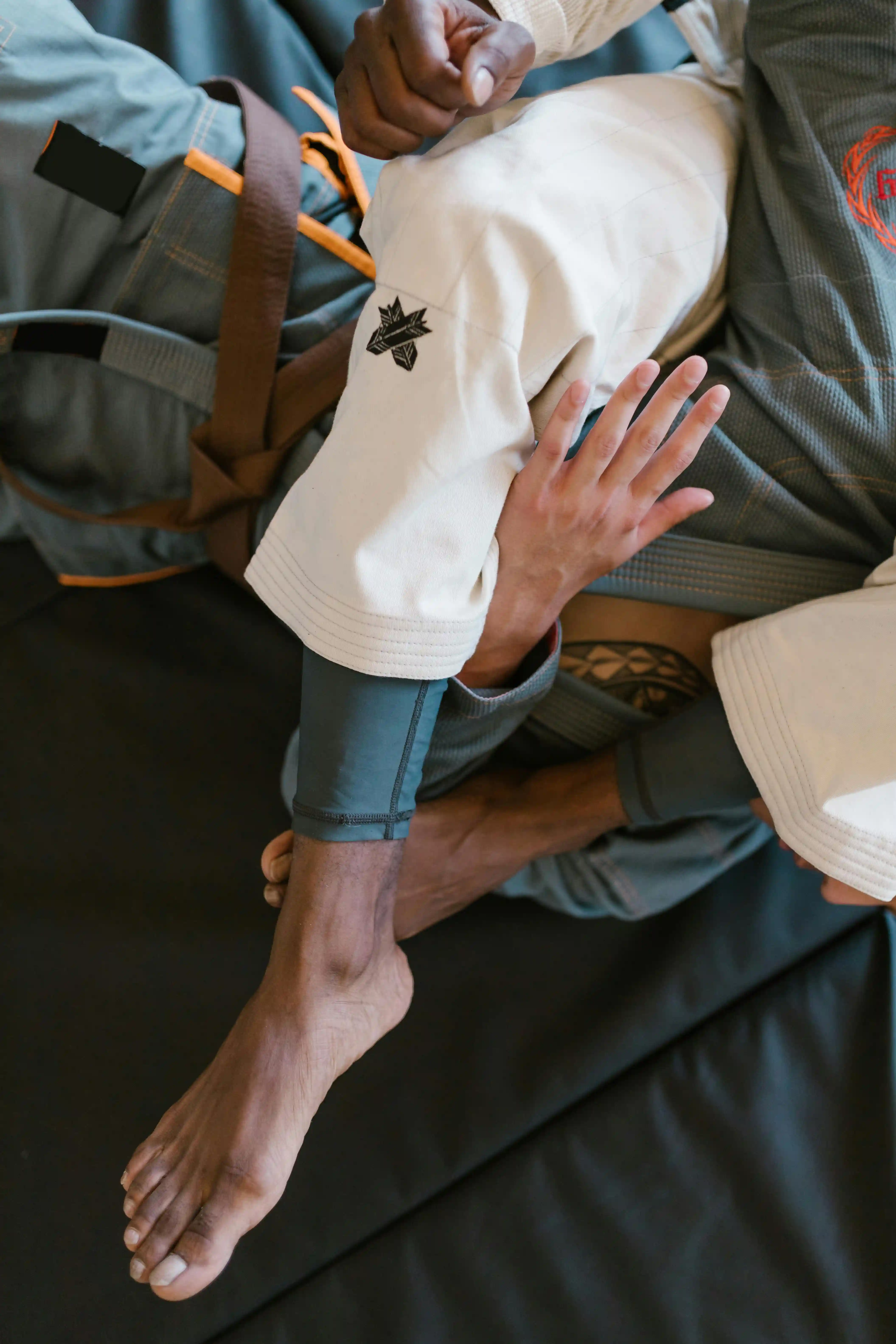
The name jiu jitsu translates, from Japanese, as "gentle art." The character jū carries meanings of yielding, flexibility, and softness. Jutsu means technique or method. Together, they describe an approach to combat built on redirection and leverage rather than brute force.
Most beginners discover this etymology sometime during their first month on the mat, usually while explaining to a coworker why their forearms look like a storm map.
The bruises are real, and they are common, and they do tend to improve. But they deserve a proper explanation, not just a shrug and a "you'll get used to it." Understanding why BJJ bruising happens, what it signals about where you are in your development, and how skill directly reduces it will help you stay on the mat long enough to experience the other side of it.
What "Gentle" Actually Means
The word jū in jūjutsu does not promise a soft experience. It describes a principle. The idea is that a skilled practitioner yields to incoming force rather than meeting it directly, using the opponent's energy and weight against them through positioning, timing, and leverage. It is gentle in the sense that a river is gentle: it does not fight the rocks, it moves around them, and over time it reshapes everything.
Jigoro Kano, who systemized the art in the late 19th century and later influenced the Gracie family's development of Brazilian Jiu Jitsu, framed this as "maximum efficiency with minimum effort." The goal was never to be painless. It was to be precise.
That distinction matters when you are trying to understand why an art named for gentleness leaves you covered in marks. The philosophy is about method. The reality of two bodies working against each other in close contact, under pressure, with grips and weight and friction involved, is something else. Gentleness is the destination. The path there is physical.
Why Beginners Bruise So Much
There are three main reasons bruising is concentrated in the early stages of training, and they all compound each other.
Your body is not conditioned for this yet
The small blood vessels beneath your skin, the capillaries, are not accustomed to the kind of sustained pressure and friction that BJJ involves. When tissue is compressed or skin is gripped and dragged, those capillaries can rupture, and blood pools beneath the surface. That is a bruise.
Over time, the body adapts. The tissue toughens. Capillaries that are regularly stressed become more resilient. The adaptation is real and well-documented among practitioners who stay with the art past the initial months. What feels dramatic at white belt is mostly a sign that your body has not yet built the physical foundation for this kind of contact.
Beginners roll with wild technique: clumsy, awkward, uncontrolled
When you are a white belt, you do not yet have refined grips, controlled movement, or a reliable sense of where your weight is going. If your training partners are also white belts, neither do they.
A seasoned blue or purple belt can apply a triangle choke with precise positioning and measured pressure. A white belt doing the same technique for the third time may clamp down on your bicep, shift their hips awkwardly, and drag fabric across your skin in ways that have nothing to do with how the technique is supposed to work. It is not malicious. It is inexperience. And inexperience bruises.
There is also a bruising source that beginners rarely consider: themselves. As a white belt you will often move frantically, shift your weight in the wrong direction, or push directly into a submission rather than away from it. You may be the rock trying to resist the stream rather than the water learning to move with it. That resistance creates pressure, and pressure creates marks.
As you progress, and as your training partners progress alongside you, the rolls become cleaner. More controlled. The bruising follows.
The gi itself is a factor
Training in the gi adds a layer of friction that no-gi rolling does not. When a training partner grips your sleeve or lapel, they are pressing fabric against skin under tension. A poorly timed fall, a scramble, or a grip that drags rather than releases cleanly can pinch and pull skin in ways that leave marks.
The inner arms, calves (from triangle chokes), neck (from lapel work and collar grips), and ribs (from extended time under side control) are the most common bruise locations in gi training. Each one maps directly to positions and techniques that beginners are still learning to navigate.
Does BJJ Bruising Actually Get Better?
Yes, and it does so for two distinct reasons that work together.
Your body adapts to the physical demands of the art. Capillaries strengthen with repeated stress. Skin toughens. The connective tissue around high-contact areas becomes more resilient. Research on adaptation timelines in BJJ suggests that most practitioners reach a point, typically around six to eight months of consistent training, where routine bruising slows significantly. The body has recalibrated to the demands being placed on it.
Separately, and perhaps more importantly, your technique improves. As you develop better positional awareness, you spend less time caught in uncomfortable scrambles. You learn to defend earlier. Your grips become intentional rather than desperate. You tap before you are cranked. And your training partners, improving alongside you, apply techniques with more control and precision as well.
Research on injury patterns in BJJ supports what experienced practitioners already know: beginners at white and blue belt level sustain more frequent minor injuries, including bruises, than more experienced practitioners. This is not just about toughness. It is about movement intelligence developing over time.
A note worth adding: the bruises do not disappear entirely. They shift. An advanced practitioner may get fewer marks from basic drilling, but a hard round against a skilled training partner still leaves evidence. The difference is that the marks reflect genuinely contested exchanges, not awkward beginner fumbling.
What Persistent or Unusual Bruising Might Signal
If you are several months into training and bruising at the same rate you did in your first week, it is worth looking beyond the mat.
Nutrition is the most common overlooked factor. Your body heals bruises using resources it needs to function: calories, protein, iron, and Vitamin C. Insufficient caloric intake is one of the more underappreciated reasons for prolonged or excessive bruising in training athletes. If your body does not have the raw materials to repair damaged capillaries, bruises layer on top of each other rather than clearing between sessions.
Iron supports the red blood cells involved in healing. Vitamin C is essential for collagen production, which is the structural component of your blood vessel walls. A diet low in either will extend healing times noticeably.
Other factors include age, certain medications (including anticoagulants and some anti-inflammatories taken regularly), and genetic predisposition. Some people simply bruise more easily than others, and that variation is normal. Women tend to bruise more easily than men due to differences in connective tissue density and skin thickness, which is worth knowing if you are training alongside people whose recovery seems faster than yours.
If bruises are unusually large, persist beyond two weeks, or appear in locations you cannot link to contact, it is worth speaking with a medical professional. The vast majority of training bruises are minor and self-resolving, but unexplained bruising should not go unexamined.
How to Reduce BJJ Bruising Without Quitting
The most effective single change you can make is wearing a long-sleeve rash guard, either under your gi or for no-gi training. The rash guard creates a barrier that reduces direct contact between skin and gi fabric, skin and the mat, and skin and training partners during scrambles. It does not eliminate all contact, but it significantly reduces the friction-based bruising that is so common in early training.
Compression wear for martial artists adds similar benefits, with the additional effect of supporting the soft tissue around high-contact areas. If you are someone who bruises easily, prioritising a long-sleeve rash guard under your gi from day one is a straightforward and low-cost change.
Beyond gear, the recovery levers are straightforward: sleep, nutrition, and hydration. These are not dramatic interventions, but they are the conditions under which your body does its repair work. Consistent sleep, adequate protein, and sufficient calories all shorten the time it takes for bruises to clear. Arnica gel, applied topically, has some evidence behind it for accelerating bruise resolution and reducing discoloration for those who want an additional recovery tool.
One thing that does not help: training on top of an unresolved injury. Returning to hard rolling before a bruised area has recovered adds stress to already-damaged tissue. Learning to manage training load in the early months, allowing proper recovery between sessions, protects both your skin and your long-term development on the mat.
Is BJJ Worth the Bruises?
This is the question underneath the question. Most people asking about bruising are not just looking for a biological explanation. They are wondering if this is supposed to happen. If they are doing something wrong. If it gets better. If it is worth continuing.
The bruises are part of the early vocabulary of the art. They are how your body communicates that it is being asked to do something new. The marks on your arms after training are not evidence that jiu jitsu is dangerous or that you are fragile. They are evidence that your body has not yet adapted to something it will, with time, handle with ease.
The practitioners who stay with BJJ past the first three to six months report that bruising becomes background noise, occasional and unremarkable rather than constant and alarming. What remains is the skill, the positional understanding, and the particular kind of problem-solving ability the art develops. The marks fade. The knowledge stays.
For more on what grappling teaches beyond the physical, see More Than Fighting: What Grappling and Wrestling Teach Me About Life.
Conclusion
Jiu jitsu earned the name "gentle art" through its philosophy, not its texture. The principle of redirecting force rather than opposing it is genuinely elegant. But elegance is what the art points toward, not where it begins.
Beginning practitioners bruise because their bodies are adapting, their technique is developing, and the training partners around them are in the same early stages. All three of those conditions change with time and consistent mat work. The body toughens. The technique refines. The rolls become more precise.
The art is gentle in the way any difficult and worthwhile practice is gentle: it builds you without breaking you, if you give it the time it requires.
Stay on the mat. The marks are a phase, not a verdict.