

World Nomad Games 2026: The Fighting Arts of the Steppe
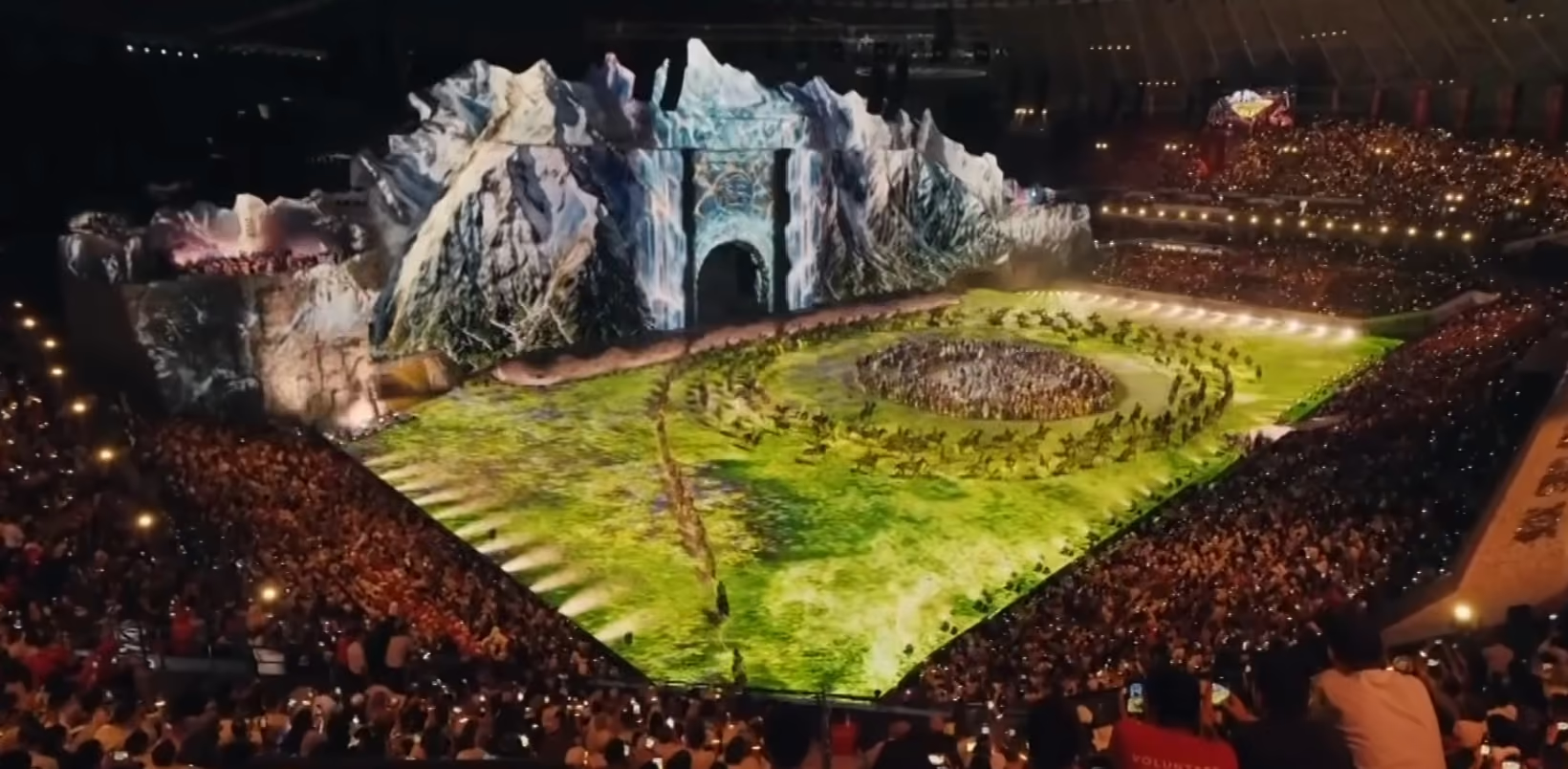
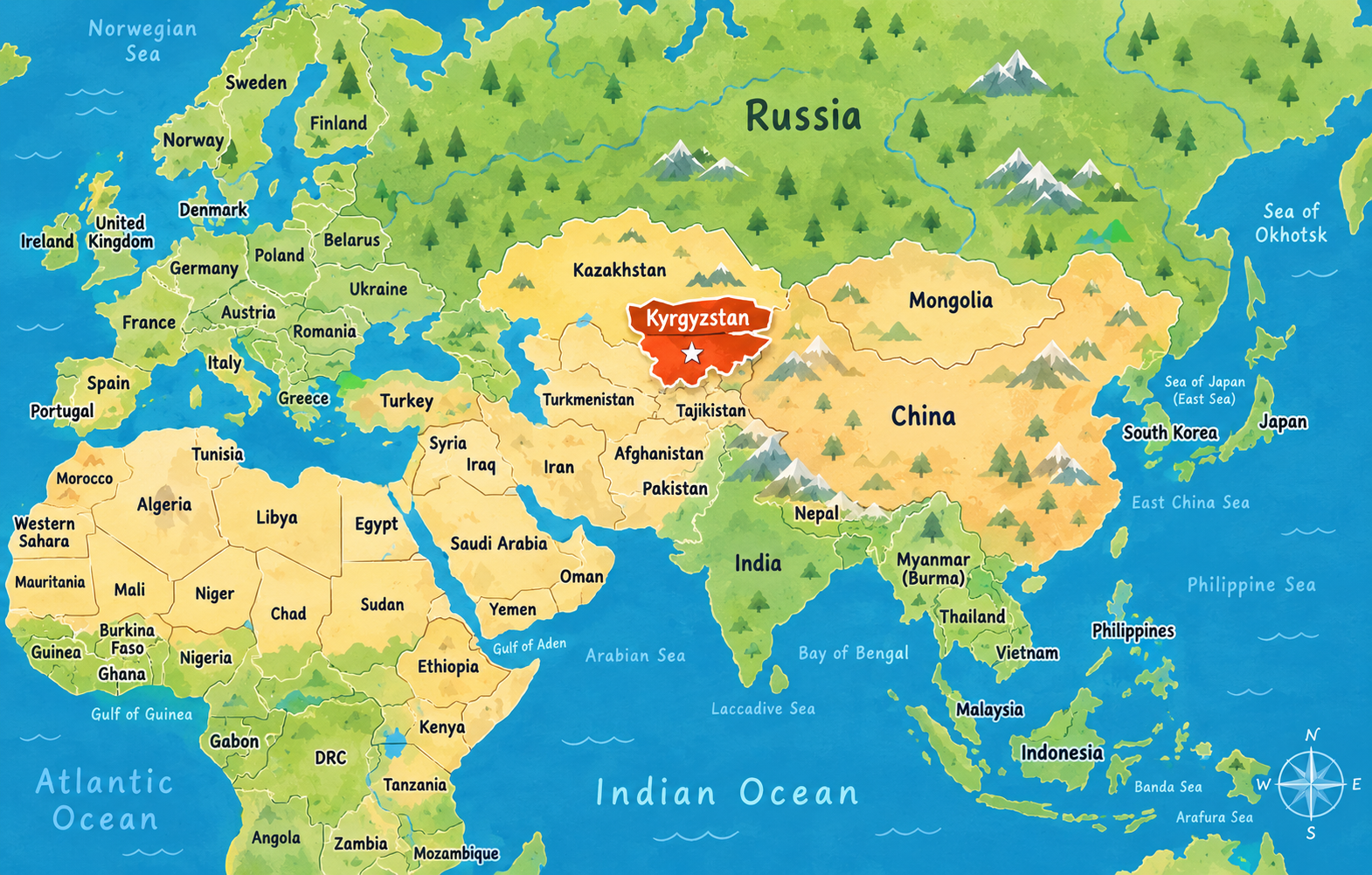
The sixth World Nomad Games ran from 31 August to 6 September 2026 in Kyrgyzstan, opening in Bishkek and finishing on the shore of Lake Issyk-Kul. It was the largest edition staged so far: 109 nations, roughly 3,000 athletes and 42 disciplines.
Most of the international coverage went to the mounted events and the cultural programme. A substantial part of the schedule, though, was combat sport — belt wrestling, jacket wrestling, mounted wrestling, mas-wrestling and arm wrestling — and that is where the medal race between Kazakhstan and Kyrgyzstan was decided.
This article covers that side of the Games. What each fighting discipline is, how it is scored, who won, and what a practitioner can take from a week of wrestling that drew almost no attention outside the region.
What Made the World Nomad Games 2026 Different
The Games returned to Kyrgyzstan for the first time since 2018, after editions in Türkiye and Kazakhstan, and the host treated it as a homecoming. The opening ceremony filled the new Bishkek Arena, and competition then moved 250 kilometres east to Cholpon-Ata, the Kyrchyn gorge and the Rukh Ordo cultural complex on Issyk-Kul's north shore.
The scale of the cultural programme is easy to underestimate. According to the closing press conference reported by УТРК, the national broadcaster, more than 600 events ran across the country during the week. An ethno-cultural town called Көчмөндөр ааламы — "Universe of Nomads" — was built on the Kyrchyn jailoo to showcase the crafts, cooking, music and dress of every region of Kyrgyzstan. The Көчмөндөр санаты festival at Rukh Ordo drew performers from 38 countries. Around 2,000 local media representatives and 250 foreign journalists were accredited.
Combat sports were visibly part of the guest list, too. Valentina Shevchenko, the Kyrgyz-born UFC champion, attended alongside boxer Dmitry Bivol and kickboxing pioneer Don "The Dragon" Wilson.
A regional audience that showed up in numbers
The broadcaster's own figures give a sense of how far the Games reached. УТРК's YouTube channel recorded 7.84 million views in seven days, with the opening ceremony passing 1M views and the kok boru final drawing over 504,000 in a single day. Its Instagram account logged 22.9 million views across the week. Roughly two-thirds of the live audience was in Kyrgyzstan, with Russia, Kazakhstan and Uzbekistan the next largest markets — a sign that these sports are a shared regional culture rather than a single country's heritage.
The next edition moves to Kazan, Tatarstan, in 2028 — the first time the Games will be hosted outside Central Asia and Türkiye.
The Programme: Eight Families of Nomadic Sport
The official programme published by УТРК organises competition into eight groups. Wrestling and archery get their own sections below; here is the rest of the field.
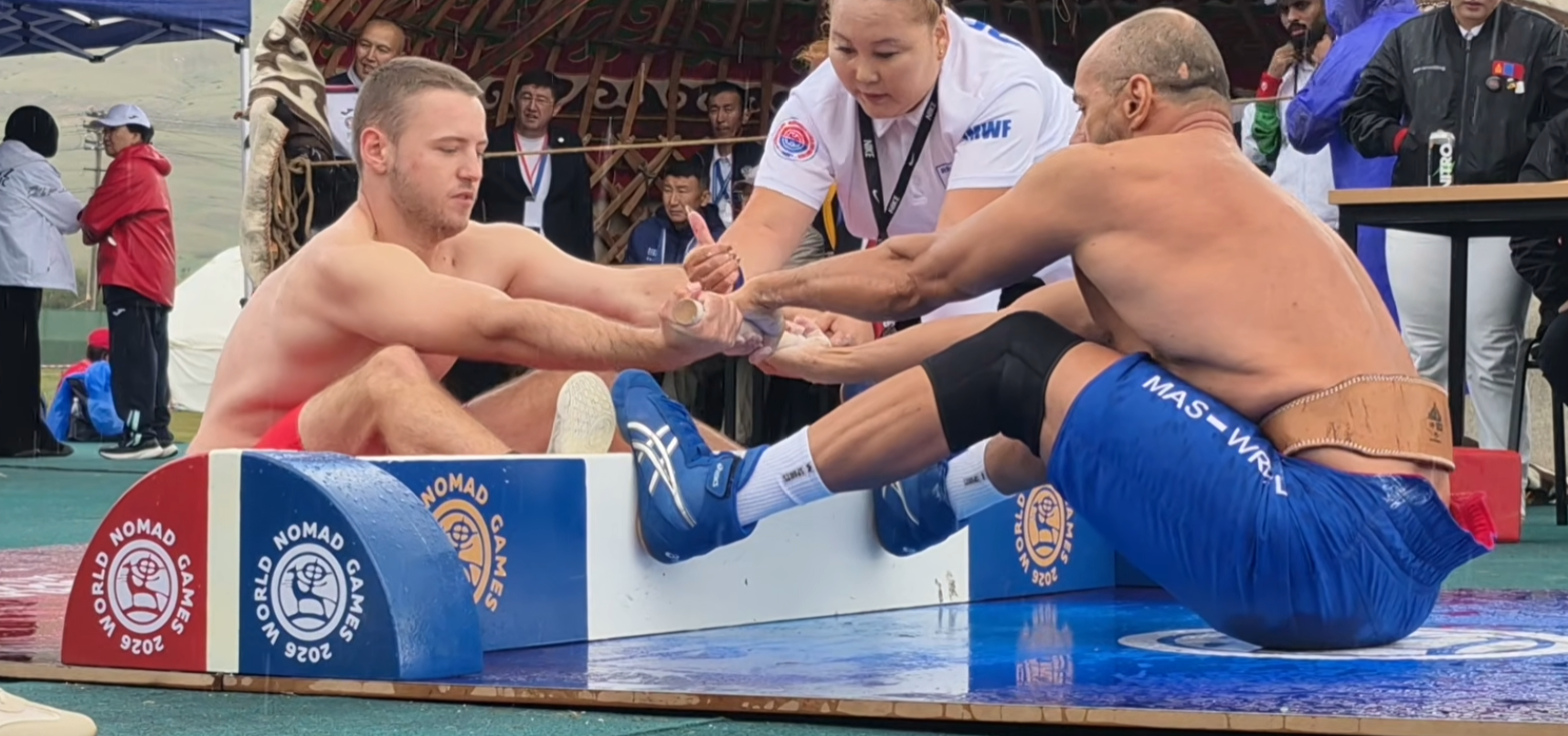
Two of these belong in any combat-sports conversation. Er enish is wrestling on horseback: two riders, no strikes, and the bout ends when any part of an opponent's body touches the ground. Mas-wrestling is a seated stick-pull with both athletes' feet braced against a board — a pure test of grip and posterior chain that any grappler will recognise from the last minute of a hard round.
Күрөш: The Four Wrestling Styles of the 2026 Games
The wrestling section of the programme carried four styles, each from a different Turkic or Persian tradition and each with its own rules on clothing, grip and what counts as a win. Seen together, they make a useful map of how standing grappling evolved across the region.
Алыш (Alysh) — Kyrgyz belt wrestling
Competitors wear a jacket, trousers and a belt, and the defining rule is that both hands stay on the opponent's belt for the whole bout. There is no grip fighting and no collar or sleeve work. Throws score from one to six points depending on which part of the body lands, and the first to six wins outright. Alysh has been recognised by United World Wrestling since 2008 and has its own continental championships.

Ашыртмалуу аба күрөш (Aşırtmalı aba güreşi) — Turkish aba wrestling
The style from Gaziantep in southern Türkiye. Wrestlers wear the aba, a heavy sleeveless cloak, bound by a sash. The bout begins from a fixed position: the right arm reaches across and over the opponent's shoulder while the hand grasps the belt — the reach-over is the aşırtma that gives the style its name. Matches run over two rounds, with a third to decide a tie, and the Turkish Traditional Wrestling Federation notes there is no bridging: the moment the back touches the ground, the bout is over.
Гөрөш (Göreş) — Turkmen belt wrestling
Turkmenistan's national style, wrestled in white trousers, coloured shirts and a blue belt. The belt grip is held throughout, and in the classic form it is strictly forbidden to grasp below the belt or use the legs actively. A bout is a single three-minute period, with points for forcing any part of the opponent's body except the feet to the mat. A freestyle variant permits leg attacks and trips.
Гуштини милли (Gushtingiri milli) — Tajik national wrestling
The Persian-speaking branch of the family. Competitors wear a national coat with a light belt, and the grip is the most open of the four: belt, sleeve or collar are all fair, though holds below the waist are not. Victory goes to the first clean throw to the back. Gushtingiri's roots run back to the Sogdians and Bactrians, and the 10th-century scholar Avicenna described two local wrestling styles in his medical writing.
What Separates the Four Wrestling Styles?
The clearest way to tell them apart is by three questions: what can you hold, can you use your legs, and how does the bout end.
Read across the rows and a spectrum appears. Alysh and classic göreş are the most constrained — the fixed belt grip removes the whole hand-fighting layer and leaves posture, timing and hip contact to decide the throw. Gushtingiri sits at the other end, close to judo in its freedom of grip. Aba wrestling is the outlier: a single prescribed starting position that turns every bout into the same technical problem, solved a hundred different ways.
For anyone from a judo or jacket-wrestling background, the practical lesson is how much of a throwing game depends on grip and how little depends on structure. The belt styles expose that immediately. If you want the wider picture, our breakdown of wrestling styles and what each one forbids puts these alongside sumo, judo and freestyle.
Көчмөндөрдүн Улуу балбаны: The Great Wrestler of the Nomads
The Games close their wrestling programme with a single open-weight tournament. Champions from fourteen wrestling categories were brought together on 6 September to compete under one set of rules for the title of Great Wrestler of the Nomads.
Kyrgyzstan's Baktiyar Mirlan uulu won fourteen bouts to reach the superfinal, where he met Mongush Aidyn of Russia — the Tuvan wrestler who took the same title at the 2024 Games in Astana. Aidyn won again, retaining the title and a prize of one million som, with Mirlan uulu taking the gold medal for the tournament. It is the closest thing the Games have to an absolute champion, and it rewards the wrestler who can adapt across rulesets rather than the specialist in one.
Жаа атуу: Three Schools of Traditional Archery
The programme describes its archery as "national schools of traditional archery — on foot and from horseback", and the three disciplines map onto three distinct traditions.
Теке бута (Teke buta) — long-range foot archery
Shot from the ground with traditional bows at the teke buta, a long-distance target. Categories are separated by bow type, so Kyrgyz, Korean and Turkish bows each shoot their own round; the Korean round runs to 145 metres, with the Turkish bow shot at the puta target. This is the discipline that most closely preserves the hunting and battlefield range of the original steppe bow.
Ат үстүнөн атуу (At üstünön atuu) — horseback archery
The mounted track most people picture when they think of nomad archery: a straight run at a canter or gallop, with targets set along the course and the rider shooting as they pass. It tests the archer's ability to release from a moving seat without breaking rhythm, and is the version most widely contested across the international mounted-archery circuit.
Мадьяр стили (Magyar style) — the Hungarian track
The style codified by Lajos Kassai in the late 1980s to recreate the archery of the Magyar horse-warriors. Riders gallop a 99-metre track with a target set nine metres to the side, and must shoot forward, sideways and backwards in a single pass as the target's angle changes. It is the most technically demanding of the three because the backwards shot — the historical "Parthian shot" — has to be delivered while the horse is still moving away.
Why Do the World Nomad Games Matter for Martial Artists?
Because they are the only place where this many living wrestling and archery traditions are contested side by side under their own rules. Most of these styles survived a century of forced settlement and standardisation only because village clubs kept teaching them. Kok boru carries a UNESCO Intangible Cultural Heritage listing, and alysh and göreş sit under United World Wrestling — meaning there is now a real competitive pathway from a regional federation to a world championship.
There is also a training argument. Belt wrestling strips grip fighting out of grappling entirely; aba wrestling fixes the start position; horseback disciplines move the whole contest onto an unstable base. Each one isolates a variable you normally take for granted. The same reason Korean ssireum and sumo reward study also applies here: constraint teaches structure.
What the 2026 Games Showed
Three things stand out from the week. The Games have grown into a genuine regional institution, with a live audience spread across four countries and a cultural programme larger than the sporting one. The wrestling section — four styles, one open-weight final — is a coherent technical curriculum in its own right, not a folk display. And the traditions on show are being carried forward by federations and clubs that will still be working long after the Kazan edition in 2028.
Preservation is not a ceremony. It is a training session, repeated. The path rewards those who respect it — and those who keep showing up to walk it.